

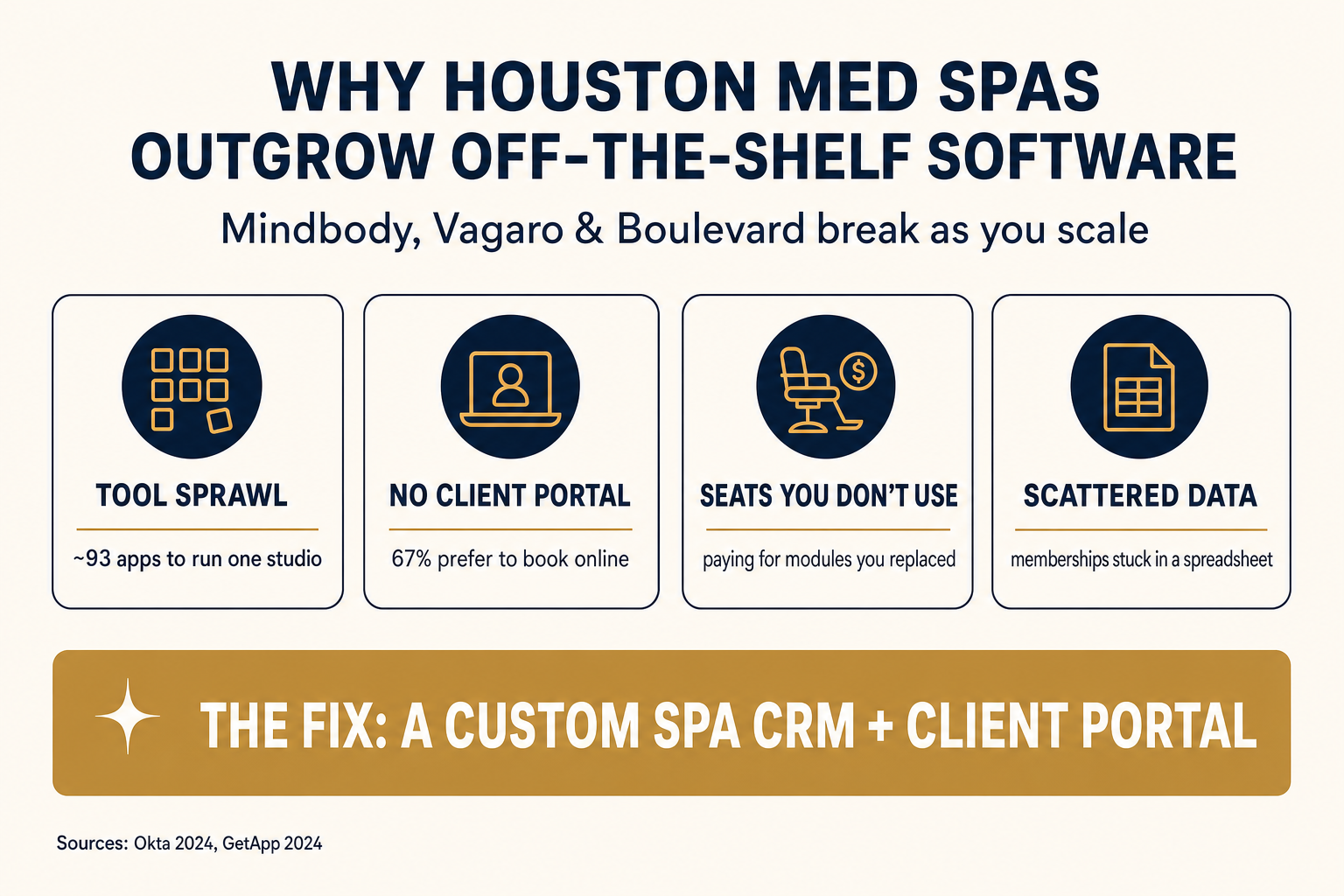
A Houston med spa opens on Mindbody, Vagaro, or Boulevard, and for the first year it’s the right call. The software is cheap, it books appointments, and it takes payments. Then the studio grows — a second location in The Woodlands, a membership program, an injector’s packages, a laser series that needs its own cadence — and one morning the owner realizes the tool that launched the business is now the thing slowing it down.
The short answer: most Houston med spas outgrow off-the-shelf booking software somewhere between their first membership program and their second location. That’s the point where paying for seats you don’t use, stitching data across five apps, and having no place for clients to log in starts costing more than a purpose-built system would. When you hit that wall, custom software — a spa CRM, a client and booking portal, and membership dashboards built around how your studio actually works — usually pays for itself faster than owners expect. This guide shows you exactly where the wall is and how to know you’ve reached it.
Table of contents
- Why Houston is where med spas outgrow their software
- The 4 walls every growing med spa hits
- The hidden cost of “good enough” software
- What “custom software” actually means for a spa
- Off-the-shelf vs. custom: when each wins
- How to know you’re actually ready
- Frequently asked questions
Why Houston is where med spas outgrow their software
Houston is one of the best aesthetics markets in the country, and that’s precisely why its studios outgrow generic software so fast. It’s the largest city in Texas at roughly 2.4 million residents (World Population Review), anchored by the Texas Medical Center — the largest medical complex in the world, employing more than 120,000 people (TMC). That’s a metro saturated with medical professionals, disposable income, and a culture that treats aesthetics as routine maintenance.
The demand backdrop is enormous. Americans underwent more than 28.5 million minimally invasive cosmetic procedures in 2024 — Botox, fillers, skin resurfacing, and the like (American Society of Plastic Surgeons). Nationally, the med spa business has scaled into a real industry: AmSpa counted 10,488 med spas in 2023 (up from 8,899 the year before), with the average location generating close to $1.4 million in annual revenue (AmSpa 2024 State of the Industry). And the U.S. med spa market is projected to grow from about $7.1B in 2023 to $17.6B by 2030 — a 13.7% CAGR (Grand View Research).
Here’s the pattern I’ve watched dozens of times: a studio launches lean on a booking app, grows into the demand, and within 18–24 months is running memberships, packages, multiple providers, and sometimes multiple locations — on a tool that was designed for a single-chair salon. The software didn’t get worse. The business got bigger than the software.
The 4 walls every growing med spa hits
Off-the-shelf platforms — Mindbody, Vagaro, Boulevard, Zenoti — are genuinely good products. The problem isn’t quality; it’s fit. Once you scale past a certain point, you run into the same four walls.
Wall 1 — Tool sprawl (you’re running a stack, not a system)
Booking lives in one app, payments in another, marketing in a third, consent forms in a PDF, memberships in a spreadsheet, and reviews in a fourth tool. That’s not unusual — it’s the norm. The average company now runs about 93 different applications, and even the smallest businesses run roughly 36 (Okta, Businesses at Work 2024). Every one of those is a login, a subscription, and a place your client data can drift out of sync.
Wall 2 — The “work about work” tax
When your systems don’t talk, your people become the integration. Your front desk re-keys a booking into the membership spreadsheet, checks a second app for the package balance, and emails a consent form by hand. Research on how modern teams actually spend their time found that knowledge workers burn about 60% of their day on coordination — searching for information, switching apps, chasing status — instead of the skilled work they were hired for (Asana, Anatomy of Work). In a med spa, that’s an injector or an esthetician doing data entry between clients.
Wall 3 — You pay for seats and modules you never use
Generic platforms bundle features and charge per seat. You end up paying for a marketing suite you replaced, an inventory module you don’t touch, and provider seats that sit idle. It’s an industry-wide pattern: organizations waste an average of $18M a year on unused software licenses, with a large share of paid seats never logged into (Zylo, 2024 SaaS Management Index). A studio’s numbers are smaller, but the principle is identical — you’re renting shelf space you don’t need, forever.
Wall 4 — Your clients have nowhere to log in
This is the one that quietly costs the most bookings. On most off-the-shelf spa tools, a client can’t log in to see their treatment history, package balance, upcoming visits, or membership status — let alone sign a consent form or rebook a laser series on their own at 11 p.m. Yet 67% of consumers say they’d rather book online than pick up the phone (GetApp, 2024). No portal means every one of those moments routes back through your front desk during business hours — or doesn’t happen at all.
The hidden cost of “good enough” software
The walls above aren’t just annoyances — they leak revenue in three specific places.
No-shows. When reminders, deposits, and self-rescheduling live in three disconnected tools (or none), no-shows climb. Missed appointments cost the U.S. healthcare system an estimated $150 billion a year, at roughly $200 per empty slot (Healthcare Finance News). A system that ties reminders, card-on-file deposits, and one-tap rescheduling into a single flow is the difference between an empty laser slot and a filled one. (We break the mechanics down in our guide to reducing spa no-shows.)
Retention. Aesthetics is a repeat business — the money is in the second visit, the membership, and the package renewal, not the first Groupon facial. And retention is disproportionately profitable: Bain & Company’s classic research found that increasing customer retention by just 5% can lift profits between 25% and 95% (Bain & Company). Software that can’t see who’s lapsing, whose package is burning down, or whose membership is about to churn is software that’s leaving that profit on the table. (See our breakdown of spa client lifetime value.)
Self-service demand. Every hour your clients can’t self-book, self-pay, or self-manage is an hour of demand you’re capping at your front desk’s capacity. In a market as busy as Houston, that ceiling is the difference between a studio that scales and one that plateaus.
What “custom software” actually means for a spa
“Custom software” sounds like a two-year, six-figure project. For a med spa in 2026, it usually isn’t. It means building the specific two or three pieces your generic tool can’t do — and connecting them to what already works — instead of ripping out your whole stack. In practice, that’s some combination of:
- A spa CRM built for your model — one that actually understands treatment packages, fill-cycles, membership tiers, provider schedules, and consent status, instead of a generic contact list you bend to fit.
- A branded client & booking portal — where clients self-book, sign consent forms, view treatment history, manage memberships, and pay, on any device, 24/7.
- Membership & package dashboards — real-time views of package burn-down, membership revenue, recare dates, and provider utilization: the numbers you need to grow, in one place.
- A custom AI agent — chat, voice, or intake — trained on your treatments and booking rules, so it qualifies and books the right client for the right service instead of reading a generic script.
Running the studio, before and after
Bookings in one app, memberships in a spreadsheet, consent forms by email, package balances looked up by hand, no client login, front-desk-only rescheduling.
One spa CRM + client portal: clients self-book and sign forms 24/7, memberships and packages track themselves, dashboards show recare and churn live, and the AI agent books after hours.
The reason this is affordable now is how it’s built. Traditional dev shops bill hours while engineers hand-type code. We direct Claude Code — Anthropic’s official AI-assisted development tool — which lets a small team ship the same software roughly 10× faster, at lower cost, with you owning 100% of the code and IP. A client portal typically runs a few weeks, not a few quarters. (If your goal is to extend or migrate what you already run in GoHighLevel rather than build net-new, that’s our GHL development track — and here’s a real-world GHL migration for a Dallas med spa.)
Off-the-shelf vs. custom: when each wins
Custom software is not always the answer — and I’ll be the first to say so. If you’re a single-chair studio finding your feet, an off-the-shelf platform is the right, cheap, fast choice. The honest comparison looks like this:
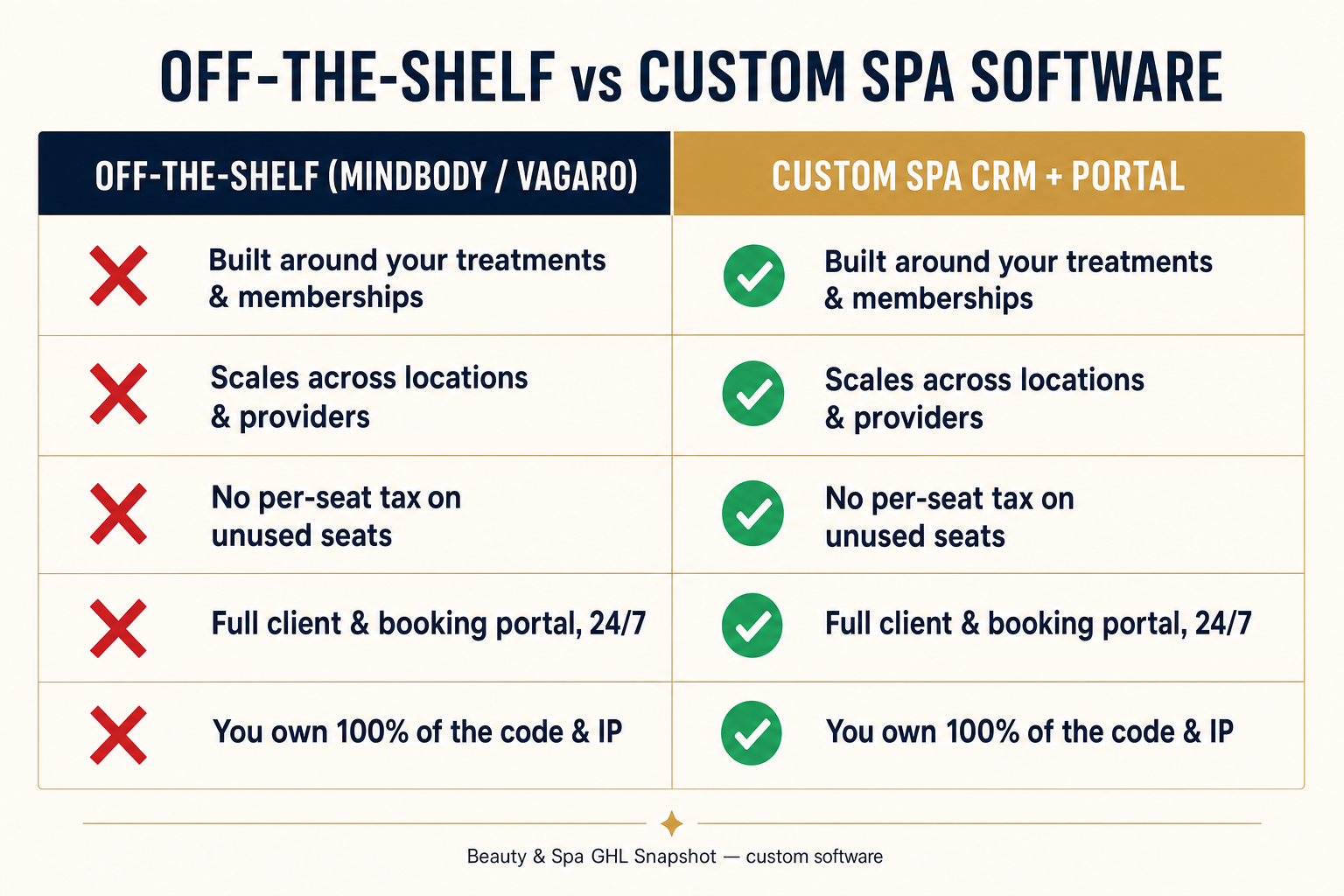
Off-the-shelf spa software vs. custom-built
| Plan | Off-the-shelf (Mindbody, Vagaro, Boulevard) | Custom spa CRM + portal recommended |
|---|---|---|
| Price | Best early / single location | Best at scale / multi-location |
| Feature 1 | Live in days, low monthly cost | Built around your treatments & memberships |
| Feature 2 | Great for a single chair or one location | Scales across locations and providers |
| Feature 3 | You adapt to the software's rules | The software adapts to how you work |
| Feature 4 | Per-seat pricing; pay for unused modules | No per-seat tax on people who don't use it |
| Feature 5 | Limited or no client self-service portal | Full client & booking portal, 24/7 |
| Feature 6 | Data spread across bolt-on apps | One source of truth; dashboards included |
| Feature 7 | You don't own the platform or your data model | You own 100% of the code and IP |
| See booking-software picks → | See custom software → |
The switch point is rarely about revenue alone — it’s about complexity. One location, one service menu, no memberships? Stay off-the-shelf. Multiple providers, membership tiers, package series, more than one location, and a spreadsheet holding it all together? You’ve crossed the line where custom pays off.
How to know you’re actually ready
You don’t need every box checked — but if three or more of these are true, you’ve almost certainly outgrown your current platform:
- You keep a spreadsheet (or three) “on the side” for memberships, packages, or recare dates.
- Your front desk re-keys the same information into more than one system every day.
- You’re paying for seats, modules, or a second tool you barely use.
- Clients can’t log in to see their history, packages, or memberships, or to rebook themselves after hours.
- You’re opening — or seriously considering — a second location.
- You can’t answer “who’s about to churn?” or “how much membership revenue renews this month?” without a manual export.
If that’s you, the next step isn’t a two-year rebuild. It’s scoping the one or two pieces that would take the most pressure off — usually a client portal or a membership dashboard — and building those first. That’s how the highest-leverage custom work starts, and it’s exactly the kind of project we scope on a 15-minute call. For studios that want the automation layer without net-new software, our CRM & workflow automations and appointment automation cover a lot of the same ground inside GoHighLevel.
Houston’s aesthetics market isn’t slowing down — the demand, the incomes, and the medical density are all here. The studios that win the next few years won’t be the ones with the flashiest injector. They’ll be the ones whose software gets out of the way — so every membership renews itself, every client can book at midnight, and every provider spends their hours on clients instead of spreadsheets.
Frequently asked questions
Custom med spa software in Houston — FAQs
Do I have to replace Mindbody or Vagaro entirely to go custom?
No — and usually you shouldn't at first. The highest-return approach is to build the specific pieces your current tool can't do (a client portal, a membership dashboard, a custom AI booking agent) and connect them to what already works. Many Houston studios keep their booking engine and add a custom portal and CRM layer on top, then migrate more over time only if it makes sense.
How much does custom med spa software cost?
It depends on scope. Fixed-price projects generally run from a few thousand dollars for a focused agent or dashboard up to $50K+ for a full CRM and booking platform, or you can work hourly on a flexible retainer. Because we build with Claude Code, timelines and costs are typically about half of a traditional dev shop's. The fastest way to a real number is a short scoping call.
How long does it take to build a client portal for my spa?
A branded client and booking portal typically takes a few weeks, not months. A single AI agent can be even faster; a full custom spa CRM with memberships, packages, and multi-location support runs longer. We scope the timeline against your exact requirements before any work starts.
Do I own the software, or am I locked in like with a SaaS tool?
You own 100% of the code and intellectual property — that's the whole point versus off-the-shelf software. The code lives in your repository, deploys to your infrastructure, and runs under your accounts. There are no per-seat licenses, no royalties, and no lock-in to us.
Is a custom med spa system compliant with TCPA and health-data rules?
It can be, by design. We build consent capture and STOP handling into any messaging (TCPA), follow least-privilege access and audit logging for client data, and use BAA-eligible vendors where appropriate. Med-aesthetic data is treated carefully from day one — but always confirm your specific state and scope-of-practice obligations with your medical director and counsel.
What if I just want better automation, not brand-new software?
Then you may not need custom software at all — you may need your existing systems automated and connected. Our done-for-you snapshot and GoHighLevel development handle booking, reminders, reviews, and no-show recovery without a ground-up build. We'll tell you honestly on the call which path fits your studio and budget.
Camila Reyna is a spa automation strategist who spent nine years running the front desk and then the marketing for a three-location med-spa group before moving full-time into GoHighLevel and custom build-outs. She writes about the booking funnels, membership systems, and software decisions that fill treatment rooms — with one rule: if it doesn’t fill a room, it doesn’t ship.
Related reading: Best spa booking software (2026) · Build a spa membership program to $20k/mo · Spa client lifetime value · Dallas med spa GoHighLevel migration · Med spa industry statistics 2026