
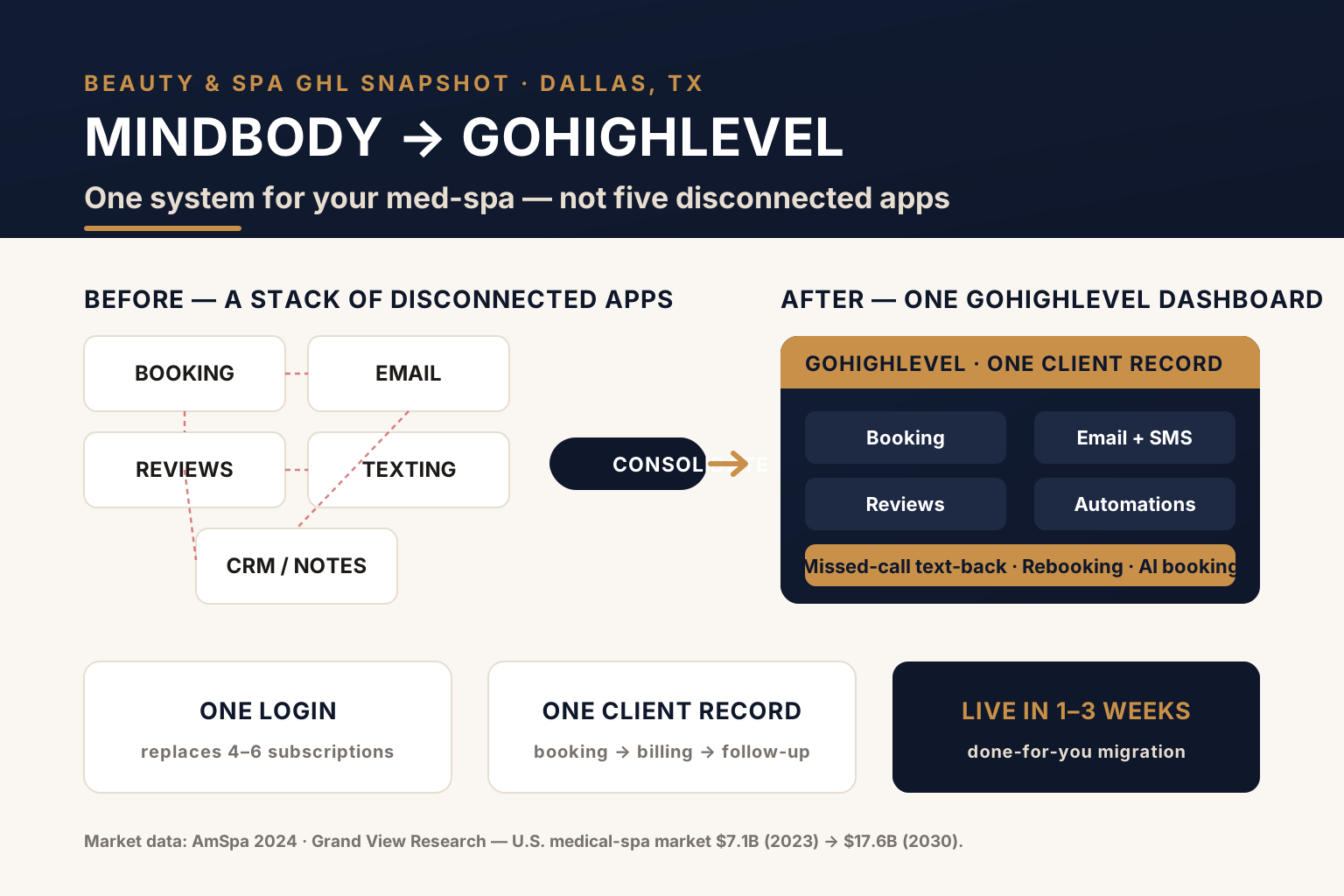
A Dallas med-spa owner opens her laptop on a Monday and logs into five different tools before 9 a.m.: Mindbody for the calendar, a separate email platform for campaigns, a reviews app, a texting service, and a spreadsheet holding the client notes that don’t fit anywhere else. Every one of them charges a monthly fee. None of them talk to each other. And the client who booked Botox last night is a different “record” in three of them.
The short answer: if your Dallas studio is stitching together a booking app, an email tool, a review service, and a texting platform that don’t share data, consolidating onto an all-in-one system like GoHighLevel is almost always worth it — you replace four-to-six subscriptions with one client record, and the automations that fill chairs (missed-call text-back, review requests, rebooking) finally run on their own. It’s worth it when your admin time, your monthly software bill, or your leads-falling-through-the-cracks problem is already big enough to feel. This guide walks through the real costs, what actually breaks in a migration, and the ROI math — so you can decide before you switch.
Table of contents
- Why Dallas med-spas outgrow their booking app
- The hidden cost of a fragmented software stack
- Mindbody & Vagaro vs. an all-in-one like GoHighLevel
- “But migration sounds risky” — what actually breaks
- What you gain by consolidating
- How a done-for-you migration works
- Is switching right for your Dallas studio?
- Frequently asked questions
Why Dallas med-spas outgrow their booking app
Almost every studio starts the same way: you pick a booking app — Mindbody, Vagaro, Boulevard — because you need a calendar and a payment button on day one. That’s the right call early. The trouble starts as you grow. You want email campaigns, so you add a marketing tool. You want more Google reviews, so you add a reputation app. You want to text clients, so you add an SMS service. Now you’re running a stack, and each piece keeps its own copy of the client.
This is a national pattern, and Dallas–Fort Worth — one of the fastest-growing metros in the country — feels it acutely, because the aesthetics market here is crowded and getting more so. The U.S. added 1,589 net new med spas in a single year, reaching 10,488 locations in 2023 with average revenue near $1.4 million (AmSpa 2024 State of the Industry). The U.S. medical-spa market itself is on track to grow from roughly $7.1 billion in 2023 to $17.6 billion by 2030, a 13.7% CAGR (Grand View Research). When a dozen studios within a ten-mile radius all run Instagram ads for the same lip-filler special, the winner is whoever books the client first and keeps them longest — and that’s a job for connected systems, not a pile of tabs.
The point isn’t that your booking app is bad. It’s that a booking app was never designed to be your marketing engine, your CRM, and your reputation manager — and taping those functions on with three more subscriptions is what quietly drains your time and margin.
The hidden cost of a fragmented software stack
The cost of app sprawl doesn’t show up as a single line item, which is exactly why it’s so easy to ignore. It hides in your team’s day.
Research on how people actually work is blunt: the average knowledge worker switches between about 10 apps roughly 25 times per day, and it takes around 9.5 minutes to get back into a focused workflow after each switch (Asana, Anatomy of Work Index). The same body of research found workers lose about 4 hours and 38 minutes every week redoing work that was already done somewhere else — think re-typing a client’s details from the booking app into the email tool into the review app. For a front desk juggling five spa systems, that’s not a rounding error; it’s most of a workday, every week.
There’s a second, quieter cost: buyer’s remorse you never act on. Gartner found that 60% of technology buyers involved in renewal decisions regret nearly every purchase they make — and yet most renew anyway (Gartner, June 2023, survey of 1,503 buyers). The friction of switching keeps studios paying for tools they’ve already outgrown. Automation is the offsetting lever: Zapier’s automation research reports business owners save a median of about 5 hours a week, and employees around 11.5 hours, once repetitive manual work is automated (Zapier, State of Business Automation). You can’t automate across tools that don’t share a database — which is the whole case for consolidating.
Mindbody & Vagaro vs. an all-in-one like GoHighLevel
This isn’t a knock on Mindbody or Vagaro — both are capable booking platforms, and for a studio that only needs a calendar and payments, they do the job. The question is whether a booking-first tool plus a stack of add-ons beats a single system where booking, CRM, email, SMS, reviews, and automation share one client record. Here’s the honest side-by-side. (Pricing for Mindbody and Vagaro below reflects publicly reported ranges — Mindbody doesn’t publish official pricing — so confirm current numbers with each vendor.)
Booking app + add-ons vs. one consolidated platform
| Plan | Booking app + add-ons | All-in-one (GoHighLevel) recommended |
|---|---|---|
| Price | $100–$700+/mo, split across tools | One platform, one bill |
| Feature 1 | Calendar & payments — strong | Calendar & payments — included |
| Feature 2 | Email, SMS, reviews = separate subscriptions | Email, SMS, reviews, chat — built in |
| Feature 3 | Client data lives in 3–5 places | One client record across everything |
| Feature 4 | Automations stop at each tool's edge | Automations run end-to-end, 24/7 |
| Feature 5 | Reported: Mindbody ~$99–$699/mo; Vagaro from ~$24/mo + add-ons | Missed-call text-back + rebooking native |
| Feature 6 | You are the integration between apps | Built to be your marketing engine, not just a calendar |
| Compare booking tools → | See the migration service → |
The difference that matters isn’t the feature checklist — it’s the single client record. When a lead texts, books, no-shows, and gets a win-back offer, an all-in-one platform treats that as one connected story it can act on automatically. A stack of apps treats it as five disconnected events, each needing a human to carry data to the next tool. That gap is where bookings — and hours — leak out. (If you’re still choosing a booking tool, our honest 9-tool booking software comparison breaks down where each one fits.)
“But migration sounds risky” — what actually breaks
This is the fear that keeps studios stuck: “If I switch, I’ll lose my client history, my recurring memberships will break, and my calendar will be a mess for a month.” It’s a fair worry — and it’s why migration should be scoped like a project, not attempted as a weekend DIY.
Here’s the honest framing. When large enterprises botch a platform migration, it’s genuinely expensive: the average software platform-migration project runs about $315,000, and 83% exceed their budget or timeline (CloudBees, via CIO Dive). But that’s 300-person IT departments moving decades of systems. A single med-spa’s migration is a fundamentally smaller, well-understood job: export the client list and history, rebuild the calendar and services, recreate the automations, and — critically — run the old and new systems in parallel until you’re confident, then cut over. Done this way, a spa migration is typically a 1–3 week engagement, not a saga.
The safe sequence is boring on purpose: migrate the data, rebuild in parallel, verify, then switch. Nobody should be flipping a switch and hoping. When it’s done for you by a team that has migrated off Mindbody, Vagaro, Boulevard, and Zenoti before, the “what if I lose everything” risk is handled by process, not luck.
What you gain by consolidating
Once your studio runs on one platform, the automations that were impossible across disconnected apps suddenly become trivial — and they’re the ones that directly fill treatment rooms:
- Missed-call text-back. Every call you can’t answer gets an instant “Sorry we missed you — want to book?” text. Speed is the whole game: contacting a lead within five minutes makes you dramatically more likely to connect and qualify them than waiting even 30 (Harvard Business Review). See our missed-call text-back playbook.
- Automatic review requests. After every completed visit, a text-and-email request goes out — the compounding reputation engine that wins the map pack.
- No-show recovery & reminders. Healthcare no-show rates average around 15% and run as high as 31% in dermatology (systematic review, NIH/PMC; JAAD 2024). Deposit rules plus automated reminders — impossible to run cleanly across separate tools — cut that sharply (full no-show playbook).
- An AI receptionist that books 24/7. With one system behind it, an AI receptionist can answer, qualify, and book straight onto the same calendar your team already uses.
- Rebooking & lifetime value. One record means you can see who’s due for a fill and text them automatically — the difference between a one-time guest and a member (see spa client lifetime value).
None of this is exotic. It’s the standard payoff of a connected system — and it’s precisely what a fragmented stack can’t deliver, no matter how many apps you bolt on.
How a done-for-you migration works
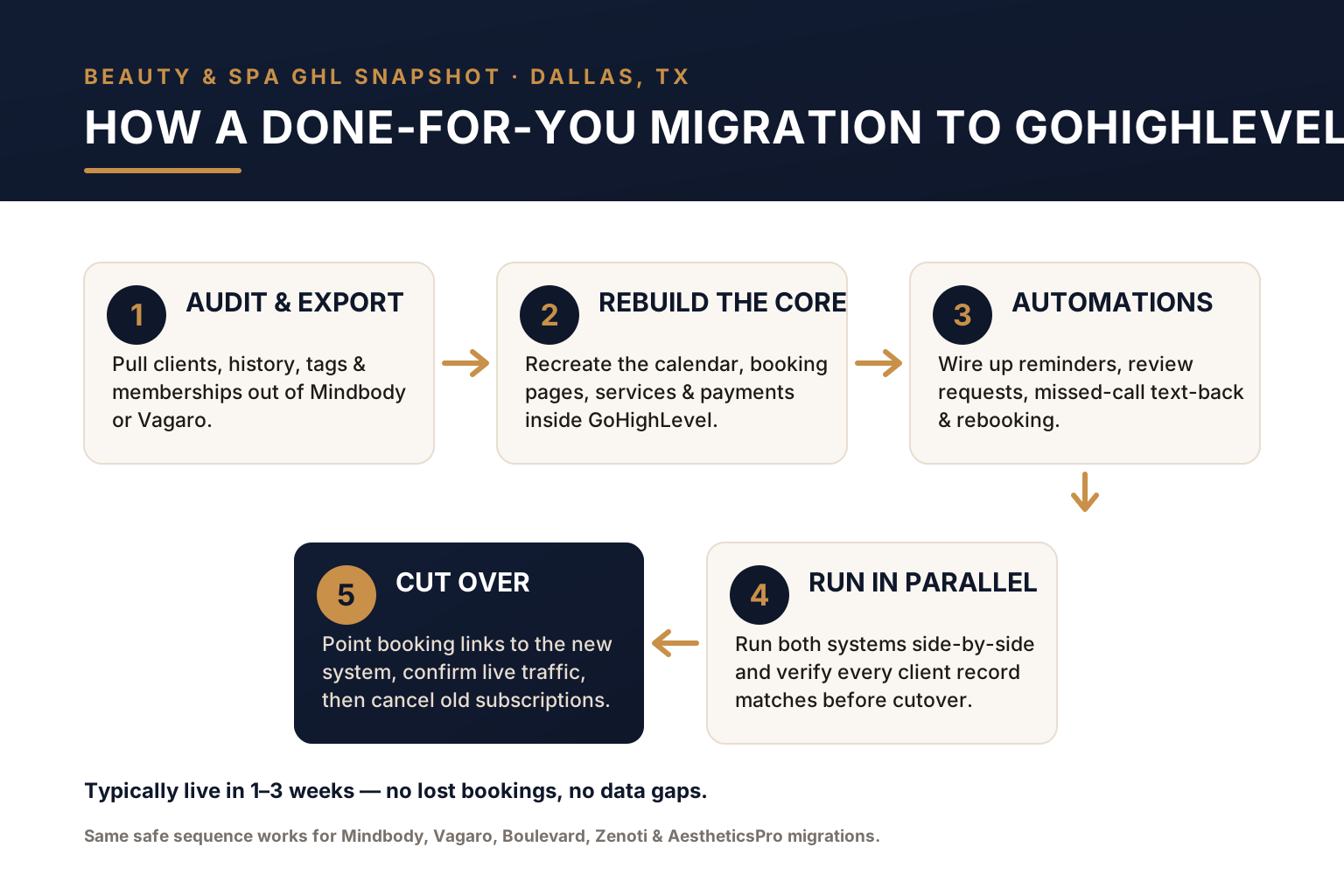
A clean spa migration follows the same five-step arc every time — whether you run it yourself or have it built for you:
- Audit & export. Pull your full client list, appointment history, tags, and active memberships out of Mindbody or Vagaro, and document every automation you currently rely on.
- Rebuild the core. Recreate your services, staff calendars, availability rules, booking pages, and payment setup inside GoHighLevel — matched to how your studio actually books.
- Recreate the automations. Wire up reminders, missed-call text-back, review requests, and rebooking flows — the pieces that were scattered across separate apps now living in one place.
- Run in parallel & verify. Import your data into the new system and run both side-by-side. Test a real booking, a real reminder, a real review request. Confirm the client records match before anything is retired.
- Cut over & retire. Point your booking link and forms to the new system, confirm it’s handling live traffic, then cancel the subscriptions you no longer need — and watch your monthly software bill drop.
If you’d rather not touch any of it, that’s the entire point of a done-for-you GoHighLevel build and migration: the process, the data integrity checks, and the parallel-run safety net are handled for you, usually inside one to three weeks. New to the platform itself? Start with our GoHighLevel for spas setup guide.
Is switching right for your Dallas studio?
Consolidating onto GoHighLevel is worth it if two or more of these are true for your studio:
- You pay for three or more separate tools (booking, email, reviews, SMS) that don’t share client data.
- Your front desk re-types the same client details across apps, or things fall through the cracks between them.
- You know you’re leaving money on the table — missed calls, un-asked-for reviews, no follow-up on no-shows — because no single tool owns the whole client journey.
- You want automations (missed-call text-back, rebooking, AI booking) that simply can’t run across disconnected apps.
It’s probably not urgent if you’re a solo esthetician with a single calendar, no email/SMS marketing, and no interest in automation — a lightweight booking app is fine until you grow into the problem. The tell is time and leakage: the day your software is costing you hours and lost bookings instead of saving them is the day consolidation pays for itself. For a fast-growing Dallas market where the studio that answers first wins, that day tends to arrive sooner than owners expect.
Frequently asked questions
Mindbody to GoHighLevel migration for Dallas med-spas — FAQs
Will I lose my client data if I switch from Mindbody or Vagaro to GoHighLevel?
Not with a proper migration. Your client list, contact details, tags, appointment history, and notes are exported and mapped into GoHighLevel's client record, and you verify a test import before anything is retired. The safe process runs both systems in parallel until you've confirmed the data matches — you should never flip a switch and hope. A done-for-you migration handles this data-integrity step for you.
How long does a med-spa migration to GoHighLevel take?
For a single studio, a done-for-you migration is typically a 1–3 week project, depending on how many client records and active memberships you have and how many automations need rebuilding. That's a scoped engagement — very different from the multi-month, six-figure enterprise IT migrations you may have read about, which involve far larger systems.
Is GoHighLevel cheaper than running Mindbody plus separate email, SMS, and review tools?
In most cases, yes — because you replace several subscriptions (a booking app plus add-on tools for email, texting, and reviews) with one platform. Mindbody's reported plans run roughly $99–$699/month and Vagaro starts around $24/month before add-ons, and those are before you layer on separate marketing and reputation apps. Confirm current pricing with each vendor, then compare the total of your stack to one consolidated bill.
What happens to my recurring memberships and stored cards during migration?
These need a deliberate plan — they don't automatically 'just move.' Depending on your payment processor, memberships and card-on-file data are either migrated with the processor or re-collected from clients with a smooth, on-brand message. This is exactly the kind of detail a done-for-you migration scopes up front so there's no gap in your recurring revenue.
Do I have to rebuild all my automations from scratch?
You rebuild them once, in one place — and then they run end-to-end, which they never could across separate apps. A migration documents the reminders, review requests, and follow-ups you rely on today and recreates them inside GoHighLevel, usually improved, because now they share a single client record and can trigger off booking, no-shows, and payments automatically.
Can you migrate a Dallas med-spa off Boulevard or Zenoti too, not just Mindbody?
Yes. The same migration process applies to Mindbody, Vagaro, Boulevard, Zenoti, AestheticsPro, and similar platforms — export the records, rebuild the booking and workflows in GoHighLevel, run in parallel, and cut over. The starting platform changes the export details, not the safe sequence. Book a call and we'll scope your specific stack.
Devon Ashby runs a small agency that resells and installs GoHighLevel snapshots for day spas, lash studios, and med-spas across the Southeast. He came up through performance marketing, so he treats every studio account like a P&L — cost per booked consult, package conversion, lifetime value — and writes the practical, numbers-first pieces on the software, funnels, and migrations that actually move a spa’s bottom line.
Related reading: Best spa booking software 2026 · GoHighLevel for spas: 2026 setup guide · Missed-call text-back for spas · How to reduce spa no-shows · Spa client lifetime value