

It is 10:15 on a Tuesday and the 10:00 facial is a no-show. Not a “running late” text. Just an empty room, a prepped bed, and an esthetician on the clock with nothing to do. You know the client. You have decided, again, to “start taking deposits,” and then not done it, because last time two clients pushed back, one disputed the charge and won, and it felt like more trouble than it was worth.
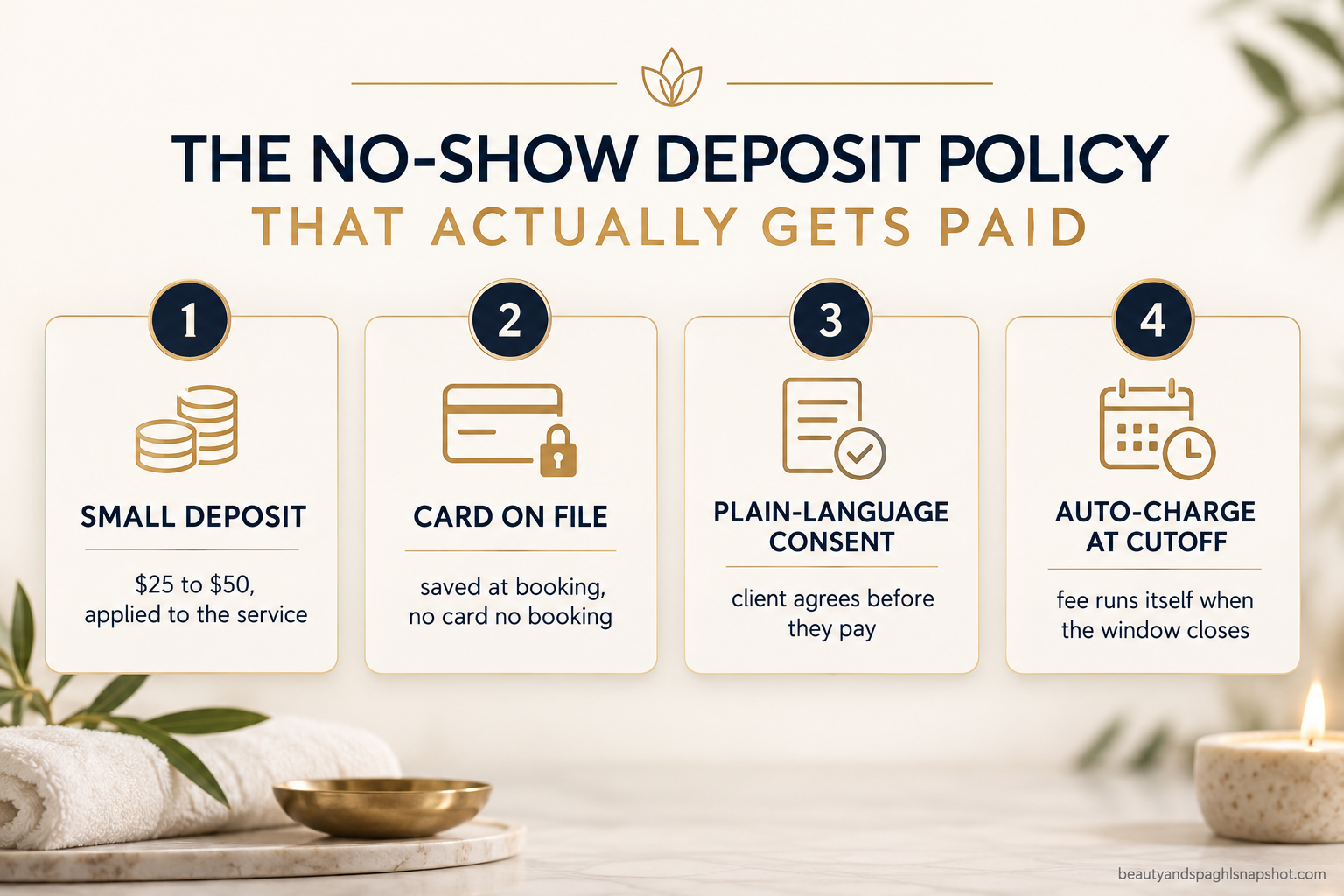
Here is the short version, because you have a business to run. A deposit policy works when it is small enough that clients barely notice, built on a card saved at booking, disclosed in plain language they agree to, and charged automatically the moment the window closes. Get those four things right and the deposit collects itself. Get one wrong and you are back to chasing money and losing disputes. Below is the whole policy, the exact wording to copy, and how to win the chargeback when one comes.
Table of contents
- What a no-show actually costs you
- The six-part policy, start to finish
- Part 1: Pick the deposit amount and the window
- Part 2: Save the card at booking
- Part 3: Write the policy and get consent
- Part 4: Confirm and remind so nobody is surprised
- Part 5: Charge the fee automatically
- Part 6: Handle pushback, chargebacks, and waivers
- Solo, mid-size team, and multi-location
- The legal line you cannot cross
- Steal these: policy text, scripts and messages
- Objections
- FAQ
What a no-show actually costs you
Here is the surprising part: most spas do not have a sky-high no-show rate. Zenoti’s 2026 Beauty and Wellness Benchmark Report puts the median no-show rate at about 4% for medical spas, 2% for salons, and 1% for full-service salons and non-membership spas, with a healthy target of under 5% (Zenoti). The deeper leak is in cancellations: summarizing the same report, Salon Today found some verticals running cancellation rates as high as 18%, and first-visit salon clients cancelling at a staggering 72% (Salon Today).
So the real question is not how many ghost you, it is what each empty room costs. Run the math: appointments per week times your no-show-plus-late-cancel rate times your average ticket, times 52. At a 4% no-show rate on the $216 median med-spa ticket Zenoti reports, a room doing 30 appointments a week quietly leaks over a thousand dollars a month, before you count the product you pre-mixed and the provider you paid to stand there. A no-show is the one problem where every cost stays and all the revenue walks, and the client on your waitlist who wanted that slot is gone too.
A deposit does not get that specific hour back. What it does is change behavior before the fact, so the hour never goes empty. GlossGenius reports that businesses using deposits see a 32% increase in successful appointments, and that deposits plus reminders together cut cancellations and no-shows by an average of 42% (GlossGenius, Fast Company). Those are the vendor’s own figures, so take the exact percentages with a grain of salt, but the direction is not in doubt. For the full anti-no-show system beyond deposits, see our playbook on reducing spa no-shows.
Here is why most “deposit policies” never do this. Either the deposit is honor-system (a “deposit may be required” line on your site, nothing actually collected, no card saved, so the client knows there is no consequence), or it is an after-the-fact chase (texting someone to Venmo you $25 for a slot they already skipped, which nobody pays). Both fail because the money was not secured before the appointment and the policy was never agreed to. The fix is the opposite of both, in six parts.
The six-part policy, start to finish
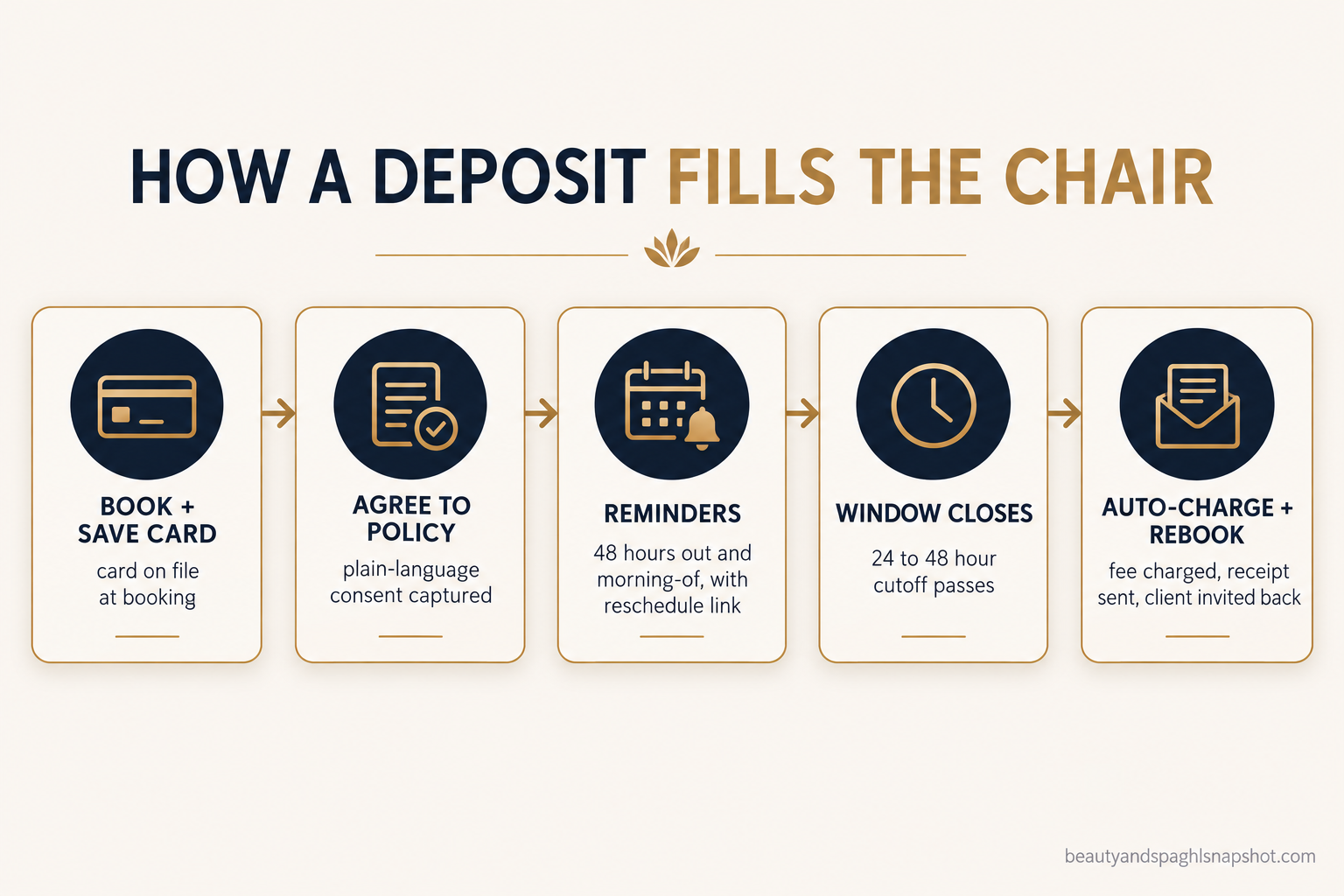
Here is the whole thing in order: pick the amount and window, save the card at booking, write the policy and get consent, confirm and remind, charge automatically, and handle pushback, chargebacks and waivers. Each part has a way it quietly breaks, so I have flagged how.
Part 1: Pick the deposit amount and the window
Two numbers decide everything: how much you hold, and how much notice you require.
For the amount, the sweet spot is a flat $25 to $50 for a standard service, or 25% to 50% of the price for anything long or expensive (a two-hour laser session, a bridal party). Small enough that a real client does not blink, big enough that a tire-kicker thinks twice. Square’s own salon templates land here too: a 24-hour notice window, a late-cancel or no-show fee of up to 50% of the service, and a card collected at booking to make it enforceable (Square). For the window, require 24 to 48 hours’ notice: 24 is the client-friendly standard, 48 fits high-demand rooms and long services you cannot refill last minute. And make the deposit apply to the service when they show, so it is prepayment, not an extra cost, and only becomes a fee on a no-show or late cancel.
How it breaks: a $10 deposit changes no behavior, and a 7-day window makes you sound like a cable company. Keep the amount real and the window humane.
Part 2: Save the card at booking
This is the part that makes the policy work, and the part most people skip.
The deposit has to be captured at the moment of booking, online, with the card stored on file. The client picks a time, enters a card, agrees to the policy, and the booking confirms. No card, no booking. That single rule settles the money question before anyone is in a treatment room. Your booking tool can almost certainly do it: Mindbody, Vagaro, Boulevard, Square and GlossGenius all support card-on-file and deposits, though several bury it or charge extra for the texting around it. What matters is that the card is authorized and saved, so you can charge the no-show fee later without calling to ask for the number again.
How it breaks: the card is collected but not saved in a re-chargeable way, so at no-show time you have nothing to bill. Or online booking takes a deposit and phone bookings don’t, and every no-show turns out to be a phone booking. Take the appointment by phone, take the card by phone, same policy, same moment.
Part 3: Write the policy and get consent
A no-show fee only holds up if the client agreed to it, clearly, before you charged it. That is both the law and the thing that wins you the chargeback.
So the policy is written in plain English, shown at the point of booking, and accepted with a checkbox or a texted “YES” you can prove later. Not buried in a terms-of-service PDF. Not implied. Agreed to, in the same flow where they hand over the card. The wording names the deposit, the window, what happens if they cancel late, and the fact that the deposit applies to their service if they show. The exact copy is in the steal-this section below.
How it breaks: the policy lives only on a website footer the client never saw, so when you charge the fee they honestly did not know it existed, and the dispute goes to them. Capture the consent where the card is captured, and keep the timestamp.
Part 4: Confirm and remind so nobody is surprised
A deposit policy is not a gotcha. The whole point is that the client never gets surprised, because a surprised client disputes the charge and never comes back.
So the appointment gets a confirmation right after booking that restates the policy in one line, and reminders that do the same: one around 48 hours out, one the morning of. Every message gives an easy way to reschedule inside the window, because a reschedule keeps the chair full and the deposit alive. Done right, reminders do most of the work a deposit gets credited with; the deposit handles the person who was never going to reply to a reminder. That is why the booking, the reminders and the fee should run off one system instead of three disconnected tools.
How it breaks: the reminders don’t carry a one-tap reschedule, so a client who genuinely can’t make it has no easy out, no-shows instead, and you are charging someone who tried. Make rescheduling the easiest button in the message.
Part 5: Charge the fee automatically
When the window closes and the client has not shown or rescheduled, the fee gets charged. Automatically. By the system. Not by you, at the end of a long day, working up the nerve.
This is a discipline problem more than a technical one. Owners collect the card, write the policy, then don’t charge the fee because it feels mean in the moment. Clients learn fast: if the fee is real only when you are in a bad mood, it is a threat, not a policy, and threats change no behavior. Automatic charging takes your feelings out of it. The window closed, the fee ran, the receipt went out, nothing personal. Send a calm message with the charge, in the tone of a receptionist, not collections. The script is below.
How it breaks: you charge the fee but send no message, so the client sees a mystery charge, panics, and disputes it. Or you charge inconsistently, the fastest way to get a name as the spa that “randomly” bills people. Automatic and consistent, every time, with a receipt.
Part 6: Handle pushback, chargebacks, and when to waive
Some clients push back, and a few dispute the charge with their bank. That is fine. Built right, you win most of these, and the ones you lose were not worth keeping. In person or by text, the response is warm: you charged the deposit they agreed to when they booked, here is the policy, and you would love to get them rebooked. Most pushback ends there. A formal chargeback is where your paperwork earns its keep: you submit the booking record, the timestamped policy they accepted, and the confirmation and reminders you sent. Merchants who respond with real evidence win a meaningful share of disputes; merchants with nothing to show lose by default. A documented, pre-agreed fee with clear disclosure is one of the most defensible charges a small merchant can make, because the consent is in writing. If you cannot produce that timestamped policy, do not charge the fee.
The flip side is the waiver. Decide in advance when you let it go: a documented emergency, a first-time slip from a longtime regular, a genuine reschedule inside a grace window. The deposit protects the chair from the person who treats your time as free, not the loyal client whose kid spiked a fever. The move that keeps both the money discipline and the relationship is to waive the fee and rebook in the same message: “Totally understand, life happens. I’ve waived today’s fee and put you down for Thursday at 2.”
How it breaks: waive for everyone who asks and the policy evaporates; waive for no one and you train your best clients to book elsewhere. Pick the rule, write it down, apply it the same way every time.
Solo, mid-size team, and multi-location
The same six parts run differently depending on your size.
Solo operator or booth renter. You get stiffed and you have to charge the fee, which is why automation matters most here. Set a flat $25 to $35 deposit, a 24-hour window, card saved at online booking, and let the system charge and message so you never personally dun a client you will see at the grocery store. Keep the waiver generous early while you build the book, tighter as demand grows.
Mid-size team (3 to 8 providers). Now consistency is the problem. One provider enforces, another waives everything, and clients learn which name to book under to skip the policy. Make it a business rule, not a provider preference: same deposit, same window, same automatic charge across every calendar, with waivers logged so you see who is quietly turning it off. This is where card-on-file for phone bookings stops being optional, because a busy front desk will take “just put me down” unless the system blocks it.
Multi-location. Deposits become a cash-flow and reconciliation question on top of a behavior one. You want one policy, one deposit structure, and one reporting view across sites, so you can see no-show rate and recovered-fee revenue per location rather than a different spreadsheet per manager. The waiver rule has to be written and shared, because “the manager decides” means five different policies and a different client experience in every room.
The legal line you cannot cross
A deposit and no-show fee are legal in all fifty states when you do two things: disclose clearly before you charge and get the client’s agreement. That is the whole rule, and it is why Part 3 exists. There is no federal rule written specifically for spa no-show fees. The FTC’s Junk Fees Rule, which took effect in May 2025 and forces up-front disclosure of mandatory fees, covers only live-event tickets and short-term lodging, not salons, and it does not ban any fee (FTC). But the broader FTC Act still bars deceptive charges, which means a fee has to be disclosed clearly and agreed to before you charge it. The card networks require the same.
Two more guardrails. Keep card handling tidy: save only what you need to re-charge, through your processor’s secure card-on-file, never a card number in a text or a note on a client file. And med spas, mind the extra line: a pure day spa doing facials, waxing and massage is a straightforward payments matter, but the moment a licensed provider and medical procedures enter the picture (injectables, medical-protocol lasers, deeper peels), treat intake forms, consult notes and treatment photos as sensitive and keep them out of the casual SMS and email you use for booking. The deposit policy is fine; what changes is how you handle everything attached to a medical visit. We go deeper in our guide to what you can legally text, post, and email.
Steal these: policy text, scripts and messages
Copy these, swap in your numbers, and you have a working policy today. Keep the voice warm. You are protecting the chair, not scaring the client.
1. The booking policy (shown at checkout, accepted with a checkbox):
To hold your appointment, we collect a $35 deposit, which goes toward your service. Life happens, so you can reschedule or cancel any time up to 24 hours before your appointment and your deposit moves with you. If you cancel with less than 24 hours’ notice or miss the appointment, the deposit is kept to cover the reserved time. Booking confirms your agreement to this policy.
2. Booking confirmation text (sent immediately):
You’re booked! [Service] with [Provider] on [Day] at [Time]. Your $35 deposit is saved and applies to your service. Need to change it? Reschedule free up to 24 hrs before: [link]. See you soon, [Spa].
3. The 48-hour reminder (the one that fills the chair):
Hi [Name], looking forward to your [Service] on [Day] at [Time]. If that no longer works, you can move it in two taps here: [link], no charge as long as it’s more than 24 hrs out. Reply C to confirm.
4. The no-show charge message (calm, with a receipt, sent with the charge):
Hi [Name], we held your [Time] [Service] today and missed you. Per the policy you agreed to at booking, your $35 deposit covered the reserved time. No hard feelings, we’d love to get you back on the calendar. Rebook here: [link]. [Spa]
5. The pushback reply (warm, firm, one message):
Totally understand. The $35 was the deposit you agreed to when you booked, which holds the time for you. I’d genuinely love to get you rebooked: I can do [Day] at [Time] or [Day] at [Time]. Want me to grab one?
6. The waiver + rebook (when you choose to keep the client):
Life happens, so I’ve waived today’s fee. Let’s get you back in: I have [Day] at [Time] or [Day] at [Time]. Which works? I’ll text a reminder so it doesn’t sneak up on you.
Objections
“Won’t deposits scare clients away?” A small deposit filters out the people who were never going to show and keeps the ones who were. Serious clients expect to leave a card now; they do it for restaurants, hotels, and every other appointment that matters. The ones who walk over a $35 refundable hold were the Tuesday no-shows you were already losing. You are not losing revenue, you are stopping the leak.
“What if I already pay for Mindbody or Vagaro?” Then you already have card-on-file and deposits, so turn them on. The gap is almost never the booking tool, it is the reminders, the consent capture, and the automatic charge that most tools bury or sell as add-ons with a per-message fee. The point is to get all four working together on one system, without a meter running on every text, which is also where a setup done for you earns its keep.
“Isn’t a deposit a bad first impression for new clients?” First-timers are exactly who you want a deposit from, because they have no track record and first-visit no-shows are the worst. Frame it as holding their spot, apply it to the service, and make the confirmation feel premium. A studio that reserves your time with a small hold reads as in-demand, not desperate.
The bottom line
A no-show deposit is not about the $35. It is about making the appointment feel real before the client walks in, so the Tuesday room does not sit empty while someone else who wanted it got turned away. It works when the deposit is small, the card is saved at booking, the policy is agreed to in plain words, and the fee charges itself when the window closes. Skip any one and you are back to chasing money you will never collect.
So back to that empty 10:00. The fix was never a sterner voicemail. It was a card on file, a policy she agreed to, and a reminder with a reschedule button she could tap at 7am. Build it once and it protects every chair, every day, without you feeling like the bad guy. When you want the booking, the reminders, and the no-show fee running off one system that installs in a day, the done-for-you spa setup already has all of it wired in.
How much should a spa deposit be?
A flat $25 to $50 for a standard service, or 25% to 50% of the price for long or expensive ones like laser packages and bridal work. Small enough that a real client doesn't blink, large enough that a no-show thinks twice. Apply it to the service when they show, so it's prepayment, not an extra cost.
Is it legal to charge a no-show fee?
Yes, in all fifty states, as long as you disclose it clearly before the client books and they agree to it. Plain-language disclosure up front plus documented consent, a checkbox or texted confirmation you can produce later, are what make the charge legal and defensible. Surprise charges that were never disclosed are what get reversed.
What is a fair cancellation window for a spa?
Twenty-four hours is the client-friendly standard and fits most services. Forty-eight is reasonable for high-demand rooms and long appointments you can't refill last minute. Beyond 48 hours starts to feel unreasonable, so most spas stay in the 24 to 48 hour range.
Can I win a chargeback on a no-show fee?
Usually, if the policy is built right. When a client disputes the charge, you submit the booking record, the timestamped policy they agreed to, and the confirmation and reminders you sent. A pre-agreed fee with clear written disclosure is one of the more defensible charges a small merchant can make. If you can't produce proof of consent, don't charge the fee.
How do I take a deposit without upsetting clients?
Collect the card at online booking as a normal part of reserving the time, apply it to the service, keep the amount small, and never let the client get surprised. Confirmation and reminder messages that restate the policy and offer an easy reschedule do most of the work. Serious clients expect to leave a card, the same way they do for restaurants.