

It is the second week of January. Your December was a blur of gift cards and holiday facials. Then the calendar flipped, the phone went quiet, and your Tuesday looks like a ghost town. You know May will be packed again for Mother’s Day. You just have to survive the four months in between.
Most spa owners run their marketing by mood. A slow week scares you into a last-minute discount; a busy week makes you forget marketing exists. That stop-start pattern is why the year feels like a rollercoaster instead of a business.
The fix is boring and it works: plan the whole year once, so every season has a promo waiting for it. Five seasons, the offer to run in each, the texts you can copy, and the ways each one breaks.
Table of contents
- What the seasonal swing actually costs you
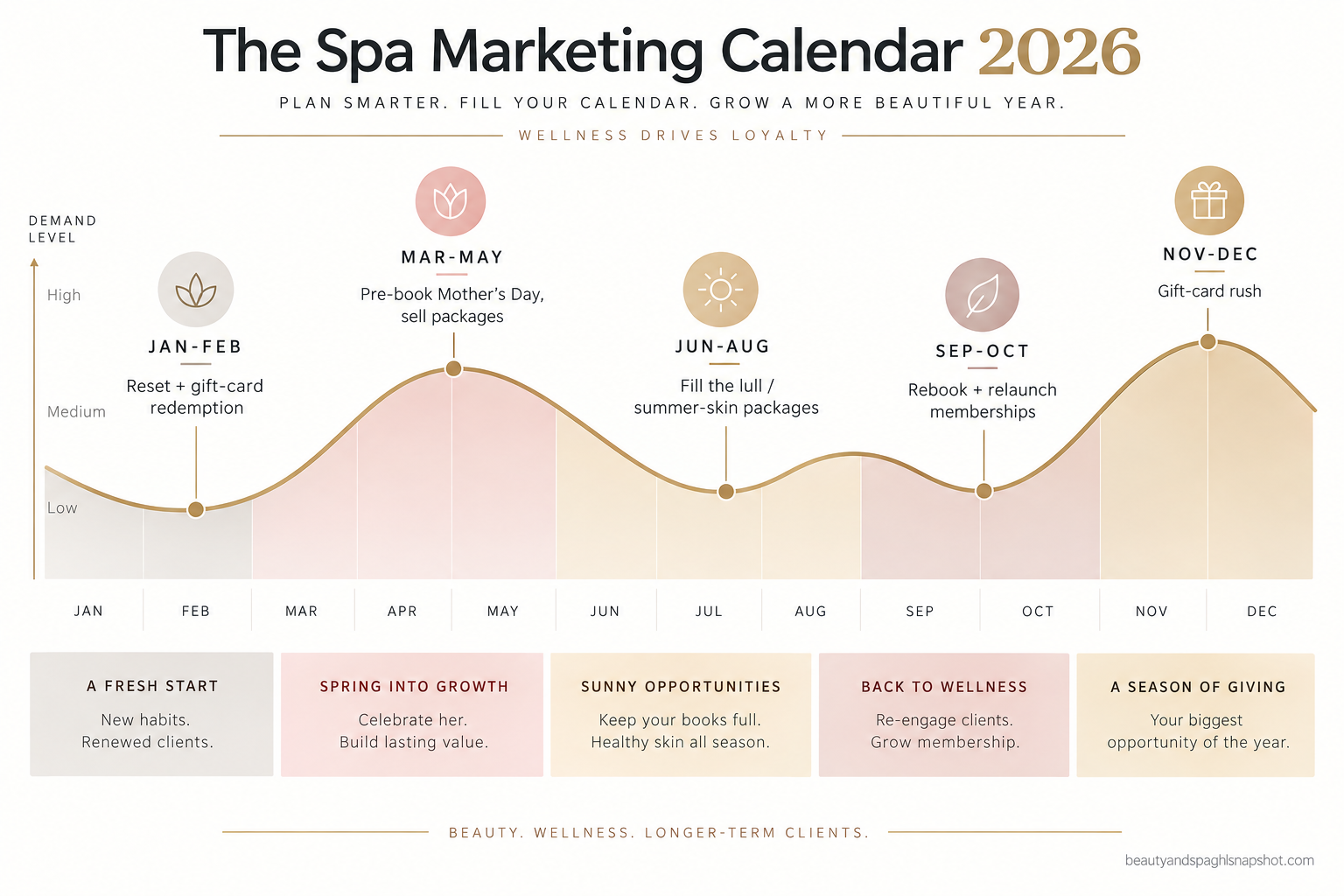
- The spa year at a glance
- January to February: the post-holiday reset
- March to May: the spring surge and Mother’s Day
- June to August: the summer split
- September to October: the self-care rebuild
- November to December: the gift-card gold rush
- Steal these: the promo templates
- Run the calendar for your size: solo, team, multi-location
- The legal fine print on promos and texts
- Objections I hear every week
- Frequently asked questions
Key takeaways
What the seasonal swing actually costs you
Spa demand is lumpy, and the swing is money. The US spa industry pulled in a record $23.5 billion across 191 million visits in 2025, up 4.2 percent, per the 2026 ISPA US Spa Industry Study from PwC, and the medical-aesthetics side has eclipsed $17 billion, per AmSpa. The demand exists. It just does not arrive evenly.
Here is the trap. A treatment room you paid rent on all January cannot be resold in May. The hour is gone. So the goal is not just to ride the peaks but to pull demand forward into the quiet weeks and bank it as a package or gift card, so the slow month still pays its rent.
Those peaks are seasonal, and big. Shoppers planned to spend $34.1 billion on Mother’s Day 2025 and $27.5 billion on Valentine’s Day, per the National Retail Federation. Be the obvious place that money gets spent.
The spa year at a glance
| Season | The mood | Your main play |
|---|---|---|
| Jan to Feb | Slow, post-holiday, budget-conscious | Reactivation and gift-card redemption, then Valentine’s |
| Mar to May | Building to the year’s biggest peak | Pre-book Mother’s Day early, sell packages |
| Jun to Aug | Split: busy for some, dead midweek for others | Fill the lull, summer-skin and pre-vacation packages |
| Sep to Oct | Quiet “back to routine” window | Rebook, relaunch memberships, warm up gift cards |
| Nov to Dec | The revenue peak, driven by gifting | Gift cards, gift cards, gift cards |
Two rules run under all of it. Market into the slow season, not during the busy one. And the best promo for a slow week is almost never a price cut. It is a reason to come in now and prepay.
January to February: the post-holiday reset
January is the hangover. Clients spent in December and “treat myself” turned into “not this month.” This is the most important window to have a plan, because panic-discounting in January trains your best clients to wait for the next sale.
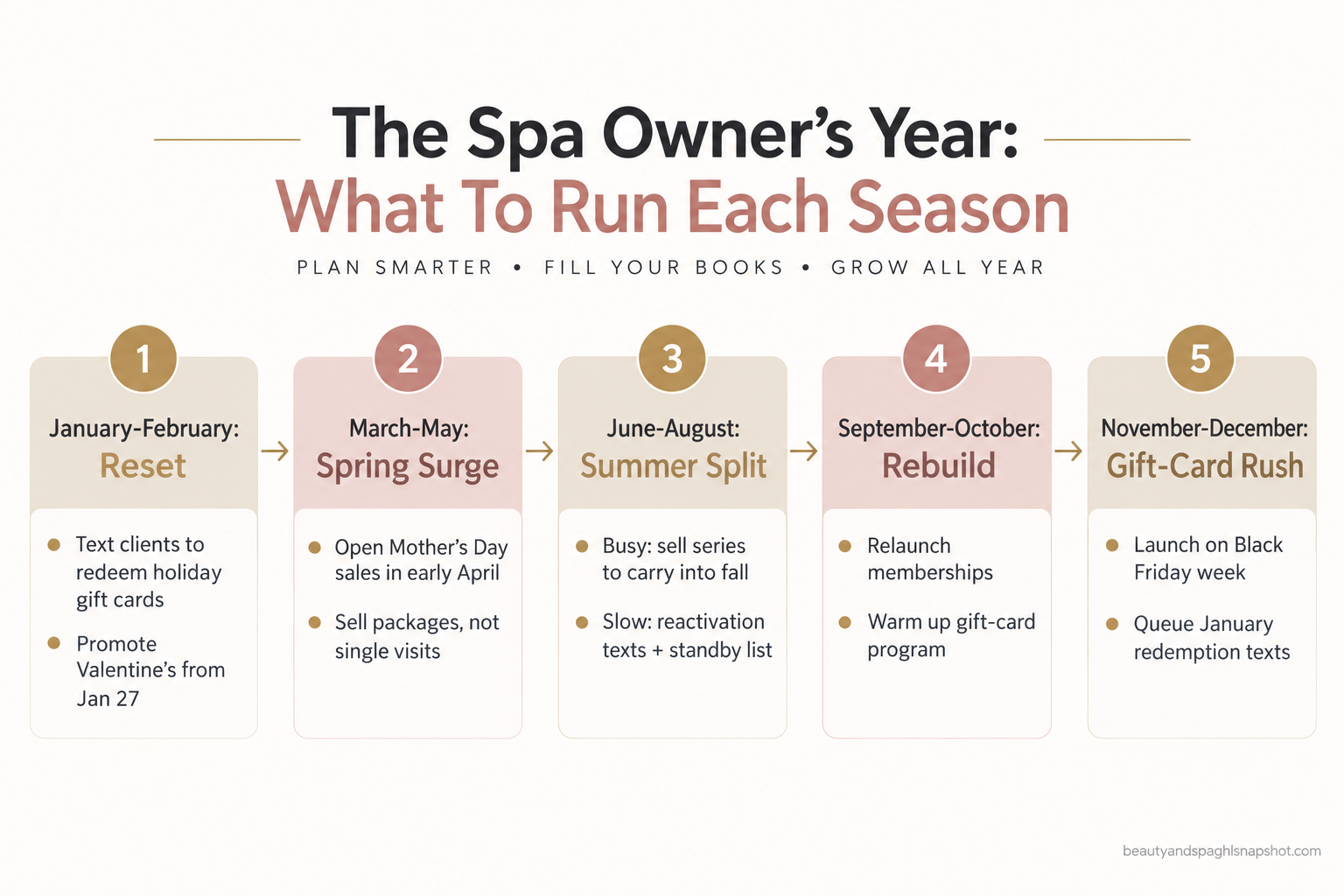
The play. Lead with two things that cost the client nothing new: redeeming the gift cards you sold in December, and a fresh-start reason to rebook. Those holiday cards are a liability until they walk back through the door, so turn them into booked visits. Then layer a “new year reset” angle framed as self-care, not a discount. Send a gift-card redemption text in the first week of January and a reactivation text to anyone who has not visited in 90 days, both in the templates below.
Then Valentine’s. Start promoting around January 27th. Couples massages and “treat them, treat you” gift cards are the easy sell, and the last-minute buyer on the 12th and 13th wants a card they can send in seconds, so make that a one-tap purchase.
How it breaks. The classic January mistake is a loud, public 30-percent-off blast. It fills a few chairs and teaches everyone that January is the discount month. Keep the reset about value, a bonus service or sample, not a slashed price. The other mistake is forgetting gift-card redemption and letting that December money sit until it expires.
March to May: the spring surge and Mother’s Day
This is the big one. Spring brings weddings, proms, and the largest gifting event of your year, peaking hard in the days before the second Sunday in May.
Average planned spend per person, 2025. Source: National Retail Federation.
The play. Pre-book everything and sell experiences, not single visits. Mother’s Day is won in April, not May. Open your gift-card and package sales in the first week of April and push them hard for five weeks. The money is in the experience: a record one in three Mother’s Day shoppers planned to give an outing, and gift cards alone accounted for $3.5 billion of Mother’s Day spending, per NRF, and your spa is squarely in that lane.
The copy. A “book Mom’s spa day before we fill up” email in early April, a gift-card push two weeks out, and a scarcity text the final week once your best slots start to go. The scarcity is real: by the Thursday before Mother’s Day you genuinely are running out of Saturday slots, so say so. A “bridal glow” package and a group-booking link also capture the spring wedding and prom parties that would otherwise go elsewhere.
How it breaks. Spas leave real money on the table by waiting until early May. By then the planners have booked elsewhere and you are catching only the last-minute crowd. Spring is also when you load the summer pipeline, so sell summer packages to your Mother’s Day buyers while they are already spending.
June to August: the summer split
Summer is two different stories depending on your spa. Med spas and hair-removal studios often run hot, because clients want to be vacation-ready and laser season peaks. Day spas and massage studios often sag, because regulars are traveling and the mid-week book goes soft. Know which one you are first.
If you are busy, ride it but protect the fall. Sell series and memberships to the summer rush so the revenue carries into your quiet September. A laser package bought in June is six visits that fill the slower months.
If you are slow, attack the lull like any dead midweek stretch: reactivation texts aimed at the slow days, a standby list to auto-fill cancellations, and a “summer skin” reason to come in now. Our guide on why your spa is empty Tuesday through Thursday has the system.
How it breaks. The summer trap is treating a slow August like a crisis and firing a desperate discount. August is predictable, and if you pre-sold packages in spring, the slow weeks are already partly paid for. The other mistake is going dark all summer, so September starts from zero.
September to October: the self-care rebuild
Early fall is the calm before the holiday storm, and it is underrated. Kids are back in school, routines reset, and clients are in a “take care of myself again” mood. It is the best window all year to rebuild the habits that pay off in Q4.
The play. Three moves. First, rebook the clients who drifted over summer. Second, relaunch memberships now, because one sold in September bills through the holidays and into the slow January. Our breakdown of the math behind a $99 a month tier shows how to price it. Third, and most important, warm up your gift-card program before the December rush, so your flows, signage, and one-tap buy link are tested and ready.
How it breaks. The mistake here is coasting. Fall feels fine, so owners stop marketing, then scramble when the holiday rush exposes a broken gift-card checkout.
November to December: the gift-card gold rush
This is your Super Bowl. For most spas, December is the single biggest revenue month, and gift cards are the engine, because the buyer pays today and you deliver the service in the slow January and February.
The play. Make gift cards impossible to miss and effortless to buy. Launch your holiday push on the Monday of Black Friday week and run it hard through December 24th. Add a self-gift angle (“buy three for gifts, get one for yourself”) and a digital, send-it-now card for the December 23rd panic buyer. The copy is a Black Friday text and a last-minute text on the 22nd and 23rd, both in the templates below.
Then plan the redemption. Every card is a booked visit waiting to happen in January and February. Tag every buyer and queue the January redemption text now. For more, see our spa gift-card marketing playbook.
How it breaks. The number-one December failure is a clunky buying process. If a last-minute shopper has to call during business hours to buy a card, you lose them to the spa down the street with a one-tap option. The second is selling a mountain of cards and never prompting redemption, so January stays empty.
Steal these: the promo templates
Swap in your name, links, and real offers. Every text ends with an opt-out because the law requires it.
January gift-card redemption text:
Hi [First name], hope your holidays were lovely! If you
have a gift card from the season, January is the perfect
time to use it. Our mornings are wide open: [booking link].
Reply STOP to opt out.
90-day reactivation text (January and September):
Hi [First name], it has been a little while and we would
love to see you. Here is your spot back on the calendar,
[provider] has openings this week: [booking link].
Reply STOP to opt out.
Valentine’s gift-card text (late January):
Hi [First name], Valentine's is close. A [spa] gift card
is the easy yes for the person who has everything, and you
can send it in 60 seconds: [gift card link]. Reply STOP to opt out.
Mother’s Day scarcity text (final week):
Hi [First name], our Mother's Day weekend is almost full.
A few Saturday slots left and gift cards are ready to send
now: [gift card link]. Reply STOP to opt out.
Black Friday gift-card text:
Hi [First name], our holiday gift cards are live. Buy for
your list, treat yourself, and skip the mall: [gift card
link]. Reply STOP to opt out.
Last-minute December text (22nd and 23rd):
Hi [First name], need a gift fast? A [spa] e-gift card lands
in their inbox in 60 seconds, no shipping, no stress:
[gift card link]. Reply STOP to opt out.
Checkout rebooking script (any season):
“You are due back in about [4 to 6] weeks. I can hold your favorite time now so you are not fighting for a spot later. Want me to book [date]?”
Texts only go to clients who gave you permission, and every message honors STOP immediately.
Run the calendar for your size: solo, team, multi-location
The calendar is the same for everyone. How much you automate depends on your size.
Solo operator or 1 to 2 chairs. You have no time to send these by hand during a surge, so automate only the two or three that matter most: the January redemption text, the April Mother’s Day push, and the Black Friday launch. The rebooking-at-checkout script is your highest-return habit.
Mid-size team, 3 to 8 providers. Your problem is consistency across staff and channels. Build the calendar once, assign who owns each promo, and automate the texts so the January message fires whether or not anyone remembers. Add a light staff incentive for pre-booking and gift-card sales during the peaks.
Multi-location chain. You can shift demand across locations: a client turned away downtown on Mother’s Day weekend can be offered a slot at a quieter suburban one. Standardize the templates and timing, and lean on memberships that work at any location.
The legal fine print on promos and texts
Every promo here leans on texting, so get the rules right first.
Texting rules (TCPA). You need clear consent before marketing texts, and every message must offer a real opt-out, which is why the STOP line is in every template above. Honor STOP immediately and text only during reasonable hours. The FCC’s guidance on unwanted texts is the starting point, and our spa SMS marketing guide has the consent language.
Honest offers (FTC). Keep every offer real and the terms clear. The FTC’s 2024 rule bans fake reviews, and review-gating, only asking happy clients to post, is an explicit violation, so never tie a seasonal perk to a five-star review. Any before-and-after you post must show a typical result or disclose that it does not. The FTC’s endorsement guidance covers it.
A note for med spas. A pure day spa doing facials, waxing, massage, and nails is generally not a HIPAA-covered entity: no protected health information, no insurance billing. Once licensed medical providers perform medical procedures, the posture changes. Keep intake forms, photos, and consult notes out of unsecured SMS and email, and keep promo texts to generic service names. Our compliance guide covers where that line sits.
Objections I hear every week
“Won’t all these promos cheapen my brand?” Only if every promo is a discount. Almost none of this calendar cuts prices. A gift card is full price. A package is often more than a single visit. Scarcity on Mother’s Day weekend raises your perceived value, it does not lower it.
“I already pay for Mindbody or Vagaro. Doesn’t my software do this?” Your booking software holds the calendar and takes payment well. What almost none of it does is run the seasonal campaign for you: the April Mother’s Day sequence, the December gift-card push, the January redemption texts. Most owners bolt those on, and the base bill climbs anyway. Mangomint moved every customer to a single plan on August 1, 2026 at $120 a month per location plus $10 per user, texting extra.
“I don’t have time to plan a whole year.” You just read the plan: you set it up once and execute on autopilot. The spas that feel calm in December built the gift-card flow in October. Thirty minutes mapping your five seasons now saves twelve frantic scrambles later.
“Won’t clients find all these messages annoying?” Only if they are frequent, generic, and impossible to stop. The calendar is deliberately spaced: a handful of relevant messages a year, each tied to a real moment, each with a one-tap opt-out. Make every message useful and complaints stay near zero.
Frequently asked questions
What is the slowest season for a spa?
For most day spas and salons, January and February are slowest, right after the holiday peak, with a second lull in summer when regulars travel. Med spas and hair-removal studios often run the opposite pattern, busy in summer. Pull your own 12-month revenue report by month first, because the exact shape varies by spa and region.
When should I start promoting Mother's Day?
Open your Mother's Day gift-card and package sales in the first week of April and run them hard for about five weeks. It is the biggest gifting event of the spa year, with US shoppers planning to spend $34.1 billion in 2025. Spas that wait until early May catch only the last-minute crowd and miss the planners who booked elsewhere.
Do gift cards really matter that much for spas?
Yes. The buyer pays today, you deliver the service weeks later in your slow season, and a share of cards go partly unredeemed, which is pure margin. December is the peak, and those cards become booked visits that fill your quiet January and February, which is why tagging every buyer and queuing a January redemption text pays off.
How do I fill the slow months without discounting?
Lead with everything except price. Redeem the gift cards you already sold, send reactivation texts to clients who have drifted, pre-sell packages and memberships that carry revenue into the quiet weeks, and rebook at checkout into a slow slot. If you must run an offer, make it a value add like a bonus service, not a public price cut that trains clients to wait.
How many promo messages per year is too many?
The test is relevance, not frequency. A handful of well-timed messages tied to real moments, plus reactivation when a client has genuinely drifted, reads as helpful. Cap it to roughly one message per client every few weeks outside peaks, personalize it, always include a clear opt-out, and honor STOP immediately to stay on the right side of TCPA rules.
The takeaway
Your January does not have to be a ghost town and your December does not have to be chaos. The spa year has a rhythm you can see coming from a mile away. Plan each season’s promo once, write the copy once, and let it fire on time.
Back to that quiet second week of January. In a spa running this calendar, the phone is not silent: the gift-card redemption texts went out Monday, the reactivation messages are landing, and the Valentine’s push is queued for the 27th. Same rooms, same team, same rent. A full book instead of a ghost town.