

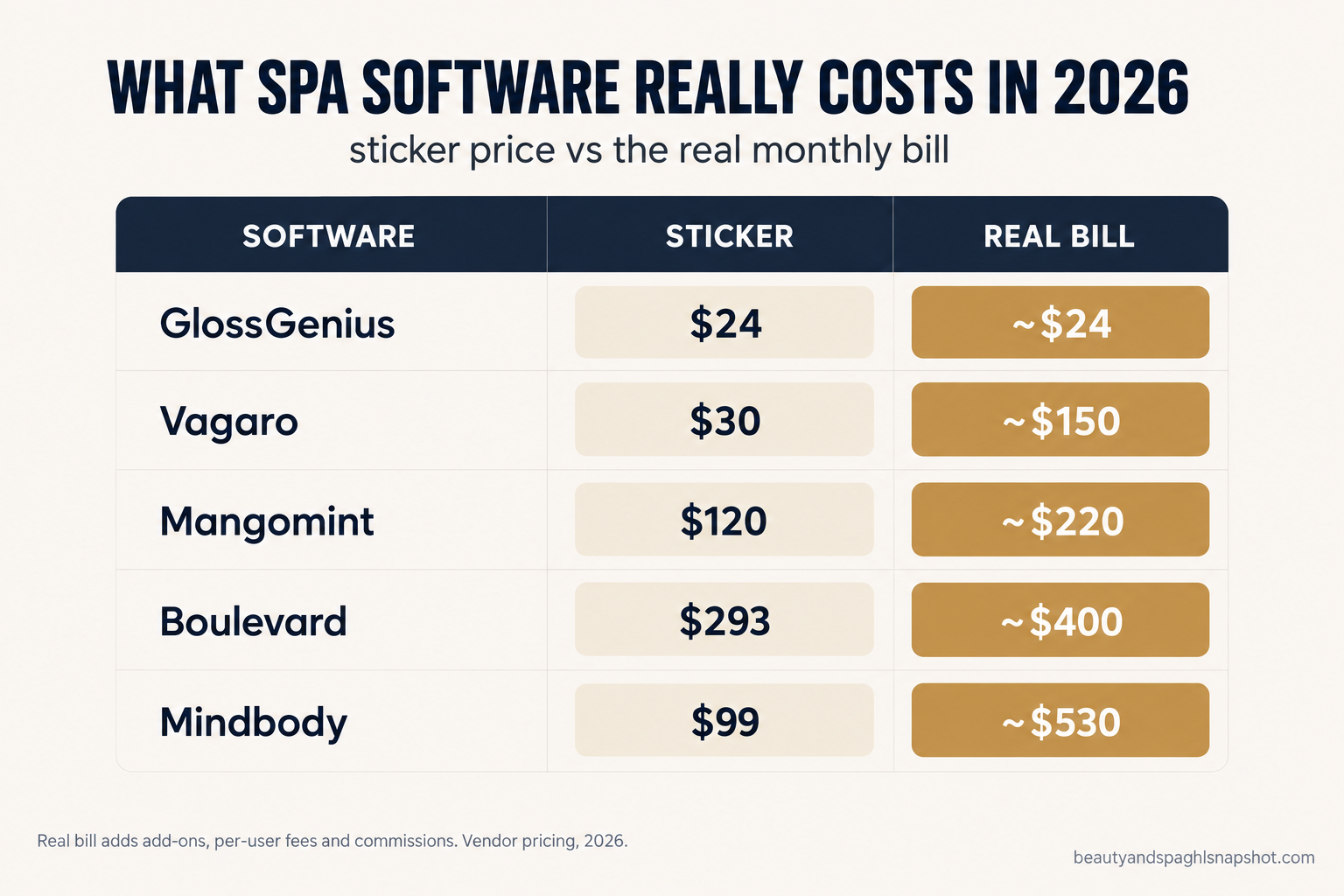
It is the first of the month and you are staring at the card statement, trying to work out why your booking software cost more than your rent. The plan you signed up for said one number. The line item says another. Somewhere between them sit a branded-app fee, a per-user charge, a texting add-on, and a marketplace commission you forgot was even a thing.
Here is the short answer, because you are busy. The sticker price on a spa software website is almost never the bill. Once you add the pieces most owners actually need, most platforms land two to four times higher than the headline tier. This post breaks down what Mindbody, Boulevard, Vagaro, Mangomint, GlossGenius, Fresha, Zenoti, and Square really cost in 2026, and how to force the true number out of a rep before you sign.
Table of contents
- Why the sticker price is never the real bill
- The 2026 price list at a glance
- Mindbody: published tiers, opaque bill
- Boulevard, Vagaro, Mangomint
- GlossGenius, Fresha, Zenoti, Square
- What it costs for a solo, a team, and a chain
- The compliance cost nobody prices in
- Questions to force out the real bill
- Objections
- FAQ
Why the sticker price is never the real bill
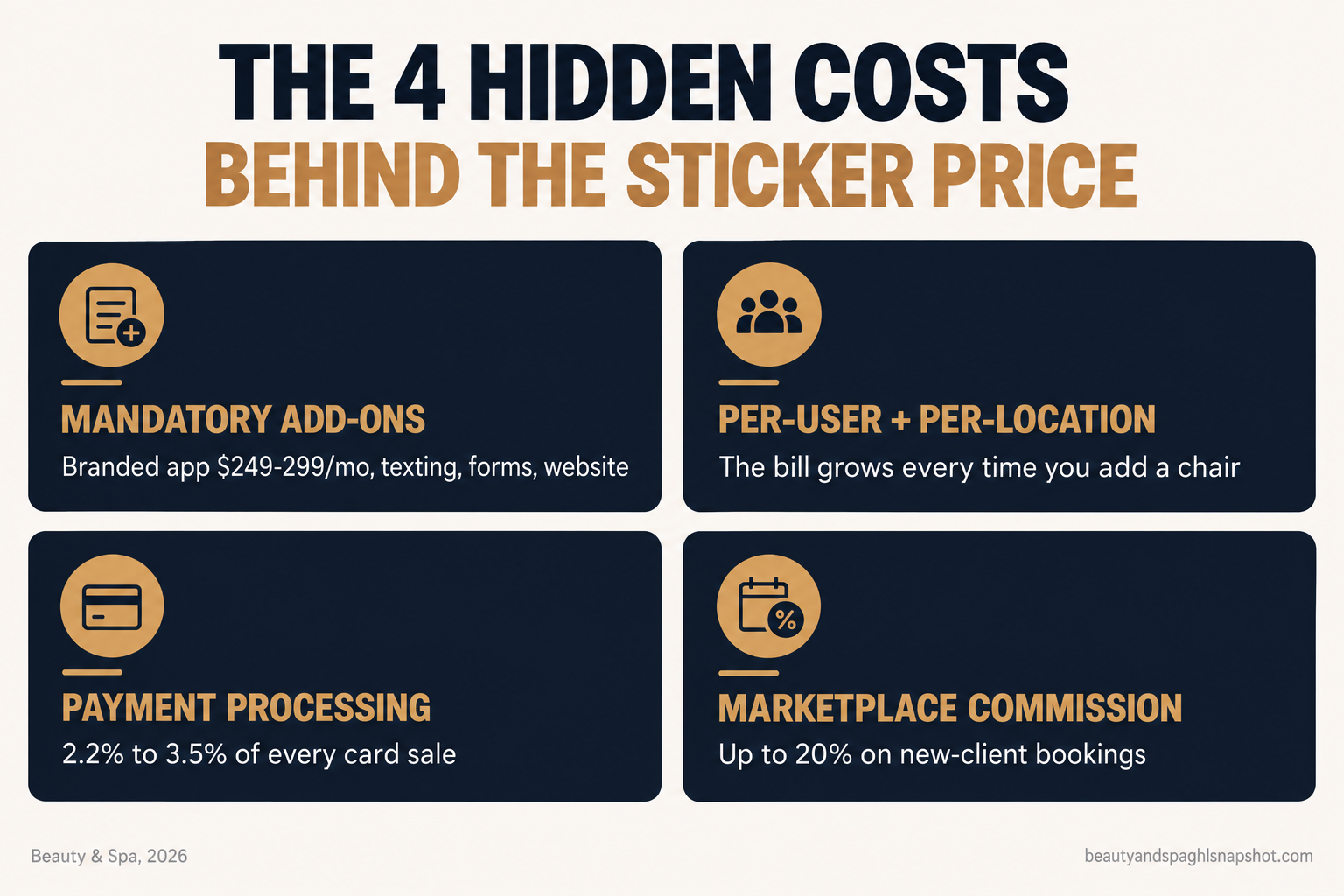
Spa software pricing is built to look cheap on the pricing page and cost real money in production. There are four places the bill grows after you sign, and every platform uses at least two of them.
1. Mandatory add-ons. The feature you assumed was included is a separate line. Mindbody’s branded client app, the thing that makes booking feel like your brand, runs a reported $249 to $299 a month on top of your plan (Pabau). Texting, forms, and a website are frequently add-ons too.
2. Per-user and per-location metering. A flat fee for a solo operator becomes a running meter the moment you add a chair or a second room.
3. Payment processing. Every card swipe carries a percentage. On $300,000 in card sales, one point of processing difference is $3,000 a year.
4. Marketplace commissions. This one grows with your success. Mindbody’s marketplace reportedly takes a 20% cut on bookings it sends you, and Fresha added a 20% commission on new clients. You do the work, they take a slice.
None of these show up on the tier you clicked. All of them show up on the statement. So compare the real bill, not the headline.
The 2026 price list at a glance
Here is where every major platform sits in 2026 by published entry price. Read it as a starting line, not a finish line.
Published entry pricing, 2026
| Plan | GlossGenius | Square Appointments | Vagaro recommended | Boulevard | Mindbody |
|---|---|---|---|---|---|
| Price | from $24/mo | Free-$49+/mo | $24-84/mo | from ~$176/mo | from ~$99/mo |
| Feature 1 | Solo and small team | Free solo tier | Priced per calendar | Per location, no free trial | Accelerate ~$259-279 |
| Feature 2 | Flat 2.6% processing | Paid ~$29-49 per location | Texting is an add-on | Premier ~$293, Prestige ~$410 | Ultimate ~$499-699 |
| Feature 3 | No commission | Processing 2.6% + 15c | Website is an add-on | Front-desk focused | Branded app $249-299/mo |
| Feature 4 | Website + booking included | Strong POS, thin marketing | Processing 2.2-3.5% | Add-ons on top | 20% commission, 12-24mo contract |
The table cannot show you the add-ons, the commission, or the contract. Let us put the real number on each one.
Mindbody: published tiers, opaque bill
Mindbody is the incumbent, and the most interesting pricing story here, because it does publish tiers. Starter sits around $99 a month, Accelerate around $259 to $279, and Ultimate around $499 to $699 per location (Pabau). So far, so normal.
The real bill is somewhere else. First, the branded app is a reported $249 to $299 a month add-on, and for many studios that feature is the reason they wanted premium software at all. Second, the marketplace commission: bookings through Mindbody’s marketplace reportedly carry a 20% cut, capped near $30 a transaction (Capterra). Third, the contract: Mindbody’s own documentation describes 12-month terms, up to 24 months, that auto-renew (Mindbody). Annual lock-in is the most repeated complaint across its review profiles, where it carries 3.7 out of 5 on G2 (G2).
How it breaks: a studio signs Accelerate at ~$279, adds the branded app, and starts taking marketplace bookings. Within a quarter the effective cost has roughly doubled, and the contract means you cannot leave for a year. Our GoHighLevel versus Mindbody breakdown runs the same numbers side by side.
Boulevard, Vagaro, Mangomint: the middle of the market
Boulevard is the polished front-desk platform higher-end salons love. Published prices, where you can find them, are Essentials around $176, Premier around $293, and Prestige around $410 per month, per location, with no free trial (The Salon Business). The trap is not commission, it is scale: the automation you want sits in the higher tiers, and a two-location group on Premier is close to $600 a month before processing. For one premium location it can be worth it; for a growing group, the per-location math gets heavy fast.
Vagaro wins the “cheapest to start” contest. Base pricing runs roughly $23.99 to $83.99 a month, scaled by how many calendars you need (Vagaro). Then you start adding: texting (about $20), forms (about $10), a website (about $10), and processing at 2.2% to 3.5%. Each piece is cheap on its own, which is how the total creeps up without any single line looking expensive. You pick Vagaro at $30 a month, and six months later it is $150 doing what you thought it did on day one. Our Vagaro versus GoHighLevel breakdown shows where that stack lands.
Mangomint just proved this article’s point. On August 1, 2026 it moved off three flat tiers ($165, $245, $375) to $120 a month per location plus $10 a month per user, with a $70 a month phone add-on (Mangomint, Salon Today). For a two-person studio that is cheaper than the old $165 tier. For a ten-person team it is $120 plus $100 in user fees before the phone line, past the old top tier. The shape of the pricing changed, and so did who it favors.
Estimated real monthly cost for a small multi-user studio, 2026, before processing and commission. From published pricing (Mangomint, GlossGenius) and reported add-ons; Mindbody adds the $249 to $299 branded app to the ~$279 Accelerate tier.
GlossGenius, Fresha, Zenoti, Square: the cheap seats and the black boxes
GlossGenius is the honest cheap option, and the pricing is clean. Standard is $24, Gold is $48, and Platinum is $148 a month (annual billing), with a flat 2.6% processing rate and no marketplace commission (GlossGenius). Website and booking are included, not bolted on. For a solo lash artist, a booth renter, or a one-to-two-chair studio, this is often the right answer, and I say that even though we sell a different kind of system. It stops fitting only when one chair becomes four rooms and two locations and you need reporting and automation it was never built to carry.
Fresha changed the game on itself. For years the pitch was that it is free. In July 2026 Fresha ended its free plan, moved to a 7-day trial, and now charges: processing around 2.19% to 3.30% plus $0.20 per transaction, and a 20% commission on new clients from its marketplace (The Salon Business). A lot of operators picked Fresha specifically to avoid a monthly fee, and that reason just evaporated. The 20% new-client commission is the quiet killer: 20% of a $200 service, every visit, is a $40 tax on growth. Moving off a metered tool without losing history is its own project, covered in our migration playbook.
Zenoti does not publish pricing at all. Everything sits behind a “book a demo” wall, so the number is set per deal. Reported estimates put it around $200 to $500 or more per month per location, with implementation fees in the $5,000 to $20,000 range (SchedulingKit). Those are third-party estimates, not published numbers. Zenoti is enterprise software that can suit a large chain, but an owner running a few locations from her phone is the wrong customer for a tool that will not name a price without a sales call. The real cost is the implementation and lock-in.
Square Appointments has a real free tier for a single location, the genuine “start at zero” option now that Fresha is not. Above it, paid plans run from roughly $29 to $49 a month or more per location (reported figures vary), and free-tier processing is 2.6% plus 15 cents in person (SchedulingKit). Square’s strength is point of sale and retail; its weakness is marketing depth. It books and takes payment cleanly, but it will not run the reactivation sequence or review engine that fills a slow Tuesday. Free is a great price for a calendar and a bad one for a marketing system.
What it costs for a solo, a team, and a chain
The right answer changes with your size. Run “what will I actually pay” through three situations.
The solo operator (one chair, booth renter, or mobile). Keep fixed cost near zero and avoid commissions. GlossGenius at $24, or Square’s free tier, is hard to beat, and with one user per-user metering does not hurt yet. Real monthly cost: $0 to $50 plus processing. Avoid a marketplace commission; at your volume a 20% cut on new clients is the most expensive line you could sign.
The mid-size team (3 to 6 providers, one busy location). This is where the meters bite. Mangomint lands around $170 to $220 before the phone add-on, Vagaro with real add-ons near $120 to $180, Boulevard Premier at ~$293 before processing. It is also the size where an empty Tuesday is a measurable loss, so the question becomes “what fills the room,” not “what is cheapest.” Real monthly cost: $150 to $350.
The multi-location chain (2+ locations, 10+ staff). Now per-location and per-user pricing compounds. Mindbody or Zenoti quote enterprise numbers, easily $500 to $1,500 or more a month across locations once add-ons and commission are in. At this size a flat, owned system you configure once and run everywhere changes the math, because your cost stops scaling with headcount. Real monthly cost: $500 to $2,000+ on metered tools, versus a one-time build you are not re-buying every month.
The tool that is right at one chair is rarely right at ten, which is why so many owners switch twice before they settle.
The compliance cost nobody prices in
There is a cost that never appears on a pricing page and can dwarf all of them: getting compliance wrong. It matters most for med spas, and it is worth being precise, because much of the internet advice is wrong.
A pure beauty or day spa, doing cuts, facials, waxing, massage, and nails, staffed by cosmetologists and estheticians, is generally not a HIPAA covered entity. There is no protected health information and no insurance billing, so HIPAA does not attach. Do not let anyone sell you “HIPAA-compliant” software you do not need.
A med spa is different once licensed medical providers perform medical procedures (Botox, fillers, medical-protocol lasers, deeper peels) and the business conducts covered transactions such as electronic insurance billing. Many med spas are cash-pay and may technically avoid covered-entity status. But once medical staff and procedures are involved, treat intake forms, treatment photos, and consult notes as sensitive and keep them out of unsecured SMS and email. Cheap software that happily texts a before-and-after photo is not saving money, it is creating a liability.
Two more rules bind your marketing regardless of HIPAA. The FTC requires that before-and-after results be typical or clearly disclosed, and its 2024 rule makes review-gating (only asking happy clients for reviews) an explicit violation (FTC). Many state boards also restrict phrases like “medical grade” and “FDA-approved.” Good software makes compliant messaging the default.
Questions to force out the real bill
Here is the part to bookmark. Before you sign, read these to the salesperson word for word, and write down the answers.
Keep the answers side by side. The winner is rarely the lowest sticker price; it is the lowest honest total for the thing that fills your chairs.
Objections
“I already pay for Mindbody. Isn’t switching a hassle?” It is a project, not a nightmare, and the deciding factor is your client history. A good migration exports your full list, history, and package balances, then rebuilds booking and follow-up before you flip the switch, so you never lose a booking. The real question is what the old contract, branded-app fee, and 20% commission cost you each month you stay.
“Isn’t the cheapest tool the smart move for a small shop?” For a true solo, often yes. But a $30 tool that leaves your Tuesday empty because it cannot run a reactivation sequence is more expensive than a $150 system that fills two of those slots. Zenoti’s 2026 benchmark, on data from 30,000+ businesses, found clients rebooked twice or more cancel at just about 4%, far below a client booked only once (Zenoti, 2026). The follow-up that drives that second rebooking is what the cheapest tools do not do. Price the empty chair, not just the subscription.
“Do I need to be technical to run any of this?” No, and if a vendor implies you do, that is a flag. If a tool needs a consultant on retainer to change a text message, that consultant is part of the price.
“Why move to a one-time build instead of a monthly plan?” Because the monthly plan never stops and grows with you. A flat, owned setup means your cost stops scaling with your headcount and your success. You are not re-buying your booking system every month, forever.
The bottom line
The card statement and the pricing page are describing two different numbers. The pricing page shows the least you could pay. The statement shows what you actually do. Every platform here is honest about the first and quiet about the second.
So do the boring thing. Get the all-in total, in writing, for your exact setup, from every tool on your shortlist. Ask the nine questions. Price the empty chair. If you would rather stop renting a meter altogether, the flat one-time pricing is here, and a 30-minute demo shows what one owned system does that eight metered ones cannot.
FAQ
What does Mindbody actually cost per month in 2026?
Published tiers run from about $99 (Starter) to $259 to $279 (Accelerate) to $499 to $699 (Ultimate) per location. The real bill is higher: a branded app is a reported $249 to $299 add-on, the marketplace takes a reported 20% commission, and the contract runs 12 to 24 months.
Which spa software is genuinely the cheapest?
For a solo operator or booth renter, GlossGenius (from $24 a month, flat 2.6% processing, no commission) or Square's free single-location tier. They stop fitting once you need multi-location reporting and real automation.
Did Fresha really get rid of its free plan?
Yes. In July 2026 Fresha ended its free plan, moved to a 7-day trial, and now charges: processing around 2.19% to 3.30% plus $0.20, plus a reported 20% commission on new clients from its marketplace.
Why won't Zenoti and Boulevard show their prices?
Zenoti hides pricing behind a demo; reported estimates are $200 to $500+ a month per location plus $5,000 to $20,000 implementation. Boulevard publishes some pricing (about $176 to $410 per location) but has no free trial. Gated pricing usually means the cost depends on what the sales team thinks you will pay.
How do I calculate my true monthly software cost?
Add four things to the tier price: mandatory add-ons (branded app, texting, forms, website), per-user or per-location fees for your headcount, processing (annual card volume times the rate, divided by 12), and any marketplace commission, then factor the contract length. That total is what to compare, not the headline tier.
About the author
Devon Ashby is a GHL Agency Lead for beauty and wellness who resells and builds GoHighLevel setups for spas, lash studios, and brow bars across the Southeast. He came up through performance marketing, so he treats every spa account like a P&L, cost per booked consult, package conversion, lifetime value, and writes the practical, numbers-first pieces on pricing math, ad funnels, and onboarding non-technical studio owners.