

It is Thursday and your best stylist just asked, on her way out the door, whether she can “go booth rent instead.” You said you’d think about it. Now you are at the front desk after close, working out whether that makes you $800 a month richer or turns her into a legal problem.
Here is the short answer, because you have a business to run. Booth rent turns you into a landlord and hands the client relationship to your renter. Commission keeps you the employer, keeps the client yours, and costs you payroll tax and management time. Neither is “better.” One fits established stylists with their own books; the other fits a growing brand you want to control. Below is the whole decision: the numbers, the classification test, and the agreement language you can copy.
Table of contents
- Booth rent vs commission: what each one really is
- What the decision actually costs you
- The six-step decision, start to finish
- Step 1: Match the model to the stylist
- Step 2: Run the real per-chair math
- Step 3: Pass the worker-classification test
- Step 4: Put it in writing
- Step 5: Collect rent or run payroll without chasing anyone
- Step 6: Plan for the day they leave
- Solo, mid-size team, and multi-location
- The compliance line you cannot cross
- Steal these: agreement clauses and scripts
- Objections
- FAQ
Booth rent vs commission: what each one really is
Strip away the jargon and these are two different businesses wearing the same haircut.
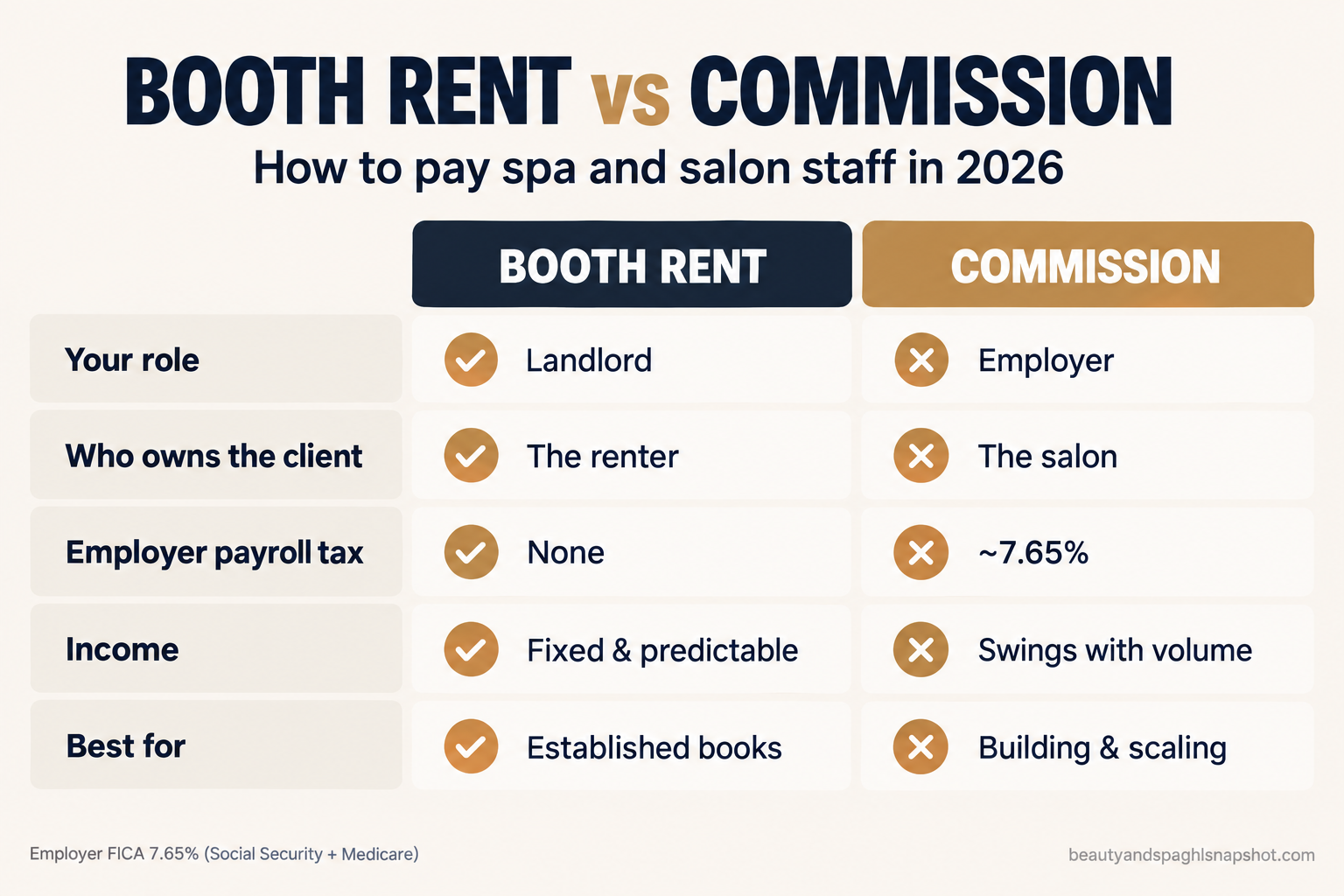
Booth rent (also chair rent or suite rent) makes you a landlord. A licensed pro pays a set fee for space, then runs their own micro-business inside your walls: their prices, their money, their clients, their product, their taxes. You get predictable rent whether they are busy or not, and almost no say in how they work.
Commission makes you an employer. The client books and pays your business, and the stylist earns a percentage of the revenue they produce. You control the schedule, prices, standards, retail, and the client list. You also carry the payroll tax, the management, and the risk of an empty chair.
This is not a pay question, it is an ownership question: booth rent trades control for cash-flow certainty, commission trades cash-flow risk for control and a client list you own.
Booth rent vs commission, side by side
| Plan | Booth rent | Commission recommended |
|---|---|---|
| Price | Fixed monthly fee | % of service revenue |
| Feature 1 | You are a landlord | You are an employer |
| Feature 2 | Renter sets prices + takes payment | Salon sets prices + takes payment |
| Feature 3 | Clients belong to the renter | Clients belong to the salon |
| Feature 4 | No employer payroll tax | ~7.65% employer payroll tax |
| Feature 5 | Income is predictable | Income swings with volume |
| Feature 6 | Little control over the work | Full control of brand + chair |
| Feature 7 | Best for established books | Best for building + scaling |
What the decision actually costs you
Booth rent in the United States in 2026 runs roughly $125 to $450 a week, about $540 to $1,950 a month, depending on city and salon quality (Hair Salon Pro). In an expensive market it climbs fast: the average chair or booth in New York City sits near $377 a week, and prime Manhattan space can hit $1,000 a week (Salon Renter).
Commission is a share of service revenue. The convention lands between 40% and 60% to the stylist, with 45% to 50% the common anchor, and most modern shops use a sliding scale from about 35% for newer staff up toward 55% for top producers (Booksy, Zenoti). On top of the split you carry employer payroll tax of 7.65% of wages (6.2% Social Security plus 1.45% Medicare), before workers’ comp and your own time (IRS).
The six-step decision, start to finish
Run these six steps in order: match the model to the stylist, run the real per-chair math, pass the worker-classification test, put it in writing, collect rent or run payroll without chasing anyone, and plan for the day they leave. Each one has a way it quietly goes wrong, so I have flagged how it breaks.
Step 1: Match the model to the stylist
The best predictor of which model works is where the stylist is in their career.
Booth rent fits a licensed pro with an established book: they have clients who follow them, know how to price and rebook, and want autonomy more than a boss. Commission fits anyone you need to build, brand, or control: new graduates who need your marketing and walk-ins, or any med-spa where protocols and injector oversight matter and the experience has to be identical in every room.
How it breaks: owners put a brand-new stylist on booth rent to dodge payroll, then watch the empty chair. The renter cannot fill it, stops paying, and leaves owing two months. Match the model to the person, not the tax bill.
Step 2: Run the real per-chair math
Put both models on the same chair producing $8,000 a month in services. Under booth rent at $1,000 a month, the business nets $1,000, flat, whatever the chair produces. Under a 50% commission, the business keeps $4,000 but pays the stylist $4,000 plus about $306 in payroll tax, and still carries product, card processing, software, front desk, and marketing against its half. Under booth rent, those costs are the renter’s problem. Load the real costs onto the commission side and a busy chair can net less than a rented one, while a slow chair on commission loses money on every visit.
How it breaks: you run the math on gross revenue and forget the backbar, the 2.6% to 3.5% card processing, and the software seat, which live on the commission side and vanish on the rent side. Run the math on net, per chair, with real costs.
Step 3: Pass the worker-classification test
This is the step that turns a good idea into a tax bill. You do not get to decide someone is a contractor by writing “independent contractor” on a form. The IRS and the Department of Labor decide, based on how the relationship actually works.
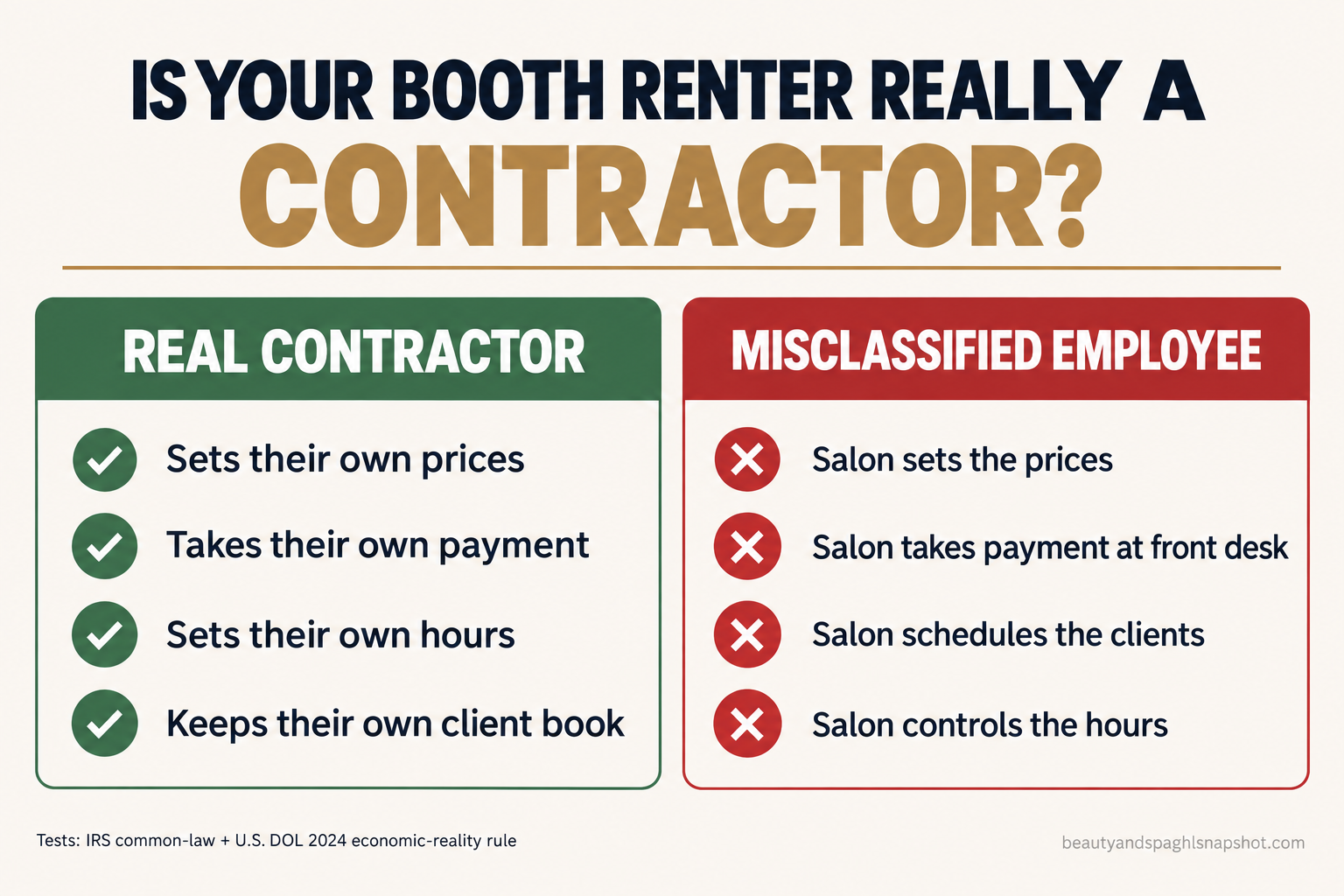
The IRS uses a common-law test across three categories: behavioral control (who sets hours, methods, and tools), financial control (who invests in equipment, who can profit or lose), and the type of relationship (is there a real agreement, is the work permanent and core to your business). No single factor decides; the whole relationship is weighed together (IRS). The Department of Labor’s 2024 final rule adds a six-factor “economic reality” test built on the same question: is the worker in business for themselves, or economically dependent on you (U.S. Department of Labor)? The rule may be revised again, but the question does not.
Translated to a chair: a real booth renter sets their own prices, takes their own payment, keeps their own hours, and carries their own book. Do those things for them and you have an employee, no matter what the paperwork says. If the IRS or the state reclassifies, you owe back payroll taxes and penalties, so get the substance right, not just the label.
Step 4: Put it in writing
Whichever model you choose, the agreement is your protection. A handshake booth deal is the fastest way to lose a client list. A booth-rental agreement has to spell out rent, independent-business status, and who owns the clients; a commission agreement, the split and that the salon owns the client relationship. The exact clauses are in the steal-this section below.
How it breaks: the agreement is silent on client ownership, so when the stylist leaves and exports “their” clients from your booking software, whether that is allowed depends entirely on what you wrote down.
Step 5: Collect rent or run payroll without chasing anyone
The model you pick creates a weekly job. Booth rent is a collections job; commission is a payroll job. Both eat your time if you run them from memory.
For booth rent, set up a recurring invoice that bills the same amount on the same day, with an automatic reminder the day before, so you never send the awkward “hey, rent” text yourself. For commission, you need clean production tracking so the split is never a debate, and a payroll run that pulls the numbers automatically. The reminder engine behind our missed-call text-back playbook and SMS automation feature keeps rent and confirmations on time.
How it breaks: you collect rent by Venmo, on no schedule. Two renters are always “about to pay,” and by quarter’s end you are down real money you never documented for taxes.
Step 6: Plan for the day they leave
Every stylist eventually leaves, moves, or goes independent. The model you chose decides how much that hurts.
When a booth renter leaves, they take their clients, because those were always theirs; your exposure is an empty chair and any unpaid rent. When a commission employee leaves, the clients are the salon’s, so your job is retention. That is the quiet reason growing brands prefer commission: the client stays even when the stylist does not.
How it breaks: on commission, the client list only exists in a stylist’s personal phone, so she leaves and takes the relationships you paid to create. Keep every client in a business-owned system, so a departure is a reassignment, not a loss, and lean on the rebooking machine in our second-visit drop-off guide.
Solo, mid-size team, and multi-location
The right answer changes with your size.
Solo or 1-3 chairs. Booth rent is attractive: simple income, no payroll, and one established renter can cover a chunk of your lease. The trap is treating that renter like staff. The moment you set their prices or book their clients, you have a misclassified employee. Keep it a true lease, or put them on commission.
Mid-size team of 4-10. A hybrid usually wins. Put building stylists on commission so you control the ramp, brand, and client list, and offer booth rent to veterans who want autonomy and would otherwise leave for a suite. Just track commission production and booth-rent invoices on one platform, not in your head.
Multi-location chain. Consistency is the brand, so most chains run commission or salary everywhere and reserve booth rent for spillover or specialty providers. Classification risk multiplies across every location and state, so the trap is one manager cutting a side booth deal that misclassifies three people. Centralize the paperwork.
The compliance line you cannot cross
State law can overrule your choice entirely, which is why you cannot copy a friend’s setup from another state.
California is the sharpest example. Under AB5 and its ABC test, a worker is presumed an employee unless the business clears a strict standard. Barbers, cosmetologists, estheticians, electrologists, and manicurists get a professional-services carve-out (now in Labor Code section 2778), but only if they genuinely operate as independent businesses: they set their own rates, process their own payments, set their own hours, keep their own book, hold their own business license, and issue the salon a 1099 for the rented space (California AB5 text, Labor Code §2778). Miss any of those and your “renter” is an employee. The rules differ by license type, so a nail-heavy shop especially should get local advice (Hackler Flynn & Associates).
There is a second layer for med-spas. A med-spa where medical providers perform medical procedures (injectables, medical-protocol lasers, deeper peels) should treat intake forms, consult notes, and before-and-after photos as sensitive and keep them off unsecured text and email, whatever the pay model (spa marketing compliance guide).
Steal these: agreement clauses and scripts
Copy these, then have a professional check them for your state. They are a starting point, not a substitute for advice.
Booth-rental agreement, the clauses that matter most:
Rent and term. Renter pays $______ per week, due every ______, for exclusive use of Station ___ plus shared use of reception, restroom, and washing stations. Either party may end with ___ days’ written notice; unpaid rent is due on the final day.
Independent business. Renter sets their own prices, collects payment directly from their own clients, sets their own hours, provides their own products and tools, maintains an active license and liability insurance, and files their own taxes. Salon issues Form 1099 as required.
Client ownership. Clients served by Renter are Renter’s. Clients from the Salon’s marketing and walk-in traffic remain the Salon’s.
Commission agreement, the clauses that matter most:
Compensation. Stylist earns % of collected service revenue on this sliding scale: % up to $__/month, % from $___ to $____, % above $__. Retail earns ___% commission.
Client ownership. All clients, contact information, and appointment history are the property of the Salon and remain in the Salon’s booking system.
The rent-reminder text (day before rent is due):
Hi [Name], quick reminder your booth rent of $[amount] is due tomorrow ([date]). It’ll auto-charge to your card on file. Any questions, just text me back. Thanks for being part of [Salon]!
The retention text when a commission stylist leaves (to their clients):
Hi [Client], [Stylist] has moved on, and we’ve saved your spot with [New Stylist], who has your history on file. Want me to hold your usual time next [day]? Reply YES and it’s booked.
Objections
“Why not just rent every chair?” Rent only works when the renter can fill their own chair. Rent to someone without a book and you get an empty station, unpaid rent, and a resentful stylist. Rent fits established pros, not people who still need your marketing.
“Isn’t commission more expensive after payroll and taxes?” It costs the 7.65% employer tax plus management time. But it keeps the client, the pricing, and the brand under your control, and on a busy chair the business often nets more than fixed rent. You are paying for an asset you own: the client list.
“My stylist wants booth rent or she’ll leave. Do I have to say yes?” No, but hear what she wants: autonomy and a bigger share of her own book. Meet that with a higher commission tier or a genuine lease, not a fake lease where you still control everything.
FAQ
What is the difference between booth rent and commission?
Booth rent means a stylist pays a fixed fee for space and runs their own business inside your salon, keeping their own prices, payments, and clients. Commission means the stylist is your employee, the client pays your business, and the stylist earns a percentage of service revenue. Booth rent gives fixed income and less control; commission gives control and the client list but adds payroll tax.
Can I just call a stylist an independent contractor to skip payroll tax?
No. The IRS and the Department of Labor look at how the relationship actually works, not what your paperwork calls it. If you set prices, schedule clients, take payment, and control hours, that person is an employee even if the contract says contractor. Misclassification can mean back payroll taxes, penalties, and back overtime.
How much is booth rent at a salon in 2026?
In most of the United States, booth rent runs about $125 to $450 a week, roughly $540 to $1,950 a month, depending on city and salon quality. In New York City the average chair or booth is near $377 a week, and prime Manhattan space can reach $1,000 a week.
What commission split is normal for a salon or spa?
The common range is 40% to 60% of service revenue to the stylist, with 45% to 50% the typical anchor. Most modern shops use a sliding scale from around 35% to 40% for newer staff up toward 55% for top producers, with retail commission handled separately.
Who owns the clients if a stylist leaves?
It depends on the model and what you put in writing. With true booth rent, the clients are the renter's and leave with them. With commission, the clients are the salon's, but only if your agreement says so and the history lives in a business-owned system, not the stylist's personal phone.
The bottom line
Booth rent versus commission is not a pay decision, it is an ownership decision. Rent buys a predictable check and hands the client and the upside to your stylist; commission keeps both with your business and costs you tax and management to run. The wrong move is picking one to dodge a tax bill and running it like the other, because that is what gets a “renter” reclassified as an employee.
So back to that Thursday. If your stylist has her own book and wants autonomy, offer a real lease with the paperwork done right. If you want to keep her chair and her clients, offer a better commission tier instead. Decide on the math and the law, not on the moment. When you are ready to run whichever model without chasing rent, the done-for-you spa system has the invoicing, reminders, and client records already wired in.