

It is the first week of a new month and your card gets charged by Fresha for the first time in years. You open the app expecting the usual $0, and instead there is a subscription line, a processing fee, and a “new client fee” you do not remember agreeing to. The tool that ran your books for free since you opened is not free anymore.
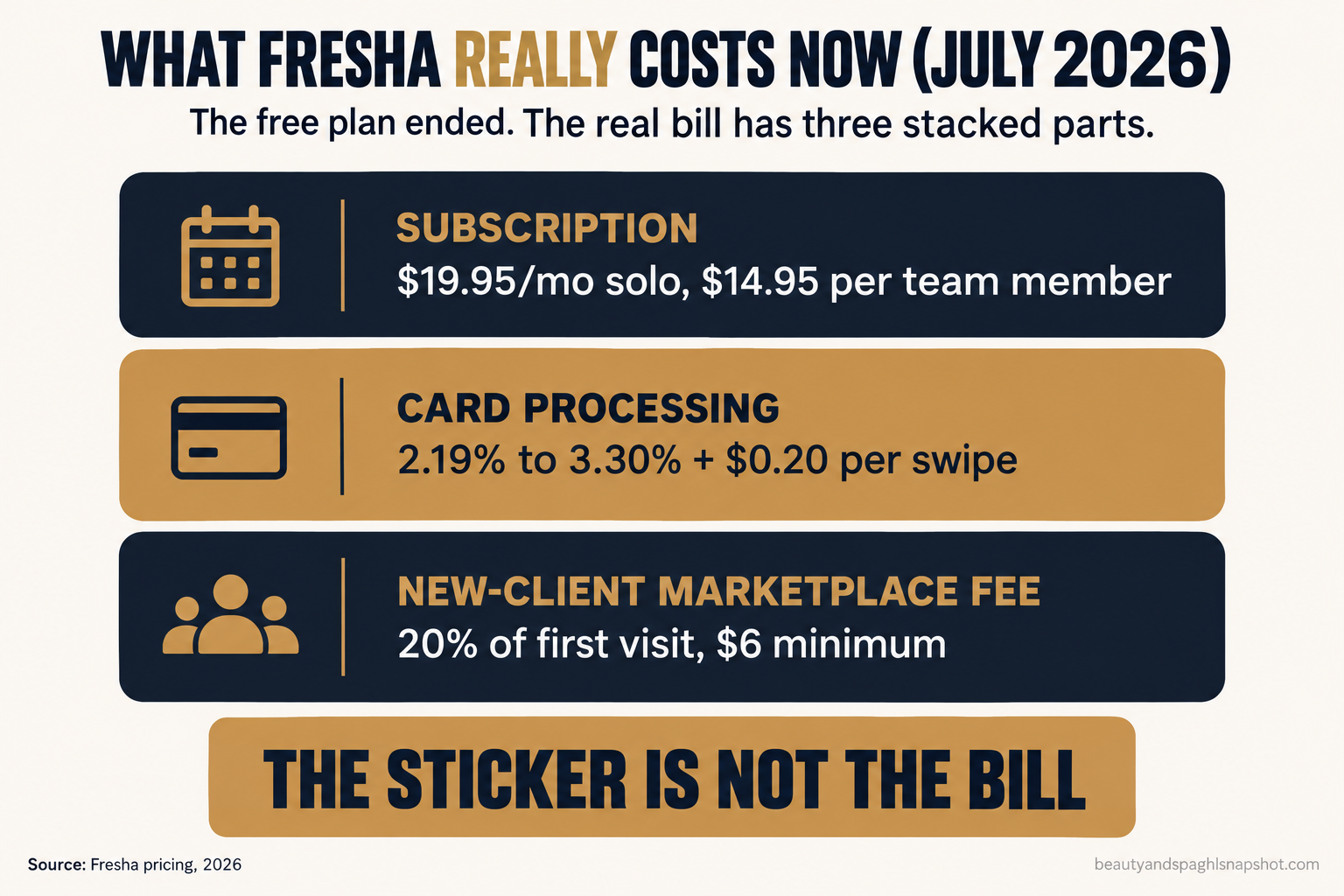
Here is the short version. Fresha ended its free-forever plan in July 2026. A solo operator now pays about $19.95 a month, teams pay about $14.95 per bookable member per month, card processing runs roughly 2.19% to 3.30% plus $0.20 a swipe, and Fresha still takes a 20% cut (minimum $6) the first time a client finds you through its marketplace. The whole “free salon software” era is closing, and the smart move is to check what you actually pay now and whether switching saves you real money.
What does Fresha actually cost now?
For years Fresha’s pitch was simple: the software costs nothing, and they make money on processing and a cut of new marketplace clients. That is over. As of the 2026 change, the base subscription is real money: about $19.95 per month for one bookable calendar on the Independent plan, and about $14.95 per bookable member per month on the Team plan (a 20-plus seat Enterprise tier is quote-only). There is a 7-day trial and no free-forever option, per Fresha’s current pricing and breakdowns like Pabau’s Fresha pricing guide.
That subscription is the part people notice. The part that quietly eats margin is the rest of the bill. Card processing sits at roughly 2.19% to 3.30% plus $0.20 per transaction in the US. And the marketplace fee is still there: a one-time 20% of the first appointment value, $6 floor, every time a brand-new client books through the Fresha marketplace rather than your own link. On a $200 first facial, that is $40 gone.
None of this makes Fresha a bad tool. It is still clean and the client app is good, and for a shop that lives off the marketplace the math can still work. The problem is that the change moved Fresha from “free” to “a real monthly bill plus a variable cut,” and a lot of owners are paying without ever running the comparison. So let us run it.
Which booking apps are actually worth switching to?
Ignore the enterprise names for a second. You run the business from your phone and want a calendar, text reminders that cut no-shows, card payments that clear, and a price you can predict. Five tools cover that range for a 1-3 chair studio.
| Tool | Starts at | Card processing | Best for |
|---|---|---|---|
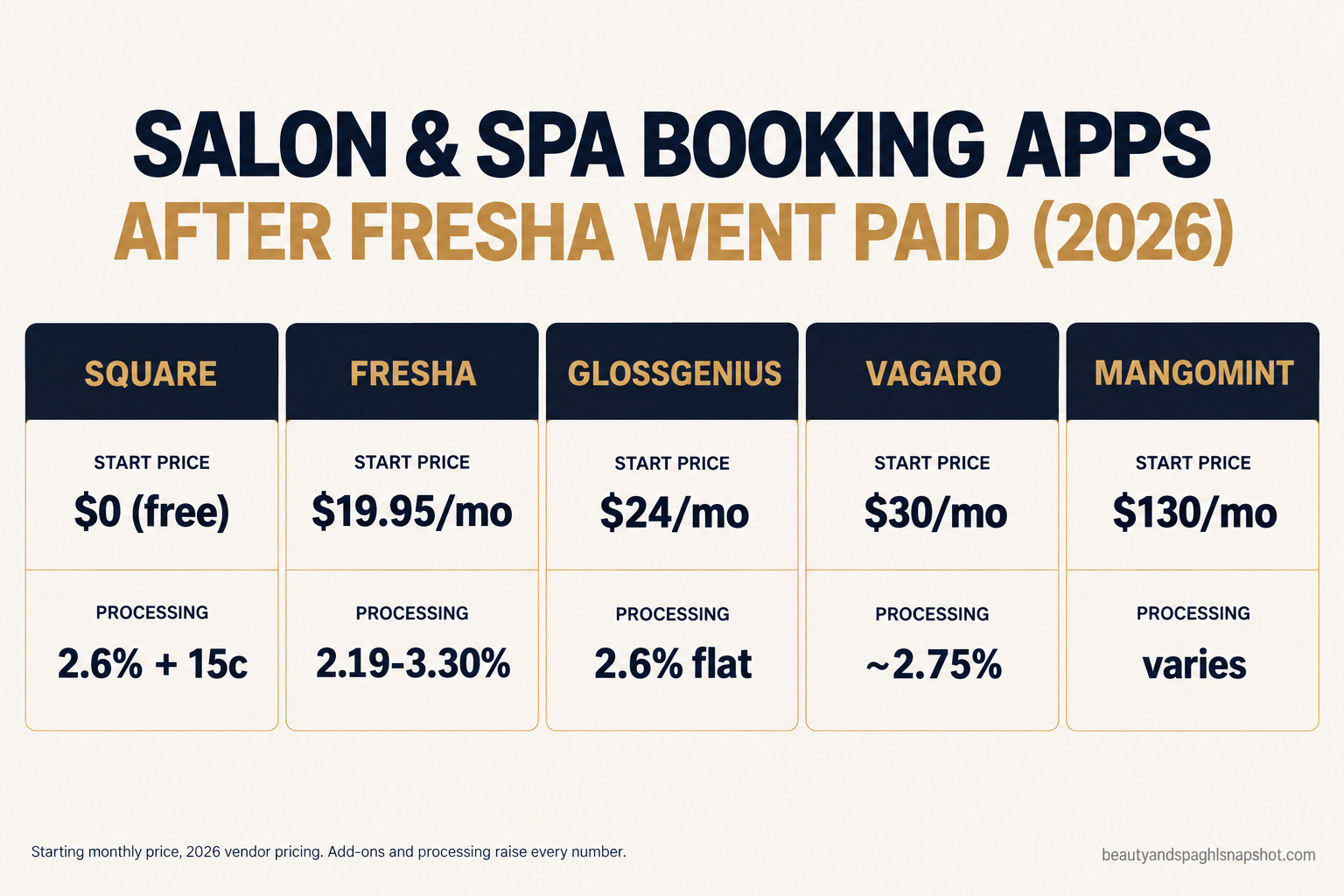
| Square Appointments | $0 (solo) | 2.6% + 15¢ in person | A one-chair studio that wants free and simple |
| GlossGenius | $24/mo (annual) | 2.6% flat | Solo to small teams that want it to look premium |
| Fresha | $19.95/mo | 2.19-3.30% + 20¢ | Shops that live off the Fresha marketplace |
| Vagaro | $30/mo | ~2.75% + 15¢ | Multi-service shops that want everything in one place |
| Mangomint | $130/mo | Varies | Growing multi-provider spas that want polish |
Prices are 2026 figures from each vendor’s pricing page, cross-checked against current review roundups. Read the rows as starting points, because add-ons and processing move the real number.
Square Appointments: still the free one
Square is the only name here that kept a genuinely free plan. A solo professional pays $0 a month per location, with card processing at 2.6% plus 15 cents in person and 3.3% plus 30 cents online, per Square’s pricing. Paid tiers are Plus at $49 a month and Premium at $149 a month per location, mostly for multi-staff scheduling and tighter no-show controls.
Where it bites: Square is a payments company that added booking, not a spa marketing tool. The reminders work, but the retention and win-back side is thin. You will send the reminder text; you will not easily run the “we miss you, here is 15% off” sequence without bolting on Square Marketing as a paid add-on. For a one-chair operator who wants a clean calendar and free software, it is the obvious default.
GlossGenius: the one that looks premium
GlossGenius prices at $24 a month for Standard, $48 for Gold, and $148 for Platinum when you pay annually, with month-to-month running roughly 15% higher, and a flat 2.6% card processing rate on every plan, per GlossGenius pricing. Standard covers about two users, Gold up to nine, Platinum unlimited. The flat processing rate is the quiet win, because you always know the cut.
Where it bites: the low sticker price is the annual rate, and the user caps matter. A four-provider shop is pushed onto Gold, and a shop past nine providers jumps to Platinum at $148. It is built for the solo-to-small aesthetic studio that wants beautiful client-facing booking, and it is very good at that. It is not built to run a busy front desk across two locations.
Fresha: fine if you live off the marketplace
Covered above. The one-line verdict: Fresha now costs about $19.95 solo or $14.95 per member, plus processing, plus the 20% first-visit marketplace cut. If a real share of your new clients discover you inside the Fresha app, that cut is paying for customer acquisition and can still be worth it. If you bring your own traffic from Instagram and referrals, you are paying a marketplace tax for leads you already had.
Vagaro: everything in one place, if you add it all up
Vagaro starts around $30 a month for one bookable calendar (promotional pricing sometimes dips near $23.99), then adds about $10 a month per additional calendar, capping near $85 a month at seven or more providers, per Vagaro’s plans. Processing runs around 2.75% plus 15 cents in person. It does a lot: booking, point of sale, memberships, even a marketplace of its own.
Where it bites: the à la carte model. Text marketing, the website builder, forms, and a branded app are separate paid add-ons, each roughly $20 or more a month. The $30 headline becomes $110 to $200 fast once a real shop turns on what it needs. Vagaro fits a busy multi-service shop that uses the whole suite. It is an expensive fit for someone who wanted a $30 calendar and got upsold.
Mangomint: polished, and it just repriced
Mangomint is the premium end of this list, and a live example of why pricing models are shifting. On August 1, 2026, Mangomint moved off its old flat tiers of $165, $245, and $375 a month to a new model of $120 a month per location plus $10 a month per user, with a $70 a month phone add-on, per Mangomint’s own pricing update. A solo provider lands around $130 a month before add-ons.
Where it bites: the per-user math scales on you, and the phone line most front desks want is another $70. Mangomint is genuinely nice software with strong automation, and a growing, well-staffed spa gets its money’s worth. For a one-chair studio, it is more system than the problem requires.
Here is the entry price for each tool side by side, the starting line, not the finish.
Starting monthly price per location or first calendar, 2026 vendor pricing. Boulevard and Mindbody added for context. Add-ons and processing raise every number.
What does this look like for a real shop?
Averages lie. The right tool for a solo esthetician is the wrong tool for a four-room med spa. Run the question through three shapes of business and the answer changes every time.
The solo operator, one chair. You do 60 to 90 appointments a month, get most clients from Instagram and word of mouth, and want to spend nothing you do not have to. Square’s free plan or GlossGenius Standard at $24 a month covers you. Skip Fresha here unless the marketplace is a real lead source, because you would be paying a subscription plus a 20% cut for traffic you already generate. Your real cost should be $0 to $30 plus processing. Anything more and you are overbuying.
The mid-size shop, three to four providers. Now the front desk matters, no-shows cost real chair time, and you want memberships and rebooking. GlossGenius Gold at $48, Vagaro with add-ons around $110 to $150, or Mangomint around $150 to $170 are the live options. The deciding question is not price, it is whether the tool chases the no-show and rebooks the client or just stores the calendar. Most tools at this level book well and follow up poorly, which is where the money leaks.
The multi-location owner. Two or more locations, booth-rent and commission staff mixed, real payroll. This is where the enterprise names circle: Boulevard at $176 to $410 a month per location, Mindbody starting near $99 but climbing fast, Mangomint at $120 per location plus users. The trap here is the contract. Read the term before you sign, because a 24-month lock-in on the wrong platform costs more than any monthly fee.
Typical in-person card processing rate (%), 2026. Fresha shown at the midpoint of its 2.19-3.30% range. On $20,000 of monthly card volume, a 0.2% gap is about $40 a month, roughly $480 a year. Software is a fixed cost you notice; processing is a variable one you do not, and it scales with every dollar you run.
The hidden costs nobody quotes you
The subscription is the honest number. Everything below is where the real bill hides.
Marketplace commissions. Fresha takes 20% of a new client’s first visit through its marketplace. Mindbody runs a similar cut, widely reported around 20%, on top of its subscription. These are framed as “free leads.” They are not free. They are performance marketing you pay for per booking, so treat them like an ad spend line, not a favor.
Contracts and exit fees. This is the one that traps people. Mindbody commonly locks new customers into 24-month contracts with auto-renew, and users report a data-export fee near $500 to get their own client history out, per Koalendar’s Mindbody cost guide. Boulevard offers no free trial at all. Before you sign anything with a term, ask two questions in writing: how long is the commitment, and what does it cost to leave with my data.
Add-on creep. Vagaro’s $30 becomes $150. Mangomint’s $120 per location becomes $120 plus users plus a $70 phone line. The base price is the invitation; the features you need are the bill.
Steal this: your switch-over kit
Switching feels scary because you think you will lose clients in the gap. You will not, if you handle the handoff with a few messages you can lift straight into your new system. Keep every text TCPA-clean: only message clients who opted in, and honor STOP.
The switch announcement (send once, to your active list):
Hi [First name], quick heads up from [Studio]. We moved to a new, faster booking link so you can book, reschedule, and pay in a few taps. Save it: [link]. Same team, same chair, easier booking. Reply STOP to opt out.
The no-show deposit line (put this on your booking page and confirmation text):
To hold your appointment we take a [amount] deposit that applies to your service. Cancel or reschedule 24 hours ahead and it moves with you. No-shows and same-day cancels forfeit the deposit. Booking means you agree.
The rebooking text (send within 24 hours of a completed visit):
[First name], you looked great today. Want to lock your next [service] before your calendar fills? Same time in [4/6] weeks works well for most clients. Book here: [link]. Reply STOP to opt out.
The win-back text (for a client who has not booked in 60-plus days):
Hi [First name], it has been a while, and we would love to see you back. Here is 15% off your next visit this month: [link]. Reply STOP to opt out.
These messages are the difference between a booking tool and a system that fills chairs. Most apps above send the reminder. Few run the deposit hold, rebooking, and win-back on autopilot. Our guide on cutting spa no-shows in 2026 walks through the deposit flow, and the midweek fill playbook covers the win-back timing.
Common objections, answered straight
“I already pay for Mindbody or Fresha. Is switching worth it?” Do the math once. Add your subscription, add-ons, processing, and any marketplace cut for one real month. If a simpler tool would run you half that for the features you actually use, the switch pays for itself fast. If you are deep in a Mindbody contract, wait for the renewal window and plan the exit around it, because breaking a 24-month term early usually is not worth it.
“Won’t I lose my client history when I switch?” Not if you export first. Every reputable tool lets you download a client list with contact details and visit history as a CSV. Do that before you cancel anything, then import it into the new tool. The one real risk is a platform that charges to release your data, which is why the exit-fee question matters before you sign. Our walkthrough on switching off Mindbody or Vagaro without losing history covers the export step by step.
“Isn’t free always better?” No. Free software that keeps a 20% cut of every new client, or that cannot run a deposit and win-back, can cost you far more in lost chair time than a $48 tool that does. Free is a price, not a value. Count the whole bill, including the money the tool does not help you make.
“What about the marketplace leads I’d lose if I leave Fresha?” Measure it. For a month, tag every new client by how they found you. If a real share come from the Fresha marketplace, that 20% cut is buying you customers and leaving means replacing that channel. If almost everyone comes from Instagram, referrals, or Google, you are paying a marketplace tax for leads you already own.
Whichever tool you land on, the booking calendar is only half the job. The deposit hold, the rebooking, and the win-back are what actually fill the chairs, and that is the part we build for spas on GoHighLevel, the platform our system runs on.
Frequently asked questions
Is Fresha still free in 2026?
No. Fresha ended its free-forever plan in July 2026. A solo operator now pays about $19.95 a month, teams pay about $14.95 per bookable member per month, plus card processing of roughly 2.19% to 3.30% and a 20% first-visit fee on new clients from the Fresha marketplace.
What is the cheapest spa booking software in 2026?
Square Appointments still has a genuinely free plan for a solo professional at $0 a month, with processing at 2.6% plus 15 cents in person. GlossGenius Standard at $24 a month billed annually is the next step up for a more premium client-facing experience.
Does Fresha really take 20% of new clients?
Yes, but only on clients who book through the Fresha marketplace, not your own link. It is a one-time 20% of the first appointment value with a $6 minimum. Clients who find you through your own link or return on their own do not trigger the fee.
Will I lose my client data if I switch booking systems?
Not if you export first. Download your client list and visit history as a CSV before you cancel, then import it into the new tool. The main risk is a platform that charges a data-export fee, so ask what it costs to leave with your data before you sign.
Which booking tool is best for reducing no-shows?
The one that can hold a deposit and automate rebooking and win-back, not just send a reminder. Most budget tools send reminders well but stop there. Pairing a calendar with a deposit-backed no-show recovery and rebooking sequence cuts no-shows far more than reminders alone.
The bottom line
Back to that first surprise charge. The free era is closing, and that is not really about Fresha. Every vendor is nudging owners toward subscriptions plus a cut, and most never run the numbers. So run them once. Add the plan, the add-ons, the processing, and any marketplace commission for one honest month, then look at what the tool does for the money, not just what it costs.
For most 1-3 chair studios, the answer is a simple, predictable tool like Square or GlossGenius plus a real system for deposits, rebooking, and win-back on top. For a growing multi-location shop, it is a platform you have read the contract on. Either way, the worst move is the common one: paying a bill that quietly grew, for software that books appointments but never lifts a finger to fill them.
If you want the honest, no-paid-placement version of the full field, our best spa booking software comparison for 2026 puts nine tools head to head, and the full spa software cost teardown shows every hidden line. When you are ready to stop just booking chairs and start filling them, the appointment automation and SMS automation built into our system are where that work actually gets done.