

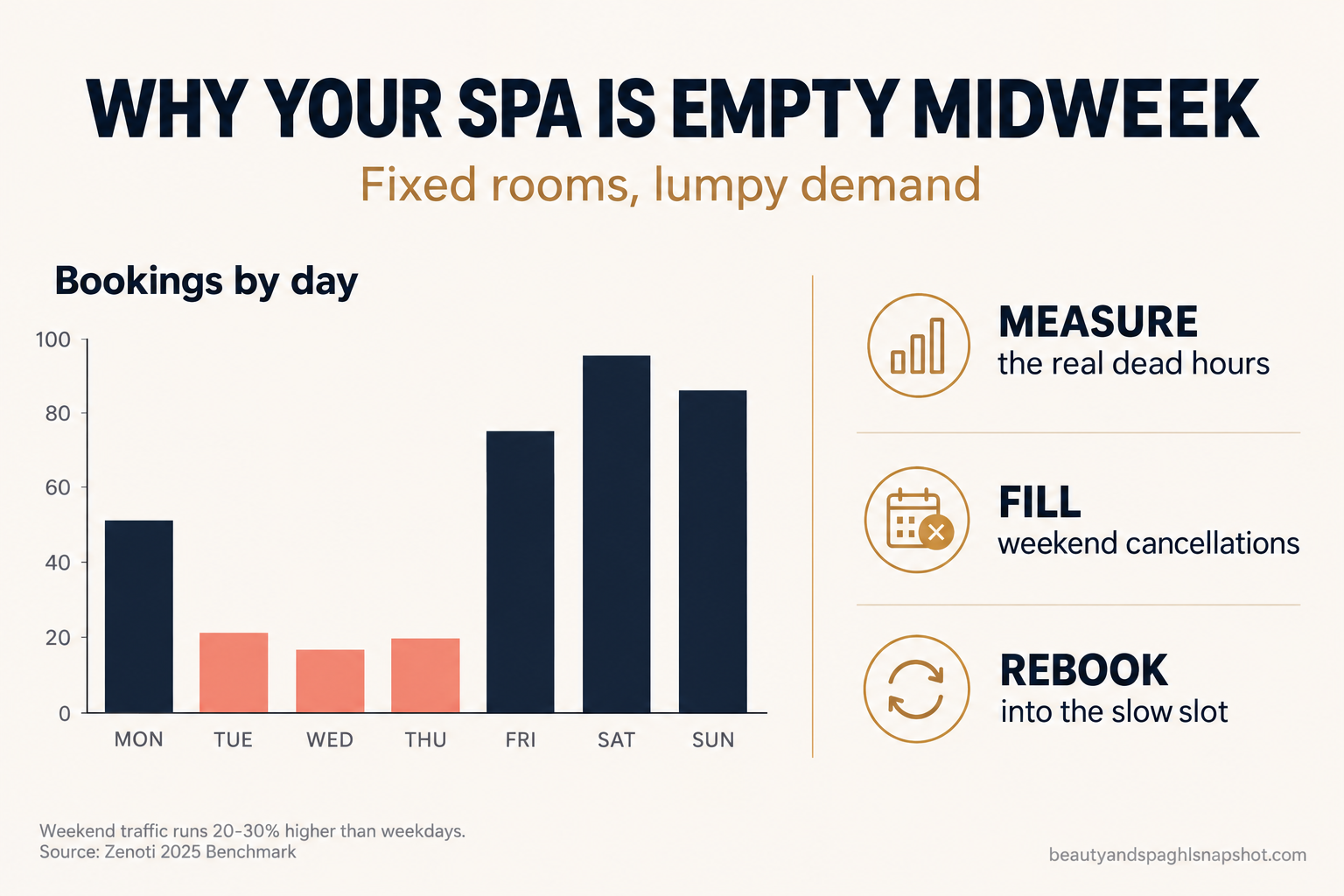
It is 2:15 on a Wednesday. Your Saturday was a wall of back-to-back facials with two people begging for a cancellation slot. Right now one room is running, two are dark, and your best esthetician is folding towels she already folded an hour ago. You still pay rent on the dark rooms and still pay her to stand there. And you cannot sell 2:15 on Wednesday ever again once it passes.
That is the whole problem in one sentence: a spa’s supply is fixed and its demand is lumpy. Everyone wants Friday at 5 and Saturday morning. Almost nobody wakes up thinking “I’ll book a Tuesday.” So the week splits into two businesses: one oversold, the other bleeding money quietly.
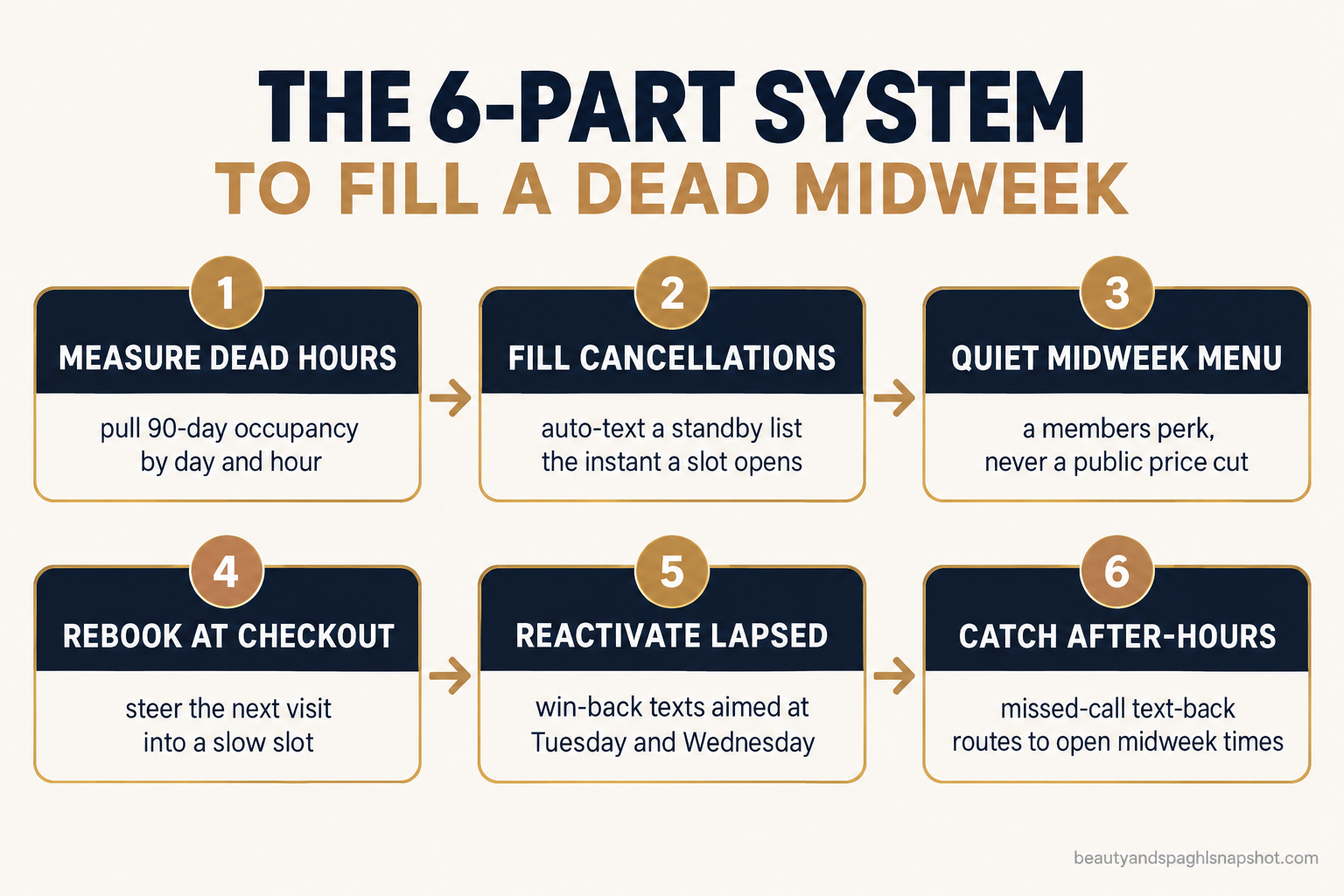
The good news: midweek is not a demand problem you are stuck with. It is a scheduling and follow-up problem, and it responds fast. This is the system, six parts, with the exact texts and scripts you can use this week.
Table of contents
- What an empty midweek chair actually costs
- Why the middle of the week goes dead
- Part 1: Measure your real dead hours before you fix anything
- Part 2: Turn every weekend cancellation into a midweek fill
- Part 3: Build a quiet midweek menu, not a fire sale
- Part 4: Rebook the next visit into a slow slot before she leaves
- Part 5: Aim your reactivation texts straight at Tuesday
- Part 6: Stop losing the after-hours inquiry
- Run the system for your size: solo, team, multi-location
- The legal fine print on texts and promos
- Objections I hear every week
- Frequently asked questions
Key takeaways
What an empty midweek chair actually costs
Say you have four treatment rooms open nine hours a day, five days a week: 180 room-hours a week. If Friday and the weekend run full but Tuesday through Thursday sit at 45%, you are giving away a big slice of the week. At a modest $110 average service, twenty unsold midweek hours is over $2,000 a week walking out. Across a year that is six figures, none of it a marketing spend. It is capacity you already paid for.
Sources: no-show, cancellation and weekday-vs-weekend benchmarks, Zenoti 2025 Benchmark Report; SMS open rate, Sender.
And it bleeds twice: a commission stylist earns nothing on a dead Tuesday, and a client who keeps getting turned away for a Saturday slot eventually books wherever has an opening.
Why the middle of the week goes dead
Clients book around their week, not yours. A spa visit is a reward tied to the weekend, so the Zenoti 2025 benchmark and everyday booking data both show weekend demand well ahead of Tuesday and Wednesday for salons and day spas.
Not every spa is the same. Med spa data runs the other way: Mangomint found that for med spas, more than 40% of appointments land between Tuesday and Wednesday, because clients want redness or swelling to settle before the weekend. Massage swings the other way, with nearly half of appointments falling Friday through Sunday. If you run a mixed shop, your dead window is a specific set of hours in a specific service line, not the whole midweek.
Nobody is steering demand. Most spas take whatever walks in and never nudge anyone toward the open slot, so the calendar fills in the shape clients prefer. Steering that shape is the whole game, and it is almost all follow-up.
Part 1: Measure your real dead hours before you fix anything
You cannot fix “Tuesdays feel slow.” You can fix “Tuesday and Wednesday from 10am to 3pm run under 40% while Friday after 3 is oversold.” Pull the last 90 days from your booking software and look at occupancy by day and hour, split by service and provider. You are hunting for the dead windows, the services that never sell midweek, and the providers with lopsided books.
How it breaks: owners guess instead of pulling the numbers, and guesses are usually wrong. Plenty of shops “know” Tuesday is dead when the real hole is Wednesday lunch. Fix the wrong window and nothing moves. Get it onto one page: your three worst day-and-hour windows, the two services that stall midweek, and the provider with the emptiest book. Every move below points at that page.
Part 2: Turn every weekend cancellation into a midweek fill
This is the highest-return move, and no discount. When a Saturday slot cancels, you have a hot opening and a list of people who wanted exactly that, but the front desk finds out at 4pm and phones down the list by hand while the slot dies. Automate it, in two pieces:
- A standby list. When someone wants a full weekend time you do not have, they opt into a waitlist instead of leaving. The moment a matching slot opens, everyone on the list gets a text and the first to tap takes it.
- A demand shifter. For flexible clients, offer the open midweek slot the instant they book, before they lock a weekend.
The text that does the work:
Hi [First name], a [service] spot just opened at [Studio]
this Saturday 11:00. First to grab it keeps it: [booking
link]. Reply STOP to opt out.
Same idea, aimed at flexible clients to pull them into the quiet window:
Hi [First name], a Wednesday 1:00 opened with [provider]
for your [service]. Midweek runs calmer and you get her
full attention. Want it? [booking link]
How it breaks: the same three regulars get blasted every week until they mute you. Cap how often any one client gets a standby text (once a week is plenty), and let people set which days and services they want.
Part 3: Build a quiet midweek menu, not a fire sale
Discounts are where good spas hurt themselves. Slap “20% OFF TUESDAYS” on Instagram and you teach your Saturday clients to move to Tuesday for the deal. You did not add demand; you just discounted it.
Do it quietly instead. Build a small midweek menu that lives with your front desk and regulars, not on a public banner:
- A midweek-only express service (an express facial, a brow-and-lash combo) at a fair price, not a slashed one.
- A same-price value swap: a small add-on (a hand treatment, a scalp massage) only on slow days, so perceived value rises and your rate does not.
- A members-only midweek perk. Members already pay monthly, so a Tuesday bonus costs you nothing and pulls exactly the clients you want more of. No membership yet? It is worth building on its own.
How it breaks: the offer leaks into a permanent public discount and cannibalizes your weekend. Keep it discreet and never advertise a standing midweek price cut to your whole list.
Part 4: Rebook the next visit into a slow slot before she leaves
The cheapest way to fill next Tuesday is to book it while the client is at your desk today. Most spas do not, and the gap shows: top-earning salons rebook about 30% of clients within 24 hours of a visit, while the industry average sits near 10%, per the Zenoti benchmark. A three-fold gap in the easiest booking you will ever get.
Share of clients rebooked within 24 hours of a visit. Source: Zenoti 2025 Benchmark Report.
The habit is a front-desk script that steers the next appointment into your dead window, offering the slow slot first as the good slot, not the leftover:
“You are due back in four weeks. Thursday mornings are our calmest, so you get [provider] with no rush. Want me to hold Thursday the 12th at 10?”
For clients who leave without booking, an automatic text next morning closes the loop:
Hi [First name], loved having you in yesterday. Most
clients rebook in [4-6] weeks, and our midweek mornings
are the calmest: [booking link]. Reply STOP to opt out.
How it breaks: the front desk offers the next open slot, which is a Saturday, and hands your scarcest inventory away while Tuesday stays empty. Train the team to lead with the slow window every time. If they can only book Saturday, take a deposit so it does not become a no-show, using the language in our no-show playbook.
Part 5: Aim your reactivation texts straight at Tuesday
You are sitting on a goldmine of clients who came once and drifted. The retention math is brutal: the Zenoti benchmark found the 42% of clients who visit more than once a year generate around 80% of revenue, while the 58% who come once contribute just 20%. Winning one back is cheaper than a new client, and you pick the day.
Aim the win-back at your dead window with a short two-text sequence, a few days apart, offering a midweek slot:
Text 1: Hi [First name], it's [Studio]. It has been a
while since your last [service] and we would love to have
you back. We saved you a calmer midweek spot this month,
your pick of Tuesday or Wednesday: [booking link]. Reply STOP to opt out.
Text 2 (4 days later, if no booking): Still holding a
midweek slot for you, [First name]. Want it before it
goes? [booking link]Send these in batches sized to the holes from Part 1. If Wednesday lunch is your worst window, pull the lapsed clients who used to book middays and offer exactly that. For the deeper playbook on writing win-backs that do not sound like a robot, see our guide on reactivating lapsed spa clients.
How it breaks: you blast the entire lapsed list one Monday, fill Wednesday, and have nothing left for the next slow week. Drip it. Reactivate a slice each week aimed at that week’s hole.
Part 6: Stop losing the after-hours inquiry
Here is the quiet reason Tuesday is empty: the person who would have filled it messaged you Sunday night, got no reply until Monday afternoon, and booked elsewhere. Your midweek hole was created over the weekend, when no one was at the desk.
Two automations plug the leak while you sleep:
- Missed-call text-back. When a call goes unanswered, an instant text fires with a booking link, turning it into a booking instead of a voicemail nobody checks. We break the whole flow down in missed-call text-back for spas.
- After-hours web and DM auto-reply. An inquiry from your site or Instagram after close gets an immediate answer and a link, steered at your open midweek times.
The after-hours reply, steering to the quiet window:
Thanks for reaching out to [Studio]! We are closed right
now but I can get you booked. We have great midweek
openings this week with shorter waits, so here is the
calendar: [booking link]. Reply here with any questions.
Speed is why the channel matters: SMS runs around a 98% open rate, most messages read within three minutes, while an email autoresponder sits unopened in a promo folder.
Average open rate by channel. Source: Sender (email reflects the common ~20% industry average).
How it breaks: the auto-reply feels like a wall of canned text and the client bounces. Keep it to two short sentences, sign it like a person, and make the next tap a real booking link, not a long form.
Run the system for your size: solo, team, multi-location
The six parts are the same; how hard you lean on each depends on your shop.
Solo operator or 1 to 2 chairs. You are the front desk, provider, and marketer, so do not run all six by hand. Your two highest-return moves are the checkout rebook (Part 4) and the after-hours capture (Part 6), since you cannot answer a Sunday text mid-facial. Keep the menu tiny and skip the waitlist until you have volume to feed it.
Mid-size team, 3 to 8 providers. The problem is coordination: different providers have different dead windows and the front desk cannot track it all. This is where the waitlist auto-fill (Part 2) and batched reactivation (Part 5) earn their keep, routing the right client to the right provider’s slot automatically. Add a light staff incentive to rebook into slow windows so the habit sticks.
Multi-location chain. Your lever is demand across locations, not just days. A client turned away downtown on Saturday can be offered a midweek slot at the quieter suburban location. Standardize the scripts, watch occupancy by location on one dashboard, and lean on membership: a member who can visit any location midweek is your most reliable filler of dead rooms.
The legal fine print on texts and promos
Everything above leans on texting clients, so get the basics right.
Texting rules (TCPA). You need clear consent before marketing texts, and every promotional message must offer a real opt-out, which is why the STOP line is in the templates above. Honor STOP immediately and text during reasonable hours. The FCC’s guidance on unwanted texts is the starting point, and our spa SMS marketing guide has the consent language.
Honest offers (FTC). If you promote a midweek deal, keep the offer real and the terms clear. The FTC’s 2024 rule bans fake reviews, and review-gating (only asking happy clients to post) is a violation, so never tie a midweek perk to a five-star review. The FTC’s business guidance covers it.
A note for med spas. A pure day spa doing facials, waxing, massage and nails is generally not a HIPAA-covered entity: no protected health information, no insurance billing. Once licensed medical providers do medical procedures, the posture changes. Keep intake forms, photos and consult notes out of unsecured SMS and email, and keep midweek texts to scheduling and generic service names, never medical detail. Our spa marketing compliance guide covers where that line sits.
Objections I hear every week
“Won’t a midweek discount cheapen my brand?” It will if you make it a public price cut, which is why Part 3 says do not. A quiet perk for members, or a same-price value swap, protects your rate and rewards flexibility, not the discount.
“I already pay for Mindbody or Vagaro. Shouldn’t it do this?” Your booking software holds the calendar and takes payment well, but almost none of it steers demand: firing a standby blast the second a slot opens, dripping reactivation texts at your dead hours, routing the Sunday-night inquiry to midweek. Most owners bolt those on, and the base bill keeps climbing anyway: Mangomint moved every customer to one plan on August 1, 2026 at $120 a month per location plus $10 per user, with texting and a phone line as paid add-ons. Paying more for the calendar does not fill the empty room.
“Won’t clients find the automated texts annoying?” Only if they are frequent, generic, and impossible to stop. A relevant text with a one-tap opt-out reads as helpful. Cap frequency, personalize, honor STOP, and complaints stay near zero.
“I run a med spa and I’m actually busy midweek.” Then your dead window is elsewhere, probably Friday afternoon or Monday, and the fix is identical: point Parts 1, 2 and 5 at the real hole. The system does not care which day is slow, only that you found it.
Frequently asked questions
What days are actually slowest for a spa?
For most day spas and hair salons, Tuesday through Thursday are slowest and the weekend carries the week. Med spas often run the opposite way, and massage skews to the weekend, so pull your own 90-day occupancy report by day and hour first: the real dead window is usually narrower than owners assume.
How do I fill midweek without discounting my prices?
The best moves are not discounts: rebook the next visit into a slow slot at checkout, auto-fill weekend cancellations from a standby list, and drip reactivation texts at your dead hours. If you add a midweek offer, make it a quiet members perk or a same-price value swap, never a public price cut that pulls full-price weekend demand into a discount.
Why is texting better than email for filling last-minute slots?
Speed and open rate. SMS averages around a 98% open rate with most messages read within three minutes, while email hovers near 20%. A last-minute midweek slot has to reach the client while she is still deciding, so a text almost always wins.
Isn't my booking software supposed to do all this?
Booking software holds the calendar and takes payment well, but most of it does not steer demand: it will not fire a standby blast the instant a slot opens, drip reactivation texts, or catch an after-hours inquiry. Those automations are usually bolted on, and that gap leaves the midweek chair empty.
How often should I text clients about open slots?
Cap it. Once a week per client is plenty, and let clients choose which days and services they want so the message reads as useful, not spammy. Always include a clear opt-out, honor STOP immediately, and text within reasonable hours to stay on the right side of TCPA rules.
The takeaway
Your empty Tuesday is not a demand problem you have to accept. It is a scheduling and follow-up problem, and it moves fast once you point the right nudge at the right hole. Measure the real dead hours, catch the weekend cancellations, rebook at checkout into the quiet slots, and aim your win-backs at the slow days. A small quiet midweek perk is then the finishing touch, not a desperate discount.
Back to that Wednesday at 2:15. In a spa running this system, that slot filled Sunday night from the missed-call text-back, or this morning from a standby text when a Saturday client rescheduled. Same rooms, same team, same rent, a full week instead of two.