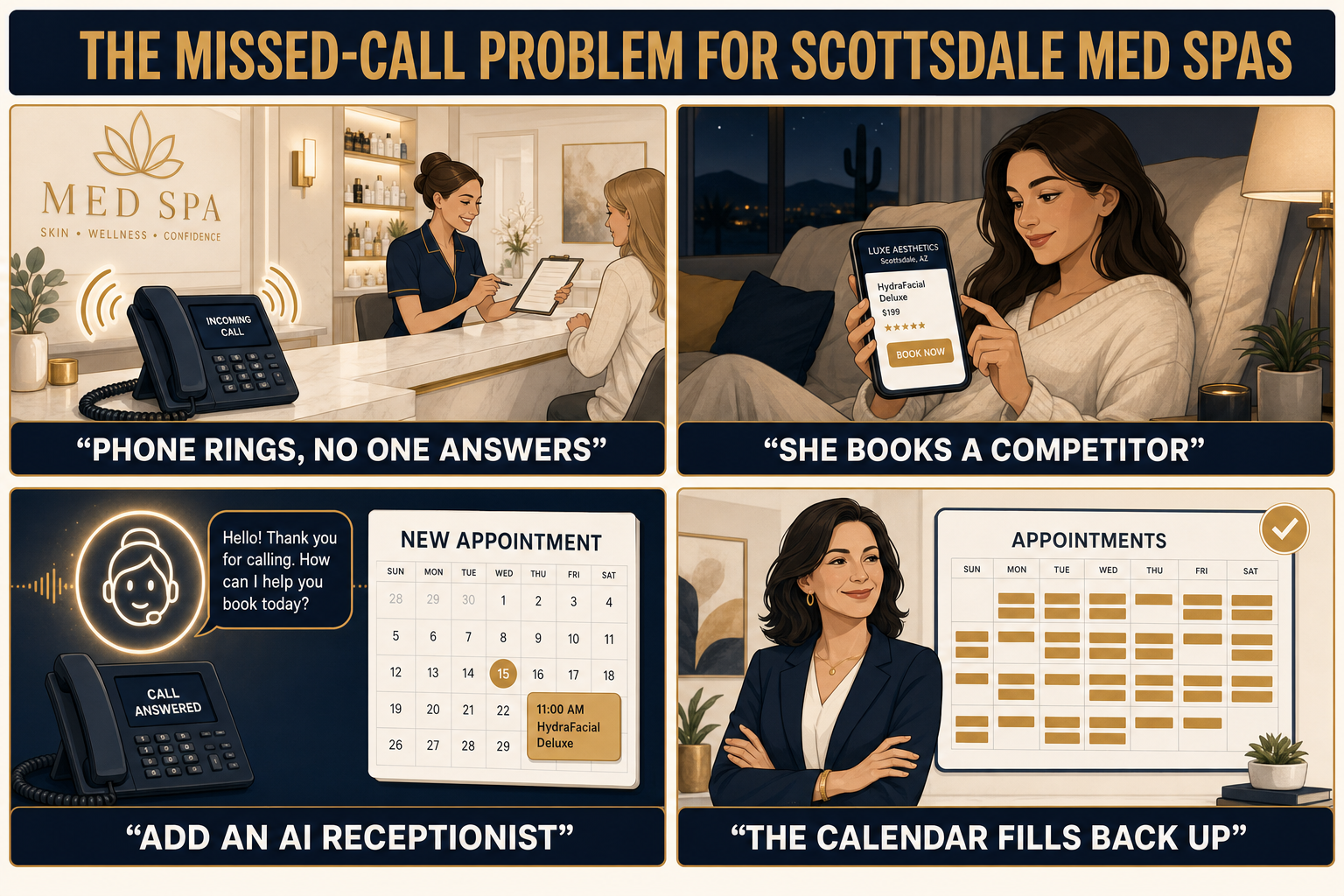
It’s 1:15 on a Tuesday in Old Town Scottsdale. Your injector is mid-treatment, your front-desk coordinator is walking a new client back to a room, and the phone rings. It rings four times and rolls to voicemail. The woman on the other end — she saw your lip-filler special on Instagram, she’s ready to book, and she’s holding a $650 first appointment — doesn’t leave a message. She taps back to Google, calls the med-spa two blocks over, and books there instead. You will never know she called.
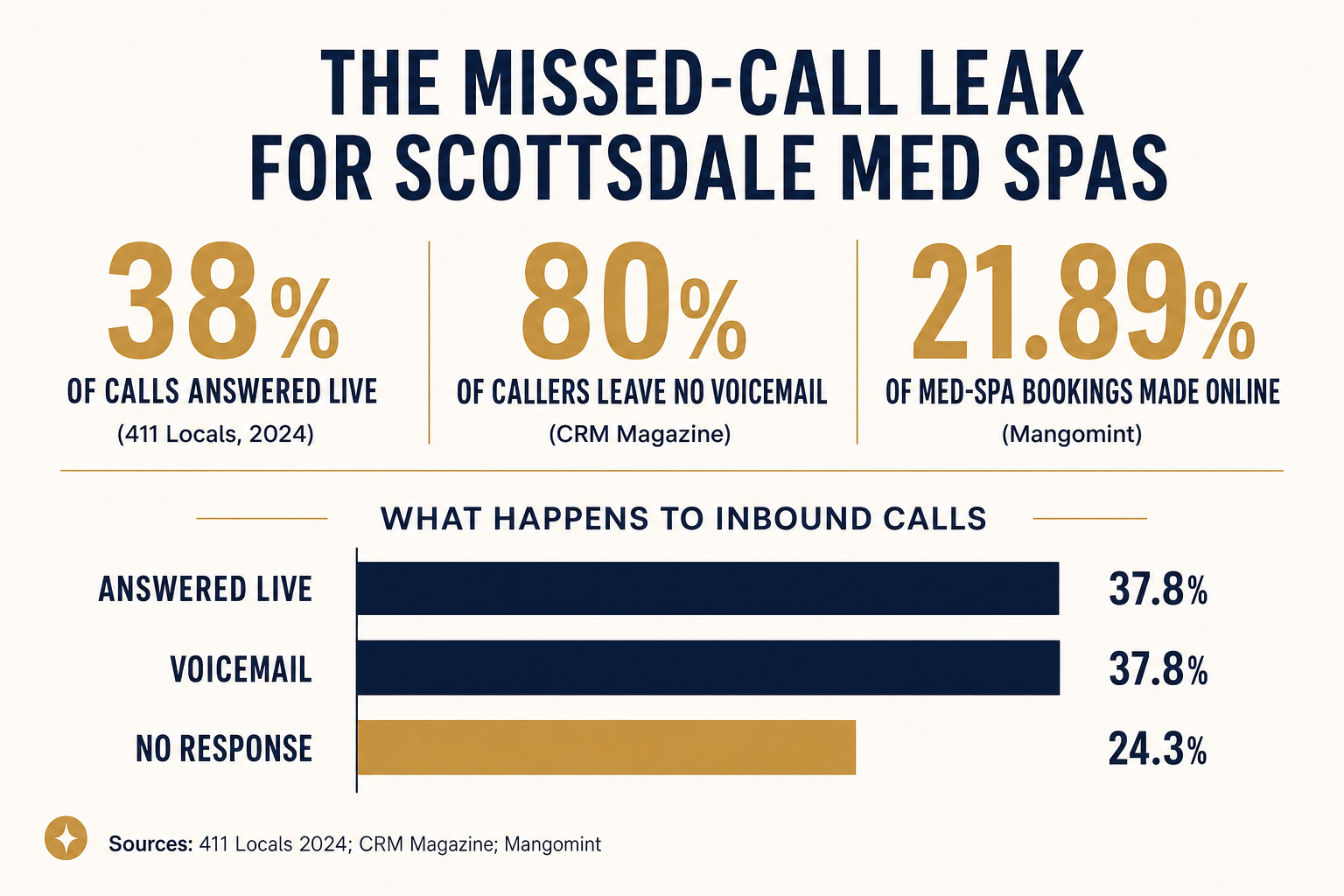
The short answer: the single most expensive leak in a busy Scottsdale med-spa isn’t ad spend or no-shows — it’s the calls nobody answers. Only about 38% of calls to local businesses get answered live; the rest roll to voicemail or get no response at all (411 Locals, 2024), and roughly 80% of callers who reach voicemail never leave a message (CRM Magazine). For a med-spa — where most bookings still start with a phone call (Mangomint) — that’s not a nuisance; it’s lost revenue. An AI receptionist closes the gap: it answers every call in one ring, 24/7, qualifies the caller, and books the appointment straight onto your calendar — so the client who called at 1:15 (or 9:45 at night) becomes a booking instead of a competitor’s.
Table of contents
- Why Scottsdale med-spas lose bookings before the client walks in
- The anatomy of a missed call — and what it costs
- After-hours: the leak most owners never see
- What a missed call really costs your Scottsdale studio
- What an AI receptionist actually does (and doesn’t)
- Manual front desk vs. AI receptionist
- Does your Scottsdale studio need one? A 60-second check
- Frequently asked questions
Why Scottsdale med-spas lose bookings before the client walks in
Scottsdale is one of the most competitive aesthetics markets in the country. Drive down North Scottsdale Road or through the Kierland and Old Town corridors and you’ll pass med-spas, injectable bars, and laser studios within a block of each other. Nationally, the U.S. counted 10,488 med spas in 2023 — up sharply from the prior year — at an average of roughly $1.4 million in revenue per location (AmSpa 2024 State of the Industry), and the U.S. medical-spa market is projected to grow from about $7.1 billion in 2023 to $17.6 billion by 2030, a 13.7% CAGR (Grand View Research). In a metro like Scottsdale, that density means one thing: when a client is ready to book, she has a dozen options, and the studio that answers first usually wins.
Here’s the uncomfortable part. Most owners obsess over the top of the funnel — Instagram Reels, Google Ads, the lip-filler promo — and pour money into making the phone ring. Then the phone rings and no one picks up. The ad worked. The booking didn’t. Only about 38% of calls to small businesses are answered live; the rest hit voicemail or nothing at all (411 Locals, 2024). And med-spa clients still reach for the phone — only 21.89% of appointments are booked online, even though roughly 70% say they’d prefer to (Mangomint, ~20,000 appointments). The problem was never demand; it was the ten seconds between the ring and the pickup.
A booking app was never designed to answer the phone. Neither was a front desk that’s already booked solid running treatments, checking clients in, and processing payments. The calls fall through the cracks — and in Scottsdale, the cracks are expensive.
The anatomy of a missed call — and what it costs
Walk through what actually happens when a call comes in during a busy afternoon:
- The phone rings. Your coordinator is with a client, so it rings out.
- It rolls to voicemail. About 80% of callers sent to voicemail leave no message — they don’t believe anyone will hear it, and 95% would rather text than sit through a beep (CRM Magazine).
- The caller taps back to search. She was in booking mode; she calls the next result.
- A competitor answers. They book the appointment you paid an ad to generate.
Every step in that chain is measurable, and the numbers are brutal. Start with this: only about 38% of small-business calls are answered live (411 Locals, 2024), and for med-spas the phone still drives bookings — only 21.89% of appointments are made online (Mangomint). Miss the call, and you usually miss the booking.
The point isn’t that your team is bad at their jobs — it’s that answering every call and delivering five-star treatments at the same time is physically impossible for a human front desk. Something has to give, and it’s almost always the phone.
After-hours: the leak most owners never see
The missed calls during business hours are the ones you at least sense are happening. The bigger, quieter leak is after-hours — because when your studio is dark, you don’t even see the voicemails pile up.
Think about when your ideal client actually decides to book. She’s not scrolling Instagram at 11 a.m. when she’s at work; she’s doing it at 9:45 p.m. on the couch, or during a lunch break, or on a Sunday. And because most med-spa bookings still happen by phone rather than a web form — only 21.89% are made online (Mangomint) — that late-night decision runs straight into your voicemail. That’s exactly when your front desk is closed. And the speed-to-lead research is unambiguous: contacting a new lead within five minutes makes a business dramatically more likely to qualify them than waiting even 30 minutes, yet the average first response to an inbound lead runs into the hours — and a meaningful share of businesses never respond at all (Harvard Business Review, The Short Life of Online Sales Leads).
This is why “we’ll call them back in the morning” quietly costs so much. By morning, the client who wanted a Saturday appointment has already booked one — somewhere that answered at 9:45 p.m. A related problem is speed to lead: the first studio to respond usually wins, and after hours, “first” means “automated.”
What a missed call really costs your Scottsdale studio
Let’s put a dollar figure on it, using conservative, illustrative math you can redo with your own numbers.
Say your average new-client first appointment is worth $300 (a mid-range injectable or laser session — many Scottsdale first appointments run well above this). Say you miss just five booking-intent calls a week — a low estimate for a studio running ads. That’s $1,500 a week in first-appointment revenue walking out the door, or roughly $78,000 a year — and that’s before you count the lifetime value of every client you never got to rebook. Given that a loyal spa client’s lifetime value can run into the thousands, the true cost of a chronically unanswered phone is far larger than the appointment itself.
What an AI receptionist actually does (and doesn’t)
An AI receptionist is a voice-and-text agent that picks up the phone, talks like a warm front-desk coordinator, and books appointments into your calendar — 24/7, on the first ring, with no hold music and no voicemail. It’s the fix for that telling gap in how clients behave: they say they’d prefer to book online, but they still overwhelmingly pick up the phone — so the phone has to be answered, every single time.
Here’s the path a call takes:
What it does well:
- Answers every call, instantly, around the clock — including the 9:45 p.m. and Sunday calls your front desk can’t.
- Qualifies and books — knows your service menu, durations, hours, parking, and pulls live availability from your calendar.
- Confirms by SMS and handles routine reschedules and cancellations.
- Deflects common questions (“Are you open Saturday?” “Where do I park in Old Town?”) so your team isn’t interrupted.
What it should not do — and where a good setup routes to a human:
- High-ticket first consults (think $3,000+ body contouring) where a nervous first-time client wants a real voice.
- Complaints that need empathy and resolution authority.
- VIP and long-time members, who should be recognized by number and routed straight to your team.
That balance — AI for the high-volume, high-tolerance calls, humans for the sensitive ones — is the difference between an upgrade and a liability. We wrote a frank breakdown of when an AI receptionist helps a spa and when it hurts if you want the nuance.
Manual front desk vs. AI receptionist
To be clear: an AI receptionist doesn’t replace your front desk. It replaces your voicemail — the calls your team was never going to reach anyway. Here’s the honest comparison for a busy Scottsdale studio.
| Front desk alone | AI receptionist + front desk | |
|---|---|---|
| Hours covered | Open hours only | 24/7, including nights & weekends |
| When the team is busy | Rings out to voicemail | Answers in parallel — every call |
| Voicemail | Most callers hang up | No voicemail — books on the call |
| After-hours bookings | Lost until morning | Captured live |
| Warmth & judgment | High — a real person | Routine handled; humans get routed the sensitive calls |
| Best for | Consults, VIPs, complaints | Booking, hours, reschedules |
The winning setup isn’t AI or your team — it’s AI catching everything your team physically can’t, so your coordinators spend their energy on the clients in front of them and the calls that genuinely need a human.
Does your Scottsdale studio need one? A 60-second check
You probably need an AI receptionist if two or more of these are true:
- You run Instagram or Google Ads and can’t prove every resulting call gets answered.
- Your front desk is regularly mid-treatment or checking clients in when the phone rings.
- You get booking-intent calls and DMs after you close (evenings, Sundays, holidays).
- You’ve ever discovered a voicemail from a would-be new client hours or days late.
- You’re competing on a crowded Scottsdale block where the client will just call the next studio.
If that’s you, the fix isn’t “hire another receptionist to sit by the phone at 10 p.m.” — it’s an always-on system that answers, books, and hands off. It’s the same AI receptionist built into the full Beauty & Spa Snapshot, installed for you and tuned to your studio. If you’d like to see it answer a live call and book a test appointment, book a walkthrough or compare what’s included.
Frequently asked questions
Will clients know they're talking to an AI receptionist?
Modern voice AI sounds like a warm, natural front-desk coordinator — tuned pacing, natural pauses, and your studio's tone. For routine bookings and questions most callers don't clock it, and the ones who do are typically fine with it because the call was fast and got them booked. The rule we follow: AI handles high-volume routine calls (booking, hours, reschedules); a human handles first consults, complaints, and VIPs. See our honest breakdown of when AI helps a spa and when it hurts.
How is this different from a missed-call text-back?
A missed-call text-back fires an automatic SMS after a call is missed — a good safety net. An AI receptionist prevents the miss entirely: it answers the call live, in one ring, and books the appointment on the spot. The strongest setup uses both, so nothing slips through day or night.
Can it book straight into my existing calendar?
Yes. The AI receptionist connects to your booking calendar, pulls live availability by service and duration, books the appointment, and sends an SMS confirmation — the same calendar your front desk already uses, so there's no double-booking.
Is automated calling and texting TCPA-compliant?
It can and should be. Our setup follows TCPA best practice — consent captured on opt-in, clear identification, and STOP-to-cancel honored on any SMS follow-up. We never send unsolicited marketing blasts; the receptionist responds to inbound callers and confirms appointments they asked for.
What happens with a complaint or a nervous first-time consult?
Those get routed to a human. A good configuration recognizes complaint language and high-ticket first-consult intent (and known VIP numbers) and hands the call to your team or takes a callback within minutes. AI is for the routine, high-volume calls; your people are for the sensitive ones.
How fast can a Scottsdale med-spa get this running?
It's a done-for-you install, not a build project. We connect your calendar and phone, load your services, hours, pricing ranges, and FAQ (parking in Old Town, licensing, prep instructions), tune the voice to your brand, and set the human-handoff rules. Most studios are answering calls with it within days — book a walkthrough to see it live.
About the author. Camila Reyna is a Spa Automation Strategist based in Scottsdale, Arizona. She spent nine years running the front desk and then the marketing for a three-location med-spa group before moving full-time into GoHighLevel build-outs, and she’s obsessed with the moment a first-time facial client becomes a member. Her rule: if an automation doesn’t fill a treatment room, it doesn’t ship.