
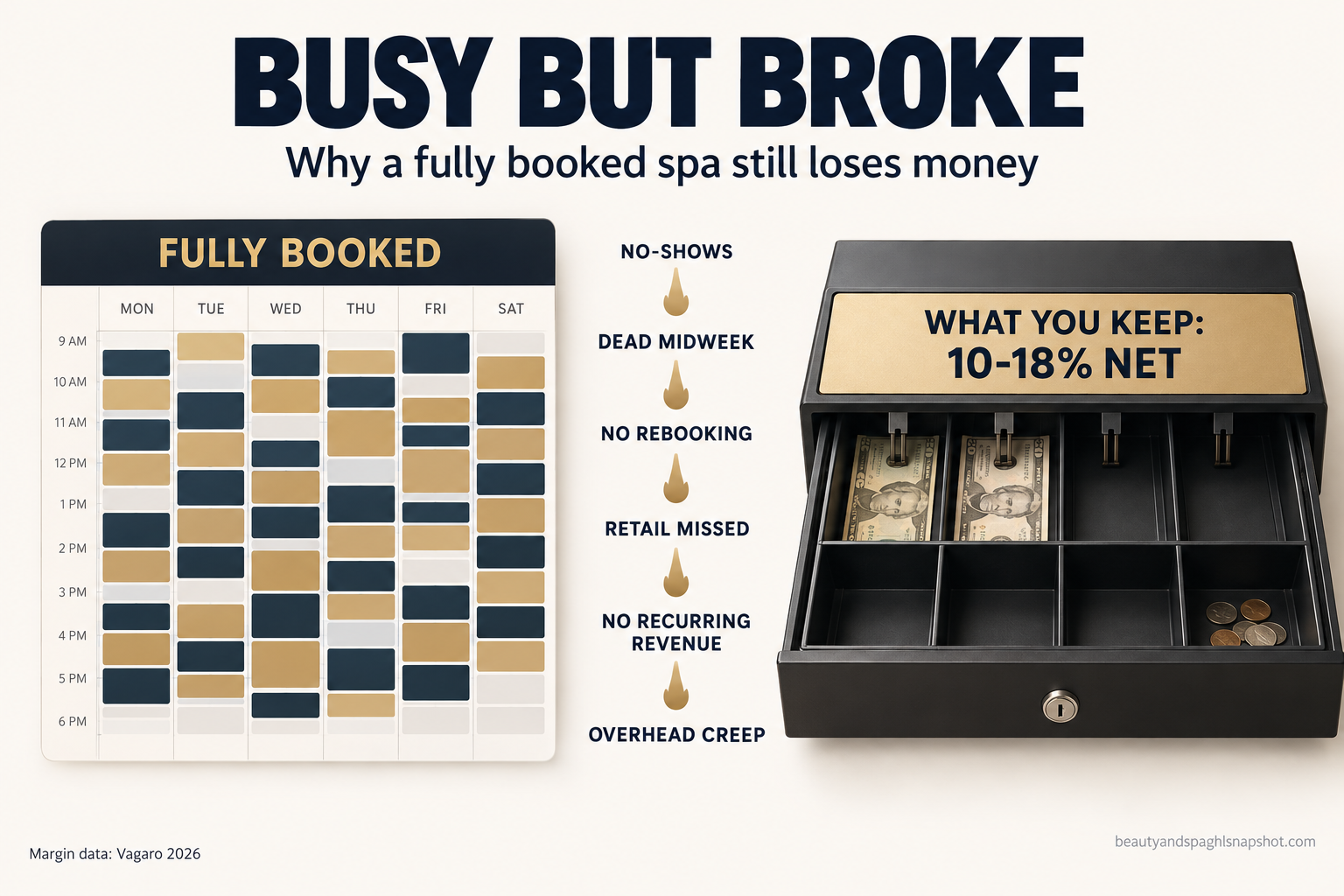
It is the end of a packed Saturday. Every room ran all day, the front desk never sat down, and your providers are wiped. You pull up the numbers, and the deposit is smaller than it has any right to be. You were fully booked. So where did the money go?
Here is the short answer. A full book and a healthy bank account are two different things, and the gap between them is rarely about getting more clients in the door. It is about what leaks out after they arrive. A spa that keeps 10% of revenue and one that keeps 18% can look identical on the calendar. The difference is six quiet leaks most owners never measure. This is the field guide to all six.
On this page
- Why “busy” and “profitable” are not the same thing
- The six leaks draining your margin
- Plug the leaks for your size shop
- One legal note before you change prices or ask for reviews
- The objections you are already thinking
- FAQ
Why “busy” and “profitable” are not the same thing
Start with where the money actually goes. For a typical day spa running two to five treatment rooms, staff labor eats 40% to 55% of revenue once you count wages, commissions, payroll taxes, and benefits, per Vagaro’s 2026 breakdown of spa profit margins. Rent and occupancy take another 8% to 15%. Back bar products run 5% to 8%, marketing 3% to 8%, software and processing 2% to 5%, and supplies, laundry, and utilities another 3% to 6%.
Add that up and the typical day spa takes home a net margin of 10% to 18%. A well-run one lands at 15% to 22%. Below 8% is not a slow month, it is a structural problem.
Where one hundred dollars of day-spa revenue tends to go, using the midpoints of the cost ranges Vagaro reports for a two-to-five-room spa. Labor is the giant, which is why wasted chair time hurts.
Look at that labor number again. You pay for the provider and the room whether the chair is full or empty, full price or discounted, with a client who rebooks or one who vanishes. When labor is half your costs, every leak below is really the same one wearing a different hat: you paid for the capacity and did not turn it into banked revenue.
The six leaks draining your margin
None of these are exotic, just boring enough that no single instance feels big enough to chase. A no-show here, an unsold product there, a client who drifts off after one visit, and across a year it is the difference between a spa that funds your life and one that just keeps you running.
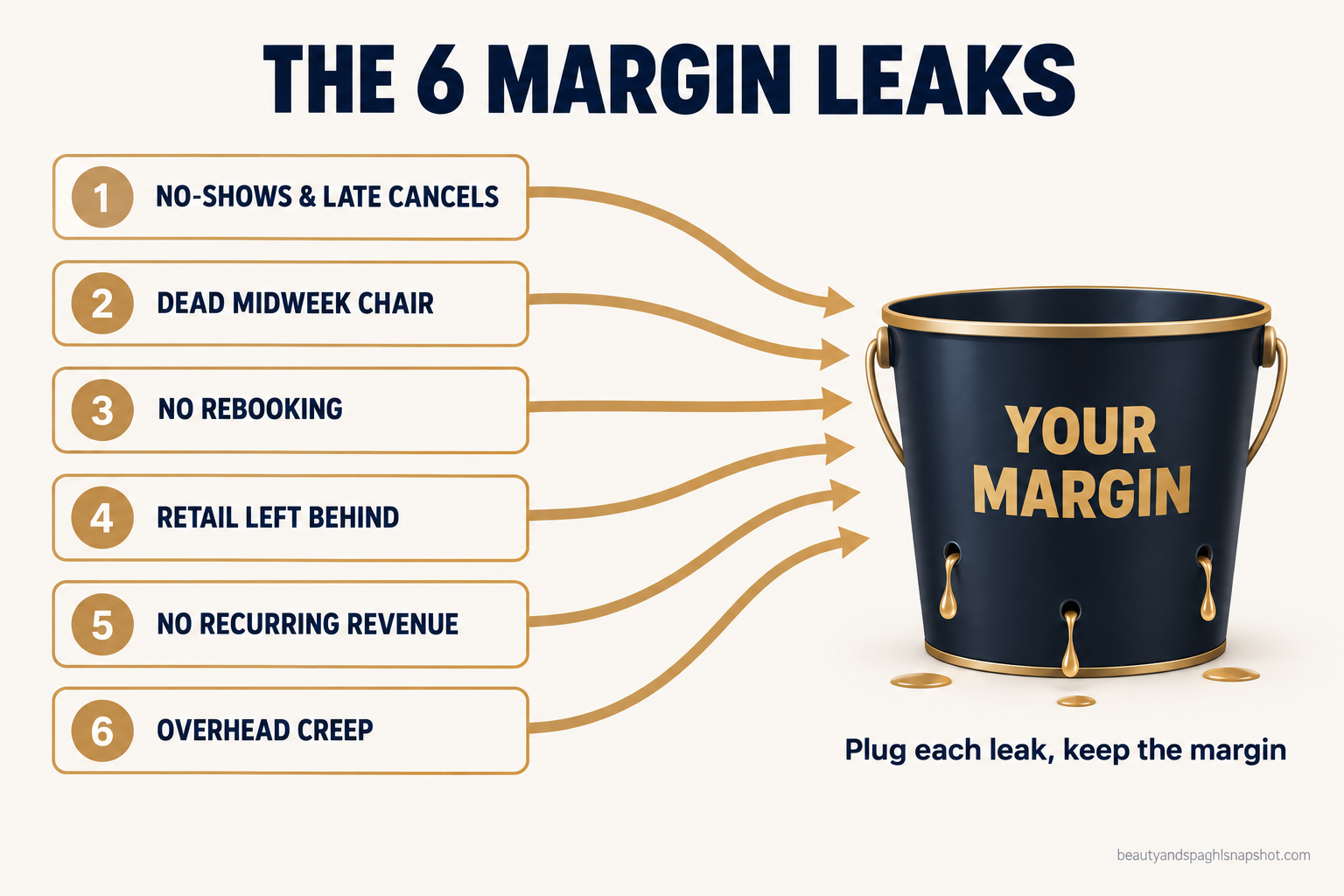
Here is the whole set, then one at a time.
| Leak | What it quietly costs | The plug |
|---|---|---|
| No-shows and late cancels | ~$30k/yr at a 5% rate on $600k | Deposits, reminders, a worked waitlist |
| Dead midweek chair | Full labor cost, zero revenue | Off-peak offers to existing clients |
| Clients who never rebook | Half your new clients, gone | Rebook in the room, then automate |
| Retail you never sell | 6-16% of revenue, uncaptured | A recommendation built into checkout |
| No recurring revenue | Flat, unpredictable cash | Memberships and prepaid packages |
| Overhead creep | 2-5% and climbing | A yearly audit of the software stack |
Leak 1: No-shows and late cancels
A no-show is the purest form of this problem. You staffed the room, turned away other bookings for that slot, and banked nothing. Vagaro’s math is blunt: a 5% no-show rate on $600,000 of revenue is about $30,000 gone a year, before the late cancels you cannot refill.
It is also the most fixable. Zenoti’s 2026 Beauty and Wellness Benchmark Report puts no-show rates near 2% for salons and 4% for medical spas, and the spas at the low end are not lucky, they are systematic. Three things do almost all the work: a deposit or card on file to book, a reminder sequence that confirms, and a waitlist you work the moment a cancel lands.
How it breaks: you ask for the deposit by hand, for some clients and not others. It has to be built into booking so every client hits the same rule and nobody has to be the villain who asks. We laid out the structure in our spa no-show deposit policy; it only works when the system collects it automatically.
Leak 2: The dead midweek chair
Saturday is jammed and Tuesday through Thursday has holes you could park a car in. Every hole is full labor cost with zero revenue against it, because your providers are on the clock either way. A spa that is packed on weekends and half empty midweek is not fully booked, it is lumpy, and the lumps are expensive.
The fix is not a public discount that trains everyone to wait for the slow-day deal. It is a quiet offer aimed at people who already love you: a members-only midweek window, a “we had a cancellation, want it” text to your waitlist, a small add-on for a Tuesday. You are not dropping your price, you are moving demand you already have into hours you already pay for.
How it breaks: the offer goes to your whole list, including Saturday regulars who would have paid full freight anyway, so you discount your best slots to fill your worst ones. Target the midweek offer at lapsed and flexible clients only.
Leak 3: Clients who never rebook
This is the big one, and it hides in plain sight because the client who does not come back never shows up as a problem, she just quietly does not appear. Across spas and salons, only about half of first-time clients ever return for a second visit, and rebooking at checkout tends to run a weak 30% to 35% (retention benchmarks compiled here). Vagaro notes the same split from the margin side: a spa at a 70% rebooking rate runs far leaner than one stuck at 35%, because it is not constantly buying new clients to replace the drifters.
This leak compounds. A client who rebooks every six to eight weeks is worth many multiples of a one-time visit, which is the point of knowing your client lifetime value. The classic Bain and Company finding reported by Harvard Business Review is that a 5% lift in retention can raise profits 25% to 95%. That is a cross-industry range, but the direction is dead on: keeping clients is where the margin lives.
Out of one hundred happy first visits, how many are still on your calendar, using the 35% and 70% rebooking rates Vagaro uses to contrast a leaky spa with a lean one. Double the number and you roughly double the value of the same front door.
The best moment to rebook is before the client leaves the room, not in a text three weeks later. A provider who books the next visit out loud at checkout beats any automation, which you then back with a system that catches everyone who slips out unbooked. We covered where this leaks in the second-visit drop-off breakdown, and the front-desk rebooking scripts give your team the words.
How it breaks: rebooking depends on one person remembering at a busy checkout. Make it a step the provider cannot skip, and let an automated nudge catch the ones who leave unbooked, plus a reactivation text for anyone who lapses.
Leak 4: The retail you never sell
Retail is the highest-margin line in a spa, and it is the one most owners leave on the shelf. The product a provider already used during a treatment is a near-automatic sale, except nobody asks. Spa benchmarking consultancy Spa Team International puts a healthy retail attach rate for a premium day spa near 10% to 16% of visits ending in a product sale, and flags anything under 10% as money left behind.
The fix is not a pushy upsell. It is a recommendation that is part of the result: the provider names the one or two products that hold the treatment between visits, and the front desk makes buying them frictionless at checkout. You did the hard part during the service already.
How it breaks: retail becomes a monthly guilt trip at a team meeting instead of a repeatable step. Build the recommendation into checkout so the product is right there to add, and track attach rate per provider so you can coach the ones who skip it.
Leak 5: No recurring revenue
If every dollar has to be re-earned from scratch next month, your cash is a roller coaster. Spas without recurring revenue feel the dead midweek and slow season at full force, and that uncertainty pushes owners into the panic discounting that feeds Leak 6.
Memberships and prepaid packages turn irregular visitors into predictable monthly revenue. A membership that bills monthly and includes a service or a credit gives you a floor, smooths the slow weeks, and lifts rebooking as a side effect, because a member has already paid for her next visit. We walked through the full build in how a spa membership program crosses $20k a month.
How it breaks: the membership is priced so generously that your full-price regulars downgrade to it. Price the perks to reward commitment, not to undercut what loyal clients already happily pay, and pitch it to the monthly-ish client, not the weekly devotee.
Leak 6: Overhead creep
The last leak grows while you are not looking. Software, processing fees, and the slow spread of discounting all nibble at the 2% to 5% your tools are supposed to cost.
Software pricing is a moving target right now. In 2026, Mangomint scrapped its three flat tiers and moved to $120 per month per location plus $10 per month per user, which can be cheaper or a lot more depending on your headcount. Add-ons stack on top: texting, a branded app, extra marketing tools, each a small line nobody questions. It is worth reading what spa software actually costs in 2026 with every add-on counted.
Discounting belongs here too, because a standing habit of markdowns is margin erosion dressed up as marketing. We made the full case in why discounting is killing your spa: every reflexive 20% off trains regulars to wait for the next one and gives away margin on bookings you would have gotten anyway.
How it breaks: you audit the software once and never look again while the per-user fees creep back up. Put a yearly reminder on the calendar to re-price your whole stack, and treat any new monthly line as a cost to justify.
Plug the leaks for your size shop
The six leaks are universal, but where you start is not.
The solo operator, one or two chairs. You feel every leak personally and have no volume to hide them, so start where the cash is concentrated: Leak 1 and Leak 3. Get a card on file for every booking and rebook every client in the room before she leaves. One recovered no-show a week and a handful of extra rebookings can be the whole difference between your 10% and your 18%.
The mid-size shop, three to four providers. Your problem is consistency. One provider rebooks and sells retail beautifully, two forget, and the numbers average out to mediocre. Start with Leak 3 and Leak 4 as systems, not pep talks: make rebooking and the retail recommendation steps nobody can skip, and track both per provider. Then add a membership (Leak 5) to put a floor under your cash.
The multi-location or chain owner. Your risk is that a leak becomes policy across every location, with nobody seeing it group-wide. Start with measurement: pull no-show rate, rebooking rate, and retail attach by location and compare. You will usually find one site propping up its numbers with discounts (Leak 6) while another leaks rebookings (Leak 3). Fix the worst leak at the worst location first, then standardize everywhere.
One legal note before you change prices or ask for reviews
Two rules keep a profitability push from backfiring. First, if you advertise a “was $X, now $Y” price to fill a slow day, the former price has to be one you actually charged, not a number inflated to make the deal look bigger. That is the heart of the FTC’s Guides Against Deceptive Pricing. Second, as you lean on reviews to drive retention and local search, never condition a discount or gift on a positive review. The FTC’s rule on fake and suppressed reviews, in effect since October 2024, prohibits buying reviews and review-gating. Ask every client for an honest one.
These are general notes, not legal advice. If you run aggressive promotions or operate as a medical spa, have a local attorney check your language.
The objections you are already thinking
“I just need more clients, not all this.” More clients through a leaky bucket means more water on the floor. If half your new clients never rebook and no-shows bleed $30,000 a year, every new client you buy partly refills a leak you could have plugged for free. Fix the bucket first.
“Deposits will scare my clients away.” A reasonable deposit or card on file filters out the people who were never serious about showing up, which is exactly who you want filtered. The clients who value your time will not blink, and the ones who ghost were costing you a staffed, empty room anyway.
“My team hates selling retail and rebooking feels pushy.” It feels pushy when it is a cold upsell. It does not when it is part of the result: the product that holds the treatment, the next visit that keeps the skin on track. That is service, not a sell.
“Do I need to be technical to run this?” No. Every plug here is a workflow, not a coding project: a booking rule that collects a deposit, a reminder sequence, a rebooking nudge, a retail prompt, a membership that bills on its own. A system runs without you babysitting it, from your phone, between clients.
FAQ
Busy but not profitable: common questions
Why is my spa busy but not making money?
Because a full book and a healthy margin are different things. A typical day spa keeps only 10-18% as net profit, and labor alone eats 40-55% of revenue, so you pay for the room and provider whether the chair turns into banked revenue or not. The money leaks out through no-shows, dead midweek slots, clients who never rebook, uncaptured retail, no recurring revenue, and creeping overhead. Those six leaks, not a lack of clients, are usually why a busy spa stays broke.
What is a healthy profit margin for a day spa?
Vagaro's 2026 figures put a typical day-spa net margin at 10% to 18%, with 15% to 22% considered strong for an established two-to-five-room spa. Below 8% usually points to a structural problem, and the fix is almost always plugging these leaks rather than cutting costs to the bone.
How much do no-shows really cost a spa?
More than most owners think. Vagaro estimates a 5% no-show rate on $600,000 of revenue costs about $30,000 a year, before late cancels you cannot refill in time. Zenoti's 2026 benchmark report puts no-show rates near 2% for salons and 4% for medical spas, and the low end gets there with deposits, confirming reminders, and a worked waitlist.
What is a good rebooking rate for a spa?
Rebooking at checkout commonly runs a weak 30-35%, while a lean, profitable spa aims for around 70%. The biggest lever is rebooking the client in the room before she leaves, backed by an automated nudge for anyone who slips out unbooked and a reactivation message for clients who lapse.
Should I raise prices or cut costs to fix my margin?
Usually neither first. Plug the leaks. Recovering no-shows, lifting your rebooking rate, and capturing retail you already recommend adds margin without raising a price or firing anyone. A small 3-5% annual price increase and a yearly audit of your software stack handle the rest.
What single change moves the needle fastest?
For most spas, rebooking in the room. It is free, it compounds every visit, and it attacks the most expensive leak: the client who comes once and never returns. Make it a checkout step nobody can skip and the deposit grows before you touch anything else.
A busy spa that does not pay you is not a mystery. It is a bucket with six holes, and every one has a known plug. Start with the leak costing you most, make the fix a system instead of a good intention, and the same packed Saturday that used to leave you wondering where the money went starts landing in the deposit where it belongs.