
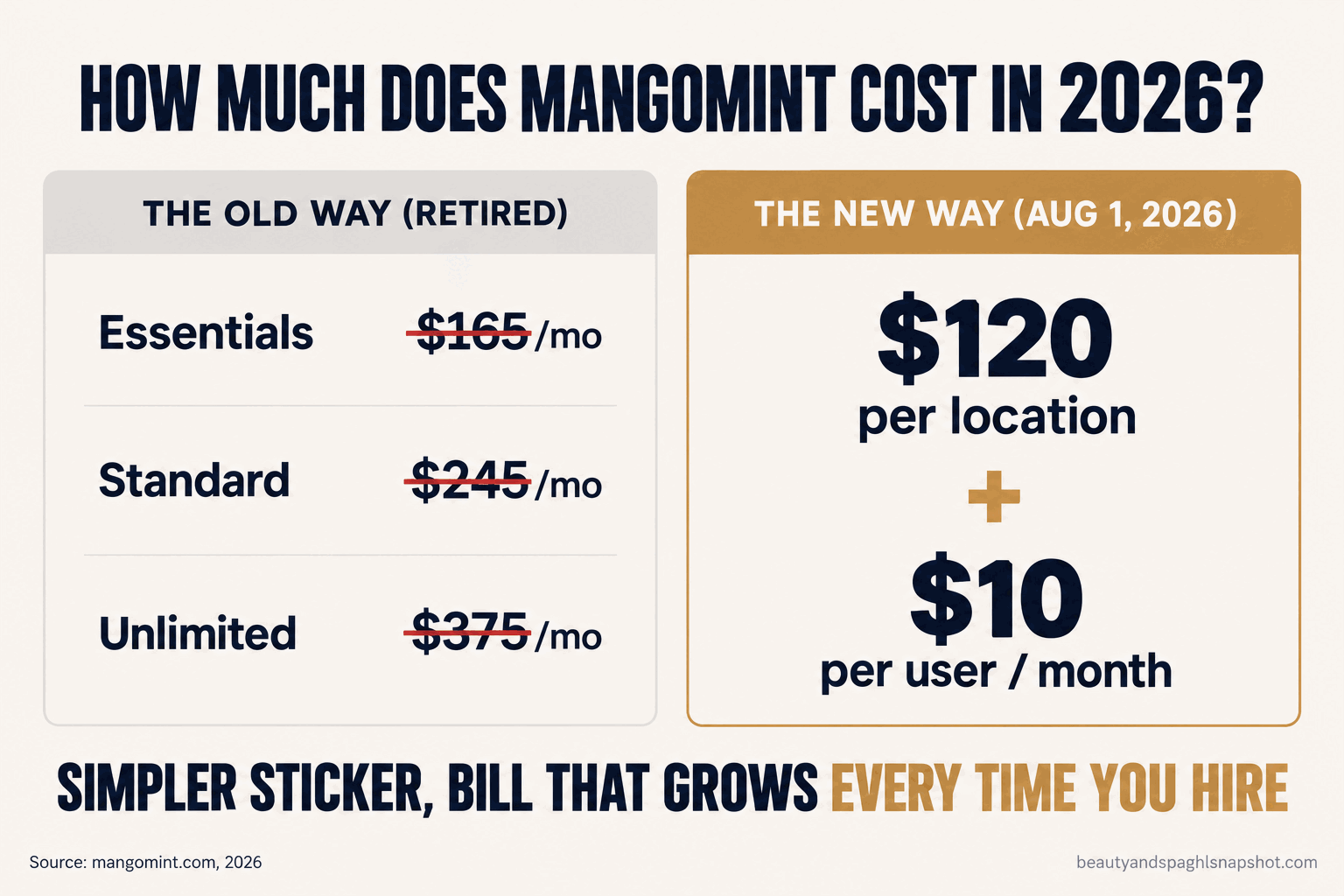
On August 1, 2026, Mangomint did something most software companies never do. It made its pricing simpler. The three old plans were gone, and in their place came one number for everybody: $120 a month per location, plus $10 a month per user (Mangomint). Clean. Honest. Easy to put in a spreadsheet.
Here is the short answer. For a small shop with a couple of people, Mangomint is now cheaper and clearer than it has ever been, and cheaper than Boulevard or a loaded Mindbody plan. But that $10 per user is a line that grows every single time you add a stylist, a booth renter, or a part-time esthetician for the holiday rush. A solo studio pays about $130 a month; a three-location shop with eighteen staff pays $540 before a single text goes out. The sticker got simpler. Whether the bill got cheaper depends entirely on how many heads you put on the schedule.
On this page
- What actually changed on August 1
- The new price, decoded
- The add-ons that are not in the $120
- The per-user trap: who counts as a “user”
- What it costs: solo, one location, multi-location
- Is Mangomint worth it in 2026?
- Cheaper or flatter, by shop size
- Steal this: the per-user cost audit
- Objections, answered straight
- Frequently asked questions
What actually changed on August 1
For years Mangomint sold three plans. Essentials, Standard, and Unlimited, reported in a mid-2026 snapshot at roughly $165, $245, and $375 a month, with the higher tiers unlocking more providers and locations (PricingSaaS). You picked a tier, you outgrew it, you called to move up.
Then Mangomint scrapped all of it. As of August 1, 2026, every customer moved to one structure: $120 per month per location plus $10 per month per user (Mangomint). Trade press confirmed one quietly important detail: existing customers whose bill would go up under the new math keep their current price instead (Salon Today). So the change only ever lowers an existing customer’s bill. That tells you who it is built to win: the small shops who found the old $165 floor too high.
Give Mangomint credit: Mindbody hides its real tiers behind a sales call and Zenoti will not show a price at all, while Mangomint printed the whole formula publicly. The catch is not hidden, just a variable most owners never run the math on: the words “per user.”
The new price, decoded
The formula has two pieces, and they behave very differently as you grow.
The $120 per location feels fair and mostly is. One salon floor, one med-spa storefront: that is one location, $120 a month, flat. It is lower than Boulevard’s entry plan and far below a working Mindbody setup, and a second physical location adds another $120. Easy to predict.
The $10 per user is the part that quietly runs the meter. A user is anyone with a login: every provider, but also your front-desk coordinator, your manager, and depending on setup, your booth renters. Two people is $20. Six is $60. Eighteen is $180, every month, on top of the base. Nobody notices $10. Everybody notices when the line has grown to real money without a single conversation about it.
Mangomint base cost for a single location as headcount grows, 2026: one location ($120) plus $10 per user. Phone, Marketing and card processing are all separate, so the real bill sits above every bar. Source: Mangomint pricing.
One genuinely good footnote: Mangomint runs a free trial with no credit card and no time limit, so you can build your whole account and test it against your real calendar before you pay a cent (Mangomint). Most competitors give you seven or fourteen days.
The add-ons that are not in the $120
The base covers booking, the calendar, and client records. The pieces that turn a calendar into a machine that fills chairs are mostly separate, and this is where a $120 sticker becomes a $250 bill.
Phone is the big one. Mangomint’s two-way texting and calling add-on, formerly Connect, is $70 a month per line, down from $75 (Mangomint). If texting is how you confirm and rebook, and for most spas it is, this is a second base cost, not an option.
Marketing (email and text campaigns) starts at $30 a month and scales with message volume (Mangomint), so budget it as a variable.
Payroll, if you run it through Mangomint, is $50 a month plus $8 per worker (Mangomint). Notice this is a second per-head charge stacked on the $10-per-user charge: the heads get counted twice.
Card processing is its own cost, and Mangomint publishes it: 2.45% plus $0.15 in-person and 2.90% plus $0.30 for virtual, card-not-present payments (Mangomint). On $30,000 a month of mostly in-person volume, processing alone is roughly $750, which dwarfs the software fee and usually moves more money than the subscription.
The per-user trap: who counts as a “user”
This section decides whether Mangomint is cheap for you or slowly expensive. The model turns on one question the pricing page does not answer for your shop: who, exactly, has to be a paid user?
Every provider needs a login, and so do your front desk and managers. A coordinator who books, a manager who pulls reports, an owner who checks numbers from their phone: each is a $10 user. A four-provider spa with a front-desk person and an owner is not four users. It is six.
Booth renters are the real exposure. Your renters pay you for the chair, but they still need to see their own calendar, take their own bookings, and run their own clients. In most setups that means each renter is a login, which means each is $10 a month on your bill. Twelve booth renters is $120 a month in user fees for people who pay you rent. You can sometimes restructure so renters run separate accounts, but then you lose the single front desk and unified booking that made the platform attractive. There is no clean answer, only the math you have to do before you sign.
Two details cut in your favor. Mangomint does not bill for deactivated or archived users, so clearing out seasonal hires when they leave saves money. And a user assigned to more than one location is counted once, which is genuinely fair for multi-location owners.
What it costs: solo, one location, multi-location
Averages are useless here, because the per-user model means the same platform costs wildly different amounts depending on your shape. Run it three ways.
The solo operator, one chair. You, one login, one location: $120 plus $10, so $130 a month, plus a phone line at $70 if you want texting, call it $200 all in before processing. Honest take: more than you need as a true solo. GlossGenius at $24 or Square on its free tier book appointments just as well for a fraction of the cost. Mangomint at $200 only makes sense for a solo about to hire who wants to grow into the platform without switching again.
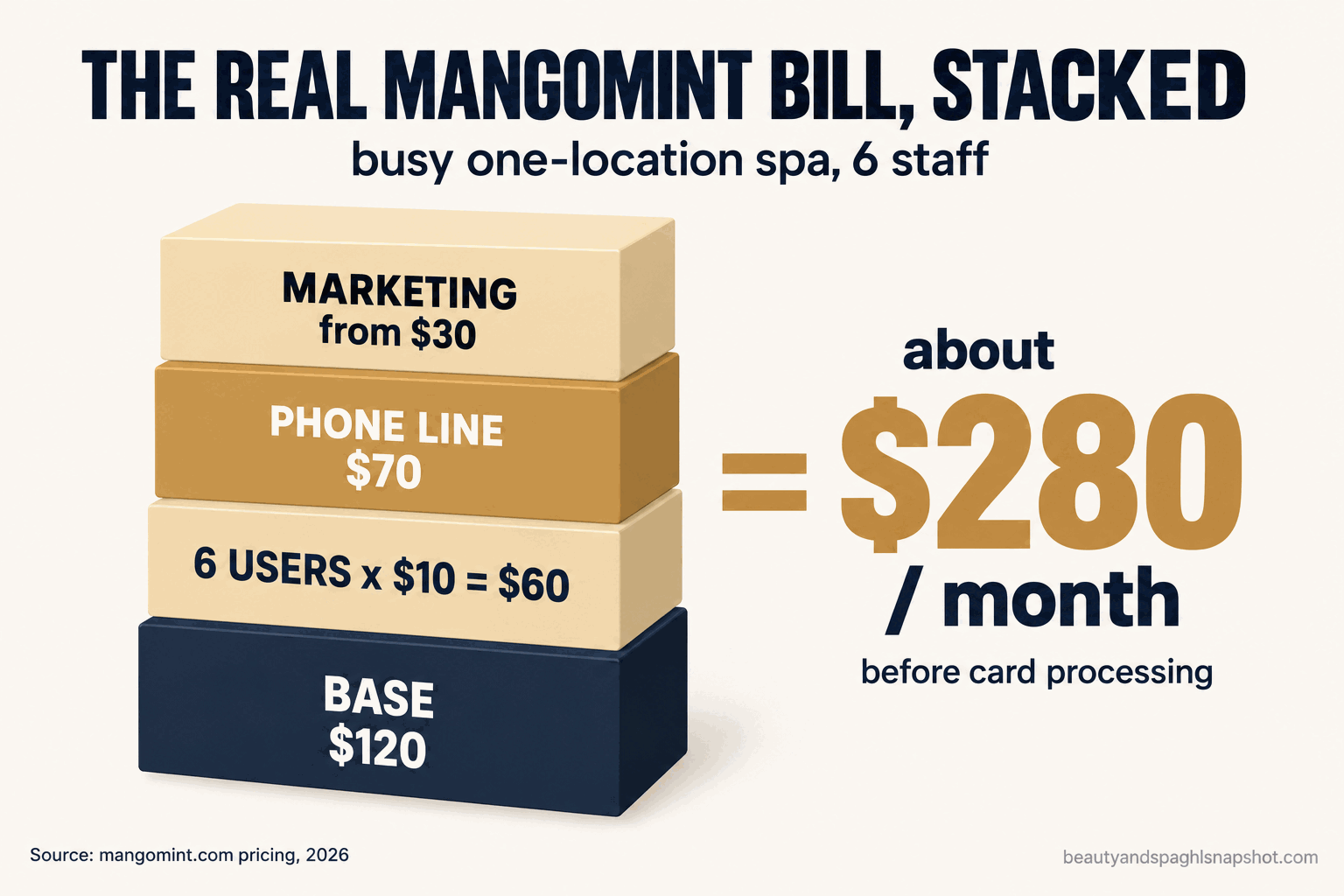
The busy one-location spa, six people. Four providers, a front-desk coordinator, an owner. Six users, so $120 plus $60, which is $180 base. Add a phone line ($70) and marketing (from $30) and you are near $280 a month before processing. This is Mangomint’s sweet spot: a genuinely good platform at a mid-tier price, cheaper than Boulevard’s Premier plan. For this shop, the per-user model works in your favor.
The multi-location shop, booth-rent heavy. Three locations, eighteen total users. Base is three times $120 plus eighteen users at $10, so $540 a month base before a single phone line, and with three lines and marketing you clear $780 a month before processing. Here per-user billing stops being a bargain: you are paying $180 a month in user fees, a chunk of it for booth renters who pay you rent, and it climbs with every hire. This is the shop that should price Mangomint against a flat-rate system very carefully.
Is Mangomint worth it in 2026?
For the right shop, genuinely yes. Mangomint has one of the cleaner, faster interfaces in the category, the automations are strong, and the new pricing is refreshingly honest. If you run one or two locations with a tight team, you will probably love it and the bill stays reasonable.
It stops being worth it in one case: a staff-heavy or booth-rent-heavy operation where the per-user line has grown into a tier’s worth of cost. If you are paying $150 or $200 a month just in user fees, you are funding a model that punishes the exact thing you are trying to do, which is grow your team. The question is no longer “is Mangomint good,” it is “is per-user the right model for a business that wins by adding chairs.”
Cheaper or flatter, by shop size
You have real options in 2026, and the honest pick depends on your size and staffing model.
| Tool | Reported 2026 price | Best for |
|---|---|---|
| GlossGenius | $24 / $48 / $148 a month, flat 2.6% processing | True solos and 1-2 chair studios |
| Square Appointments | Free to low monthly, pay-as-you-go processing | Solos who want zero commitment |
| Vagaro | ~$24-84/mo by calendars + 2.2-3.5% processing | Small teams; texting and site are add-ons |
| Mangomint | $120/location + $10/user/mo | One to two locations, lean teams |
| Boulevard | ~$176-410/location/mo | Mid-to-large salons and med spas |
| Mindbody | $79 start, mid tier reported ~$259-279 + add-ons | Chains that use the consumer marketplace |
Competitor figures come from our sourced teardowns, linked below.
At the small end, GlossGenius and Square are dramatically cheaper for a true solo, because they do not charge per user; our GlossGenius vs Square breakdown shows which fits a one-to-two chair studio. At the big end, Boulevard is the natural head-to-head: the real question is whether per-location (Boulevard) or per-location-plus-per-user (Mangomint) costs less at your headcount, and our Boulevard vs Mangomint comparison runs both bills side by side. For the whole field, our full spa software cost teardown prices every major vendor after the add-ons. The move most growing owners skip is leaving the per-head model entirely for a flat-priced platform, so your cost does not multiply every time you hire.
Steal this: the per-user cost audit
Before you switch, or before you accept your current bill as normal, run this audit. It takes ten minutes and it is the only way to know your real number instead of the sticker.
Step 1 - Count your true user roster. Not just your providers. Everyone who needs a login:
- Providers (estheticians, injectors, stylists, massage therapists): ____
- Front-desk / booking coordinators: ____
- Managers / owners who need access: ____
- Booth renters who need their own calendar: ____
- Seasonal or part-time staff active right now: ____
- Total users = ____
Step 2 - Do the base math. Locations x $120, plus total users x $10. That is your floor.
Step 3 - Add the pieces you will use. Phone lines x $70. Marketing (from $30). Payroll if you run it ($50 plus $8 per worker). Write the all-in monthly number down.
Step 4 - Add processing on real volume. Monthly card volume x 2.45% for in-person. For most spas this is the biggest line.
The four questions to ask Mangomint’s team before you commit:
- Based on my exact user roster, what is my total monthly bill including every add-on I would actually use? One number, not “starting at.”
- Do my booth renters have to be paid users, or is there a setup where they run their own account without me paying for them?
- How does the per-user charge handle part-time and seasonal staff?
- If I add three staff next year, show me what the bill looks like then, not just today.
If the answers work for your size, you buy with your eyes open. If the per-user math scares you once it is on paper, you just saved yourself a slow, creeping bill. Coming off another platform? Export your client list and visit history first; our guide on leaving Mindbody or Vagaro without losing your history covers the safe order.
Objections, answered straight
“Isn’t per-user pricing actually fairer?” For a small team, yes. You pay for what you use, and a two-person shop should not subsidize a twenty-person one. The problem is only at scale: a model that is fair at three people becomes a tax on growth at fifteen, because your cost rises with headcount instead of revenue. Fair and cheap are not the same thing once you are staffing up.
“Do booth renters really have to count as users?” In most standard setups, yes, because they need their own login. There are workarounds where renters hold separate accounts, but those usually cost you the unified front desk that made one platform appealing. This is the single biggest cost variable for a rental shop, so get the answer in writing before you sign.
“The free trial has no time limit, so why not just try it?” You should. Use the trial to run the cost audit above with your real roster loaded in, so you are testing the actual bill, not a demo.
Frequently asked questions
How much does Mangomint cost per month in 2026?
As of August 1, 2026, Mangomint is $120 per month per location plus $10 per month per user. A solo operator pays about $130, a busy one-location spa with six staff pays about $180 base, and a three-location shop with eighteen users pays about $540 base. Phone ($70 a line), Marketing (from $30), and card processing are all separate.
What happened to Mangomint's Essentials, Standard and Unlimited plans?
They were retired on August 1, 2026. Every customer moved to one plan: $120 per location plus $10 per user. The old tiers were reported at roughly $165, $245 and $375 a month. Existing customers whose bill would go up under the new math keep their old price instead.
Do booth renters count as paid users on Mangomint?
In most setups, yes. Anyone who needs their own login to run their own calendar is a $10-per-month user, which usually includes booth renters, front-desk staff and managers, not just providers. You can sometimes have renters run separate accounts to avoid the charge, but you lose the unified front desk. Confirm your exact setup with Mangomint before switching.
What is Mangomint's payment processing rate?
Mangomint publishes it, unlike some competitors: 2.45% plus $0.15 per in-person transaction and 2.90% plus $0.30 for virtual, card-not-present payments. On real card volume, processing is usually a bigger line than the subscription, so include it when you compare platforms.
Is Mangomint cheaper than Boulevard or Mindbody?
For a small, lean team, usually yes. Mangomint's base is lower than Boulevard's entry plan and clearer than a loaded Mindbody setup. For a staff-heavy or booth-rent-heavy shop, the $10-per-user charge can climb past a flat per-location plan, so run both bills at your actual headcount before deciding. Mangomint also offers a free trial with no credit card and no time limit, so you can test the real bill before paying.
Related reading
- What salon and spa software really costs in 2026
- Boulevard vs Mangomint 2026: is Boulevard worth $150 more a month?
- How much does Mindbody actually cost in 2026?
- GlossGenius vs Square Appointments for a 1-2 chair studio
- How to leave Mindbody or Vagaro without losing your client history
The bottom line
Mangomint did the honest thing in August 2026. It printed its whole pricing formula on a public page while competitors hid theirs, and it made the entry point low enough that a small shop with a lean team can afford a genuinely good platform. That is a real win.
But a simpler sticker is not the same as a cheaper bill. The $10-per-user line rises with your headcount, not your income, and for a growing or booth-rent-heavy spa it can quietly become the most expensive thing on your invoice. So do the one thing the sticker is not built to make you do: count every head who needs a login, run the audit, and get the all-in number for your size in writing before you commit. Then compare that number against a flat-priced option, because the calendar is only half the job. The booking, deposit, no-show recovery and rebooking tools inside our appointment automation and SMS automation are where the chairs actually get filled, for a one-time $997 instead of a bill that grows every time you hire. If you would rather build on GoHighLevel yourself, you can start a GoHighLevel account here. (Affiliate link; if you sign up through it we may earn a commission at no extra cost to you. See our affiliate disclosure.)