A client leaves your Ballantyne studio glowing after a HydraFacial. She meant to leave a review — she really did — but by the time she’s back to carpool, work emails, and dinner, the thought is gone. Multiply that by every happy client this month, and you have the single most expensive silence in a Charlotte med-spa: the reviews that never got written. Meanwhile the studio two exits down on I-485 quietly adds a dozen fresh five-stars a month, climbs the Google map pack, and wins the exact searches you should be winning.
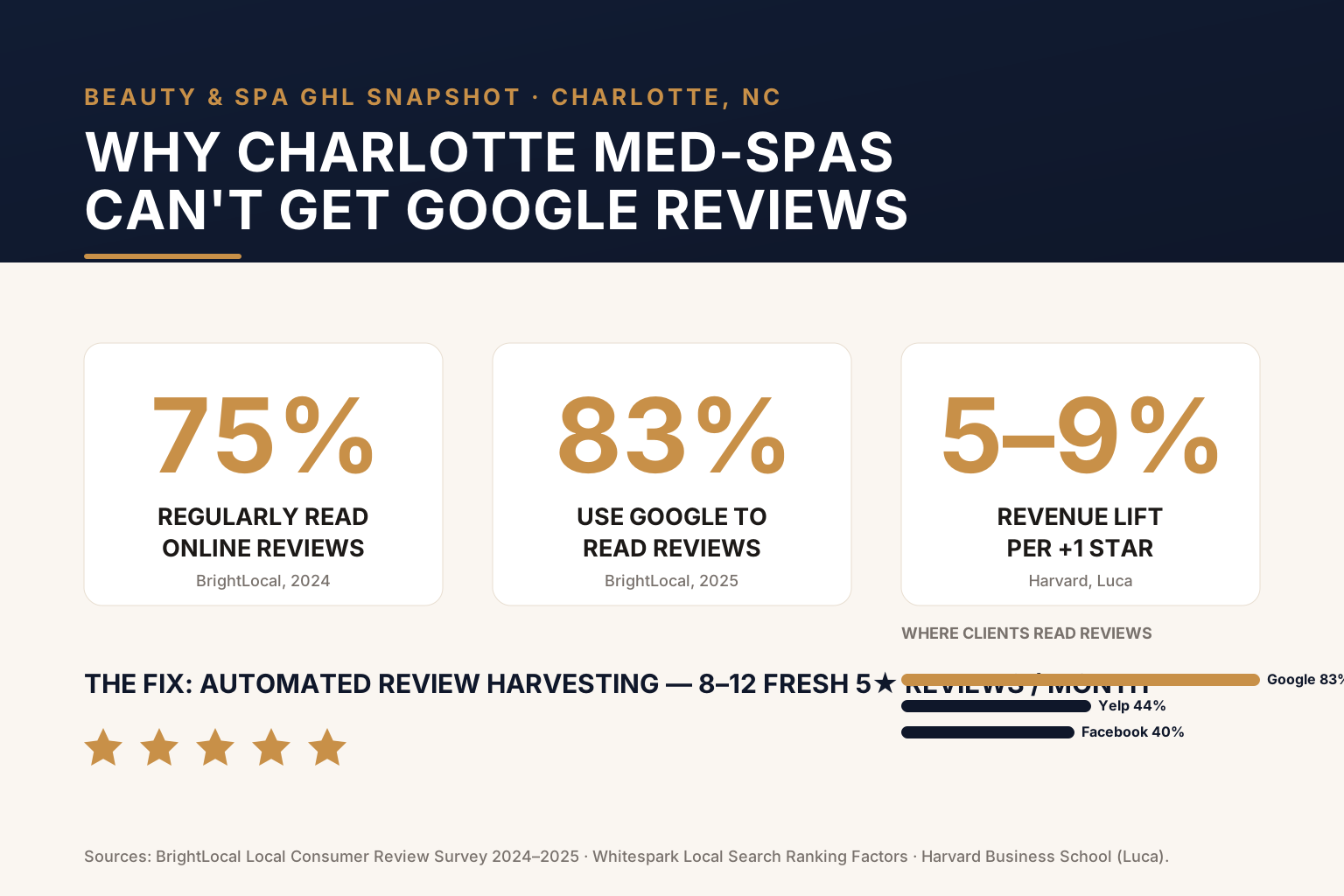
The short answer: most Charlotte med-spas don’t have a service problem — they have a review-collection problem. Google is where 83% of consumers read local-business reviews (BrightLocal, 2025), 75% read them regularly (BrightLocal, 2024), and a one-star rating increase is worth a 5–9% lift in revenue (Harvard Business School / Luca). The fix isn’t nagging your front desk to “remember to ask.” It’s an automated review-harvesting flow that asks every happy client at exactly the right moment — and routes the unhappy ones to you privately first.
Table of contents
- Why Charlotte med-spas can’t get enough reviews
- The five hidden leaks that keep your reviews scarce
- What the review gap actually costs a Charlotte studio
- The automated fix: review harvesting that runs itself
- Manual asking vs. automated review harvesting
- Setting it up right (compliance + brand voice)
- Frequently asked questions
Why Charlotte med-spas can’t get enough reviews
Charlotte is one of the fastest-growing aesthetics markets in the Southeast. From SouthPark and Myers Park to Ballantyne and the Lake Norman suburbs, affluent, appearance-conscious clients are booking injectables, lasers, and facials at record pace — and new studios open to meet them. Nationally, the U.S. had 10,488 med spas in 2023, up from 8,899 in 2022 (AmSpa, 2024), with the average location earning about $1.4 million a year and the U.S. medical-aesthetics market worth $4.1 billion in 2024 (IMARC Group). Demand is not your problem. Being chosen is.
And in a market this crowded, the choice happens on Google. When a Charlotte client searches “Botox near me” or “best HydraFacial SouthPark,” the map pack decides who gets the call — and the map pack is ranked, in large part, by reviews. 83% of consumers use Google to read reviews of local businesses (BrightLocal, 2025), far ahead of every other platform. The studio with more recent, higher-rated, well-answered reviews doesn’t just look better — it literally ranks higher and gets seen first.
Here’s the trap. The studios losing the review race aren’t worse at treatments — clients love them. They’re worse at asking. Great work earns a happy client; it doesn’t automatically earn a review. Someone has to ask, at the right moment, every single time — and that’s exactly where a busy Charlotte med-spa breaks down.
The five hidden leaks that keep your reviews scarce
If your studio does beautiful work but your Google Business Profile has 60 reviews and hasn’t moved in months, one of these five leaks is almost certainly the culprit.
1. The ask never happens. Your front desk means to hand every client a review card or send a text — but between checkout, the next client, and turning the room, “ask for a review” is the task that always loses. Relying on memory during a busy day guarantees an inconsistent trickle, not a stream.
2. You ask at the wrong moment. A review request that lands three days later, by email, competes with 200 other emails and loses. The window that actually converts is right after a great visit, while the glow is fresh — and by text, which gets read in minutes, not days.
3. One-star surprises blindside you. When you ask everyone the same public way, the occasional unhappy client posts a public one-star before you ever hear about it. Now you’re doing damage control on your storefront instead of quietly fixing a fixable problem. The right flow catches that feedback privately first.
4. Your reviews go stale. Google weights review recency and velocity, not just count. Review signals carry roughly a fifth of local-pack ranking weight, and recency is now a top-five local factor (Whitespark). A spa adding 12 fresh reviews a month consistently will out-rank one sitting on 500 reviews that stopped a year ago. To a searcher, a last-review-was-March profile reads as “are they even still open?”
5. Nobody’s responding. Collecting reviews is only half the job. 88% of consumers would use a business that responds to all its reviews, versus just 47% for one that never replies (BrightLocal, 2024). Silent profiles quietly repel the exact clients you worked to attract.
Notice what every leak has in common: none of them is about the quality of your treatments. They’re all about the system that turns a happy client into a public, recent, well-answered review — and most Charlotte studios simply don’t have one.
What the review gap actually costs a Charlotte studio
Let’s put a number on the silence. Because a rating increase compounds through both ranking and conversion, the cost of an under-reviewed profile is bigger than it looks.
Say your studio ranks just below the map pack for your best searches, and lifting your review volume and rating moves you up so you capture even 10 additional new clients a month you’re currently losing to better-reviewed competitors. That’s conservative in a market as active as Charlotte’s — and it’s before you count the compounding effect of a higher star rating on everyone who does find you.
At an average first-year client value of about $1,200 — a first treatment plus the packages, memberships, and rebookings that follow — ten new clients a month is roughly $12,000/month, or about $144,000 a year, from search traffic that already exists. On top of that, the Harvard research on Yelp ratings found a one-star increase is worth a 5–9% revenue lift on its own (Luca, HBS). You’re not choosing between “get reviews” and “grow revenue” — for a Charlotte med-spa, they’re the same lever. (It’s the same speed-and-consistency economics behind missed-call text-back and client reactivation.)
The automated fix: review harvesting that runs itself
The solution to an inconsistent human process is to stop depending on humans to remember. Automated review harvesting sends the ask for you — every time, at the right moment, in your studio’s voice — and quietly protects your public rating along the way. Here’s the flow that most of our Charlotte studios run:
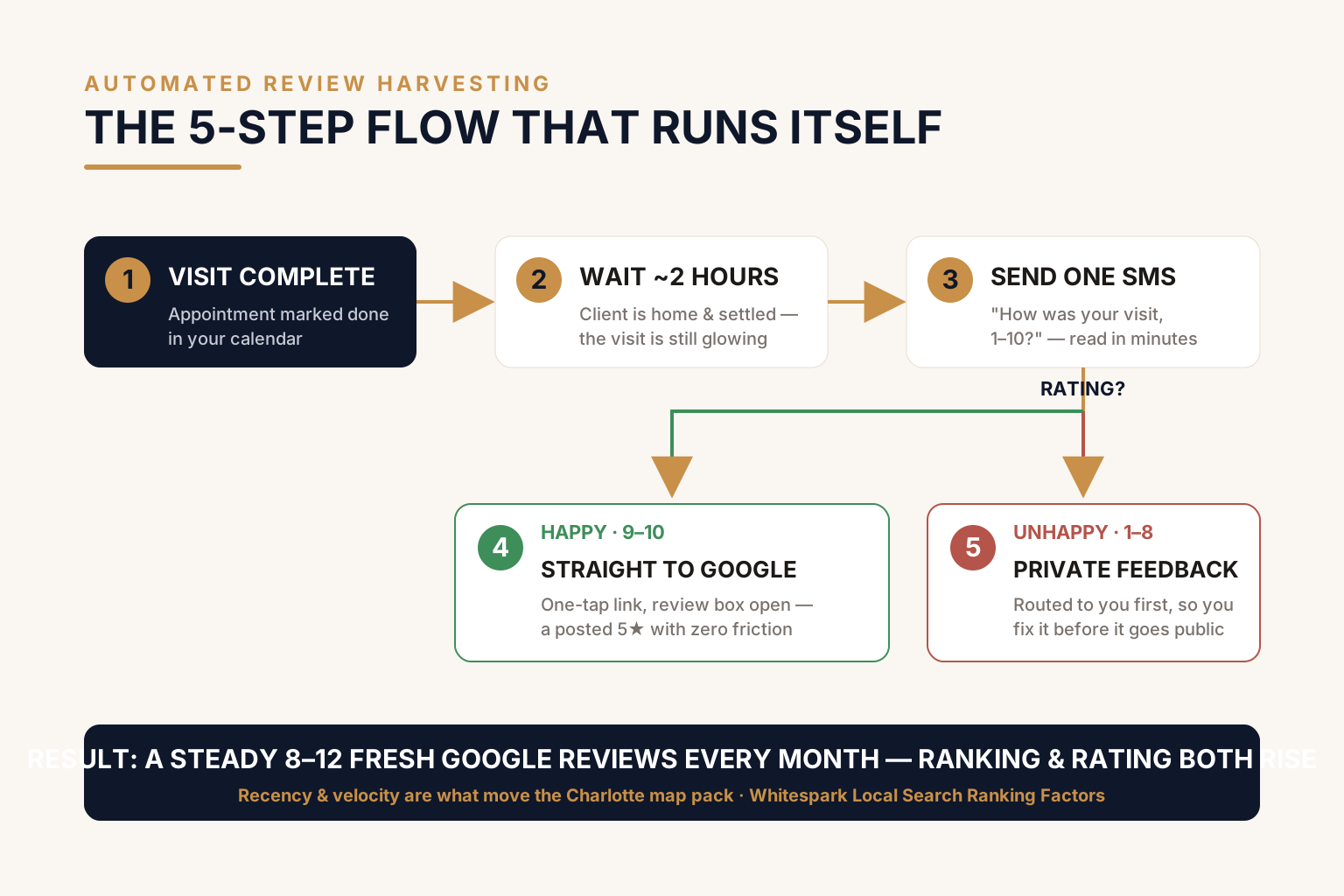
- A visit is completed. The moment an appointment is marked done in your calendar, the flow starts — no sticky note, no reminder to your front desk.
- Wait about two hours. Long enough that the client is home and settled, close enough that the visit is still glowing. This timing is the single biggest driver of response.
- Send one warm SMS, not an email. A short, on-brand text (“Hi Jordan — hope you loved your visit today! Quick one: how was it, 1–10?”) gets read in minutes. Text beats email for this by a wide margin.
- Happy clients go straight to Google. A 9 or 10 gets a one-tap link to your Google Business Profile with the review box already open — removing every ounce of friction between intent and a posted five-star.
- Unhappy feedback routes to you — privately. Anything lower goes to a private form and pings you directly, so you can make it right before it ever becomes a public one-star. Your storefront stays protective of the rating your work has earned.
Run this on every visit and the math takes care of itself: a studio seeing 150–200 visits a month, with even a modest response rate, comfortably clears the 8–12 fresh reviews a month that keep a profile ranking and looking alive. And because the same system can auto-respond to incoming reviews in your brand voice, you capture the 88%-vs-47% trust gap at the same time. (For the manual version of this playbook, see how to get 12 Google reviews a month without sounding pushy.)
Manual asking vs. automated review harvesting
The honest question isn’t whether asking for reviews works — it’s who does it, every single time, without fail. That’s where a done-for-you system pulls away from good intentions.
Getting Google reviews at your Charlotte med-spa: by hand vs. automated
| Plan | Manual asking | Automated review harvesting recommended |
|---|---|---|
| Price | Front-desk willpower | Built into the snapshot |
| Feature 1 | Someone must remember to ask at every checkout | Every completed visit triggers the ask automatically |
| Feature 2 | The ask dies on busy days — inconsistent trickle | Consistent 8–12 fresh reviews a month |
| Feature 3 | Requests sent late, by email, easily ignored | Sent by SMS ~2 hours post-visit — read in minutes |
| Feature 4 | Unhappy clients post publicly before you hear it | Unhappy feedback caught privately, first |
| Feature 5 | Reviews go stale; velocity drops; rank slips | Steady velocity keeps you ranking in the map pack |
| Feature 6 | No one has time to reply to every review | On-brand auto-replies to every review |
| The usual outcome | See the system → |
The point isn’t that your team can’t ask for reviews — it’s that a fully-booked studio rarely asks consistently, and consistency is the entire game with Google. Handing the asking to a system means the reviews keep coming whether or not it was a busy week.
Setting it up right (compliance + brand voice)
Review automation for a medical-aesthetics business has to be set up with more care than a retail coupon blast. Get these five things right and it makes you look more premium, not less:
- Get consent before you text. Capture explicit SMS opt-in at booking and honor STOP immediately. That’s standard TCPA practice, and it keeps your review requests welcome instead of annoying.
- Never incentivize or gate reviews improperly. Ask for honest feedback; don’t offer discounts for five-stars or filter who can review you. Routing unhappy clients to a private conversation first is good service — but they must still be free to post publicly. Follow Google’s review policies to the letter.
- Keep it in your studio’s voice. A stiff, generic “Please rate us” text reads as spam and costs you the polished feel Charlotte clients expect. The request should sound like your best front-desk person — warm, brief, human.
- Respond to every review — the good and the bad. Auto-replies handle volume in your brand voice; you personally step in on anything sensitive. Public, gracious responses are exactly what earns the 88% trust bump.
- Measure velocity, not just total. Track new reviews per month and your average rating trend. Those two numbers, moving up steadily, are what move your map-pack ranking.
For a Charlotte med-spa in 2026, Google reviews aren’t a vanity metric that lives next to the real marketing — they are the real marketing, working every hour your phone line isn’t. The studios that fill their rooms next year won’t necessarily be the ones with the best injector or the newest laser. They’ll be the ones whose happy clients actually said so — recently, on Google, where the next client is already looking.
Frequently asked questions
Google reviews for Charlotte med-spas — FAQs
How many Google reviews does a Charlotte med-spa need to rank?
There's no magic total — Google weights recency and velocity, not just count. A studio adding 8–12 fresh reviews a month consistently will usually out-rank one sitting on hundreds of reviews that stopped a year ago, because review recency is now a top-five local ranking factor (Whitespark). The goal is a steady stream, not a one-time push. Reviews carry roughly a fifth of local-pack ranking weight, so consistent velocity is one of the highest-leverage things a Charlotte med-spa can automate.
Why is Google more important than Yelp or Facebook for my med-spa?
Because that's where your clients look. 83% of consumers use Google to read local-business reviews, versus 44% for Yelp and 40% for Facebook (BrightLocal, 2025). Your Google Business Profile is also what powers the map pack for searches like 'Botox near me' in Charlotte, so Google reviews influence both whether clients trust you and whether they find you in the first place.
Isn't automating review requests going to feel spammy to clients?
Not if it's done right. The flow sends one warm, on-brand SMS about two hours after a great visit — the moment clients are most inclined to say something nice — and it only asks once. It's far less intrusive than a front-desk person putting someone on the spot at checkout. With proper TCPA opt-in and STOP handling, it reads as a thoughtful follow-up, not a blast.
How does routing unhappy clients privately work — is that allowed?
The flow asks how the visit went first. Clients who are thrilled get a one-tap link to your Google profile; clients who weren't fully happy are invited to share feedback privately so you can make it right. Everyone is still free to post a public review — you're not blocking anyone, you're simply giving unhappy clients an easier path to reach you directly. That's good service and keeps you inside Google's review policies. Never offer discounts in exchange for a five-star rating.
Do I really need to respond to every review?
Yes — and it pays off. 88% of consumers would use a business that responds to all its reviews, versus just 47% for one that never replies (BrightLocal, 2024). The snapshot can auto-respond to incoming reviews in your studio's voice so every review gets a gracious reply, while you personally step in on anything sensitive or negative.
How fast can review harvesting go live for my Charlotte studio?
Because the snapshot is a pre-built system, the review-harvesting flow typically goes live in days, not the months an agency would take to build one from scratch. We connect your calendar and Google Business Profile, set the timing and brand voice, add the TCPA and honest-review guardrails, and turn it on. You can book a 15-minute walkthrough to see it running in a real account first.
Priya Natarajan is a former licensed esthetician turned client-experience and retention consultant who helps boutique spas and med-spas keep the clients they already have. She writes about review and reputation automation, after-care sequences, and reactivation messaging that sounds like a real person — the human side of the systems that turn a one-time guest into a five-star regular.
Related reading: How to get 12 Google reviews a month (without sounding pushy) · Local SEO for spas · Missed-call text-back for spas · Win back lapsed clients · How to get more spa clients