

It’s a Tuesday night in Lincoln Park and someone just watched your lip-filler Reel. She taps through to your website to check prices and grab a Saturday slot. Your homepage is still assembling its hero video and booking widget when — three seconds in — she gives up, swipes back to Google, and taps the med spa two blocks away that opened in a blink. You never saw the visit, and you’ll never know you lost the booking.
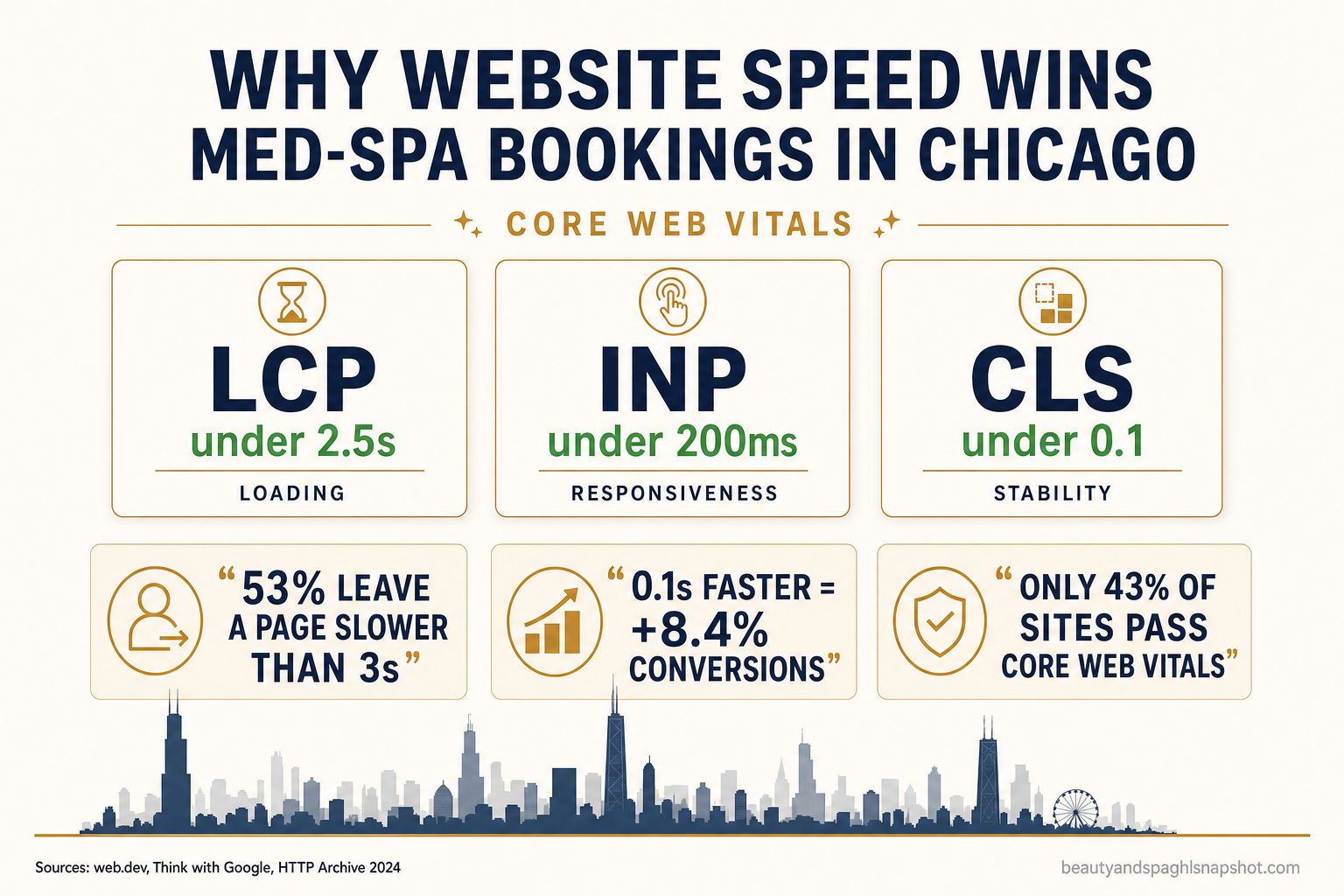
The short answer: in a market as saturated as Chicago, website speed is one of the quietest, most expensive leaks in a med spa’s marketing. Roughly 53% of mobile visitors abandon a page that takes longer than three seconds to load (Think with Google), a 0.1-second load-time improvement has been shown to lift conversions by 8.4% (Deloitte, “Milliseconds Make Millions”), and only about 43% of mobile sites pass Google’s Core Web Vitals (HTTP Archive Web Almanac 2024). This guide explains exactly what “fast enough” means in 2026, how to check your own site, and what a slow one is costing you.
Table of contents
- Why speed decides Chicago med-spa bookings
- Core Web Vitals in plain English (2026 thresholds)
- Is your med spa’s site actually fast enough?
- Does site speed really affect Google rankings?
- The booking math: what a slow site costs
- Why med-spa websites get slow — and the fix
- Frequently asked questions
Why speed decides Chicago med-spa bookings
Chicago is one of the most competitive aesthetics markets in the country, and the whole sector is booming. The U.S. counted 10,488 med spas in 2023, up from 8,899 the year before, with average per-location revenue near $1.4 million (AmSpa 2024 State of the Industry). The global medical-spa market sat at roughly $21.2 billion in 2024 and is projected to reach $78.2 billion by 2033 — a 15.8% CAGR (Grand View Research), with North America holding the largest single share. In neighborhoods like River North, Gold Coast, and Wicker Park, a prospective client can find five injectors within a mile. Your website is the tiebreaker.
And that tiebreaker is decided on a phone. Around 60% of all web traffic now comes from mobile devices (Statista), and beauty is a mobile-first, social-first purchase — most Chicago clients discover you on Instagram or a “med spa near me” search and tap through on the spot. Google’s research has long shown that 76% of people who search for something nearby on a smartphone visit a related business within a day, high-intent traffic you can’t afford to fumble.
Here’s the uncomfortable part. In Google’s mobile benchmarks, as page load time climbs from one second to three, the probability that a visitor bounces rises 32%; at five seconds it’s up 90%; at ten seconds, 123% (Think with Google). (That dataset is older Google/SOASTA research, but the pattern holds — and the 2024 field data below confirms most sites still aren’t fast.) You can run flawless Instagram ads and still bleed those taps if the landing page is slow.
Core Web Vitals in plain English (2026 thresholds)
“Fast” isn’t a feeling — Google measures it with three real-world metrics called Core Web Vitals. You don’t need to be technical to understand them, and knowing the targets is the difference between guessing and knowing whether your site is losing bookings.
- LCP — Largest Contentful Paint (loading). How long until the biggest thing on screen — usually your hero image or headline — actually appears. Good is under 2.5 seconds (web.dev).
- INP — Interaction to Next Paint (responsiveness). When a client taps “Book Now” or opens your treatment menu, how fast the page reacts. Good is under 200 milliseconds (web.dev). INP replaced the old First Input Delay (FID) metric on March 12, 2024 — it’s stricter because it measures every interaction, not just the first (web.dev).
- CLS — Cumulative Layout Shift (visual stability). Whether the page jumps around as it loads — the maddening moment a button moves right as someone taps it. Good is under 0.1 (web.dev).
One nuance that trips people up: these are graded at the 75th percentile of your real visitors (web.dev). In plain English, three out of four people have to get a “good” experience for your page to pass. It’s not about how the site feels on the fast laptop at your front desk — it’s about the client on a mid-range phone on the CTA Red Line.
Is your med spa’s site actually fast enough?
You can check in about ninety seconds, for free. Open Google PageSpeed Insights, paste your homepage and your busiest treatment page (Botox, filler, laser), and read the mobile tab first — that’s where your clients are. It reports both your Core Web Vitals from real Chrome users and a lab performance score out of 100.
Don’t be surprised if the number stings. The most sobering figure in this whole conversation is that only about 43% of mobile sites pass all three Core Web Vitals, and just 59% have a “good” LCP on mobile (HTTP Archive Web Almanac 2024). Most of the web is slow — which is exactly why speed is an edge and not just table stakes. If your competitor down Michigan Avenue is in the failing majority, a fast site is a moat.
Does site speed really affect Google rankings?
Yes — but let’s be honest about how much, because overblown claims help no one. Google confirms that page experience, which includes Core Web Vitals, is a ranking signal (Google Search Central). At the same time, Backlinko’s analysis of 11.8 million search results found the average page-load time of a first-page Google result is about 1.65 seconds, yet only a weak direct correlation between raw speed and ranking position (Backlinko).
So what’s the real takeaway for a Chicago med spa? Speed rarely outranks great local content and reviews on its own — but a slow site actively holds you back, and its biggest payoff isn’t the ranking, it’s the conversion. Being fast helps you show up and keeps the visitors you earn from bouncing, which is itself a quality signal Google notices. Speed pairs with — it doesn’t replace — the fundamentals covered in our local SEO guide for spas and a conversion-ready site structure.
The booking math: what a slow site costs
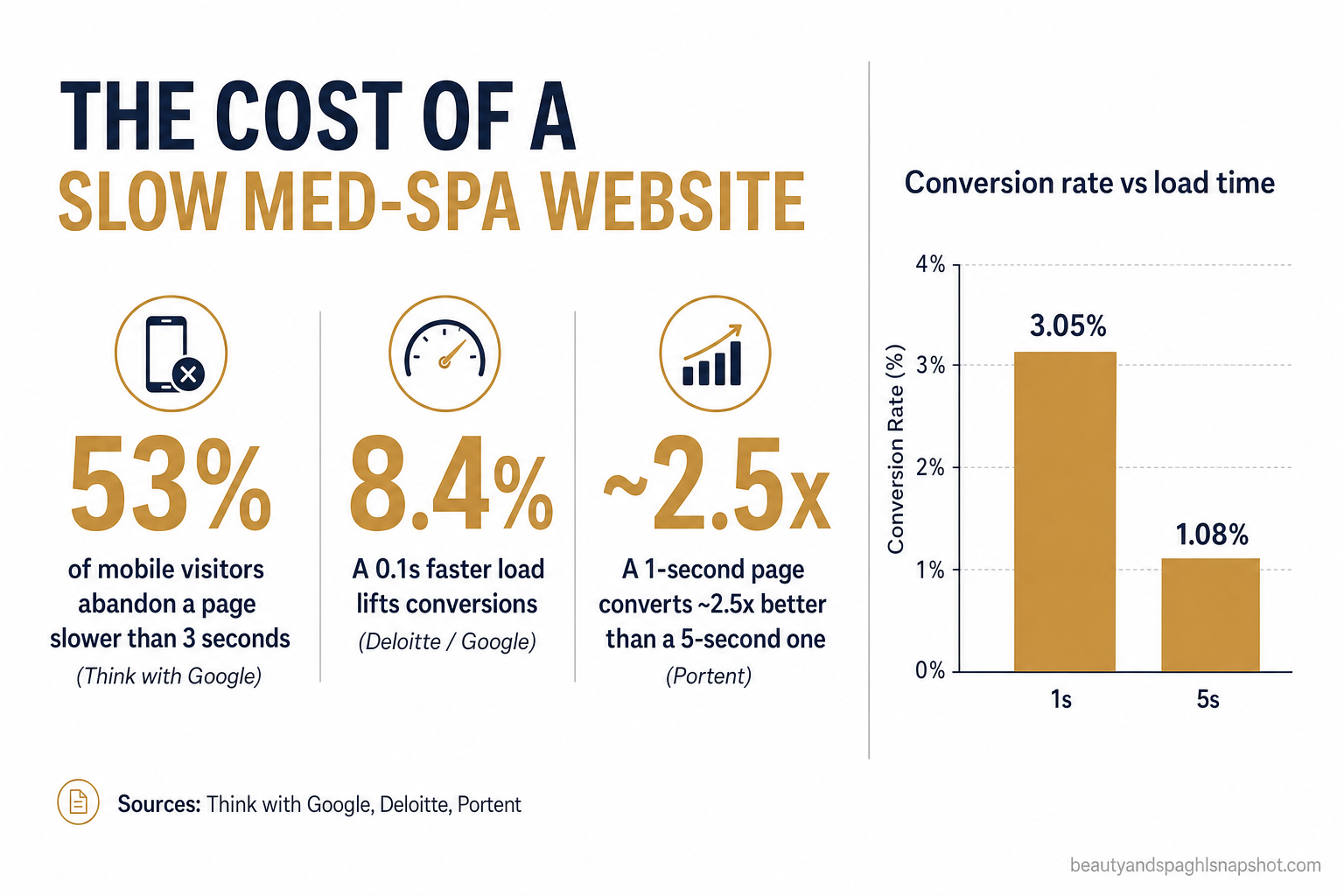
Let’s put dollars on it, because that’s the language a P&L speaks. The conversion research here is unusually clean. Deloitte’s “Milliseconds Make Millions” study with Google found a 0.1-second improvement in mobile load time lifted retail conversions by 8.4% and average order value by 9.2% (web.dev). Portent’s analysis of 100 million-plus page views found ecommerce sites that load in one second convert at 3.05% versus 1.08% at five seconds — roughly 2.5× better (Portent).
Now apply that to a mid-sized Chicago med spa. Say your site draws 2,500 mobile visitors a month, 5% book a consult, and a new client’s first treatment plus follow-ups is worth $500 (well within Chicago’s average-spend range for injectables and packages).
A conservative low-double-digit lift from cutting your load time is roughly a dozen extra booked consults a month — about $6,000, or $72,000 a year, from the same ad spend and the same traffic. A slow site doesn’t just annoy clients; it quietly taxes every marketing dollar you spend to get them there. And it compounds with speed-to-lead: a fast page gets them to the form, fast follow-up closes them.
Why med-spa websites get slow — and the fix
Slow med-spa sites almost always share the same three culprits, and none of them are your fault:
- Plugin and page-builder bloat. A typical WordPress spa site stacks a page-builder (Elementor, Divi), a booking plugin, a slider, forms, a cookie banner, and a caching plugin to undo the damage. Each injects its own CSS and JavaScript into every page, so the phone has to download and run all of it before the site feels usable.
- Enormous, unoptimized images. Before/after galleries and hero videos are the heaviest thing on a beauty site. Uploaded straight from a phone or a photographer, they’re often 5–10× larger than they need to be, and they’re usually your LCP element — the exact thing Google times.
- DIY builders and generic GHL-built pages. Drag-and-drop tools prioritize easy editing over lean output, so the code shipped to the browser is heavier than it looks.
The durable fix is architectural, not another plugin. We build on the Astro framework, which renders pages to static HTML at build time and ships almost no JavaScript by default — pages are served static-first from a global edge network, so a client in Naperville gets the same near-instant load as one in the Loop. That’s how we guarantee a 90+ Google PageSpeed score (often a perfect 100) on mobile and desktop. If you want the full technical comparison, we broke down Astro vs WordPress for spa websites in detail.
A fast Astro med-spa site vs. a typical slow one
| Plan | Done-for-you Astro site recommended | Typical WordPress / builder site |
|---|---|---|
| Price | $497 + $97/mo | Hosting + plugins |
| Feature 1 | 90–100 PageSpeed, guaranteed | Often under 90 PageSpeed on mobile |
| Feature 2 | Near-zero JavaScript by default | Plugin/theme JavaScript on every page |
| Feature 3 | Static-first, served from the edge | Server-rendered, cache plugins to patch |
| Feature 4 | Optimized images + LCP tuned | Heavy, unoptimized gallery images |
| Feature 5 | Local SEO, schema & AEO built in | SEO & schema via add-on plugins |
| Feature 6 | AI chat widget + CRM wired in | Chat & CRM = more paid plugins |
| Feature 7 | Managed — no plugin updates for you | You (or a dev) maintain updates |
| See the build |
You didn’t open a med spa to babysit plugin updates. For most Chicago studio owners, the practical move is a managed, purpose-built site: we design and build it, guarantee the speed, wire in local SEO, an AI chat widget, and your CRM, then host and maintain it — so the website quietly fills the schedule instead of leaking it. See how the prebuilt spa website fits with the rest of the Beauty & Spa Snapshot, and how a fast site pairs with the workflows that actually get more spa clients through the door.
The verdict for a Chicago med spa in 2026 is simple: most of your competitors are slow, and slow is losing them bookings. Being fast by default is one of the cheapest advantages you can buy.
Frequently asked questions
Med spa website speed in Chicago — FAQs
What is a good website speed for a Chicago med spa in 2026?
Aim to pass all three Core Web Vitals on mobile: Largest Contentful Paint (LCP) under 2.5 seconds, Interaction to Next Paint (INP) under 200 milliseconds, and Cumulative Layout Shift (CLS) under 0.1, measured at the 75th percentile of real visitors (web.dev). In practical terms, target a 90+ Google PageSpeed score on the mobile tab. Only about 43% of mobile sites currently pass Core Web Vitals (HTTP Archive 2024), so hitting these targets is a real advantage.
What replaced First Input Delay (FID) in Core Web Vitals?
Interaction to Next Paint (INP) replaced FID as a Core Web Vital on March 12, 2024 (web.dev). INP is stricter because it measures the responsiveness of every interaction on the page — every tap and click — not just the very first one. A 'good' INP is under 200 milliseconds.
How do I check my med spa website's speed for free?
Open Google PageSpeed Insights (pagespeed.web.dev), paste your homepage and your top treatment pages, and read the mobile tab first — that's where most beauty clients are. It shows your real-user Core Web Vitals plus a lab score out of 100. If LCP is over 2.5s, INP over 200ms, CLS over 0.1, or your score is under 90, you're likely losing bookings.
Does a faster website actually help my med spa rank on Google?
It helps. Google confirms page experience, including Core Web Vitals, is a ranking signal, and the average first-page result loads in about 1.65 seconds (Backlinko). Speed alone won't outrank strong local content and reviews, but a slow site holds you back — and its bigger payoff is conversion: it keeps the visitors you earn from bouncing to a competitor.
Why is my WordPress or GHL-built spa website so slow?
Usually three things: plugin and page-builder bloat that ships heavy JavaScript on every page, large unoptimized before/after and hero images (often your LCP element), and DIY builders that prioritize easy editing over lean code. The durable fix is architectural — a static-first build on a framework like Astro that ships almost no JavaScript by default.
What does a fast done-for-you med spa website cost?
Our managed Astro build is $497 one-time plus $97/month, which covers a guaranteed 90+ PageSpeed site, free domain, managed Cloudflare hosting, SSL, an AI chat widget, CRM, and maintenance. Add auto-blogging for $197/month total, or cover up to five locations for a $1,200 one-time fee plus $297/month. It's live in about 10 working days.
Devon Ashby runs a small agency that resells GoHighLevel snapshots and builds fast websites for day spas, lash studios, and med-spas. He came up through performance marketing, so he treats every spa site like a P&L — cost per booked consult, package conversion, and lifetime value. He writes the numbers-first pieces on speed, funnels, and local SEO for beauty businesses.
Related reading: Astro vs WordPress for spa websites: page speed compared · Local SEO for spas in 2026 · Med spa website design in 2026 · Speed-to-lead for spas