
A client just finished a 75-minute facial. Her skin looks incredible, she is relaxed, and she trusts your esthetician more than her own dermatologist. She pays, says thank you, and walks past the shelf holding the exact serum that got her that glow. Three weeks later she buys a worse version on Amazon because nobody told her which one to use.
That walk-past is the most expensive five seconds in your day. The product on that shelf carries a fatter margin than the service she just paid for, she already wants the result, and the sale costs you nothing. You just let it leave.
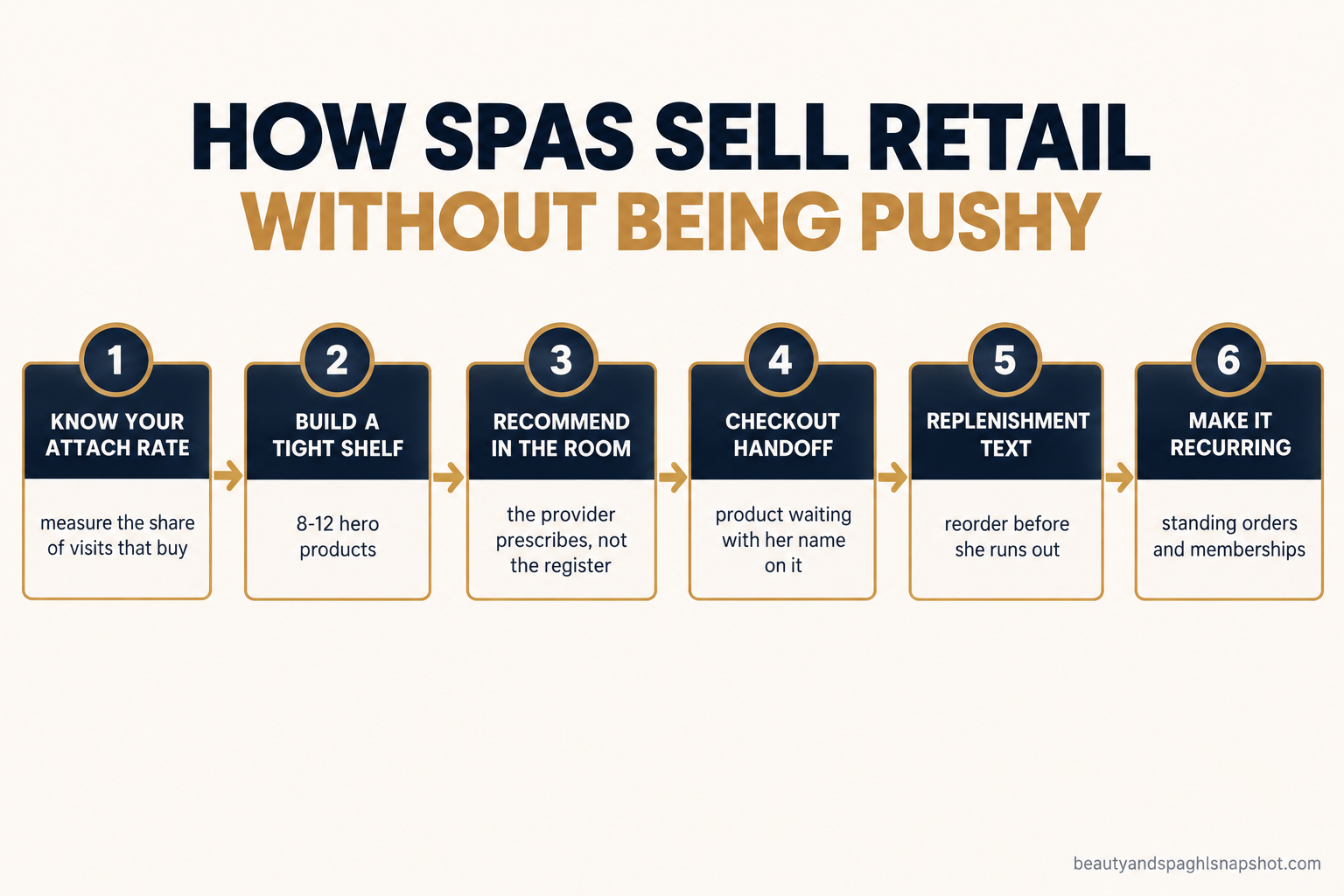
Most owners think selling retail means turning their calm, premium spa into a pushy sales floor. It does not. The spas that move the most product feel the least salesy, because they treat it as part of the treatment, not a pitch at the register. This is that system, six parts, with the scripts and follow-up texts you can use this week.
Table of contents
- What your idle shelf actually costs
- Why clients walk past your retail
- Part 1: Know your attach rate
- Part 2: Build a tight shelf
- Part 3: Recommend in the room
- Part 4: The checkout handoff
- Part 5: The replenishment text
- Part 6: Make it recurring
- Run it for your size
- The legal fine print
- Objections I hear every week
- Frequently asked questions
Key takeaways
What your idle shelf actually costs
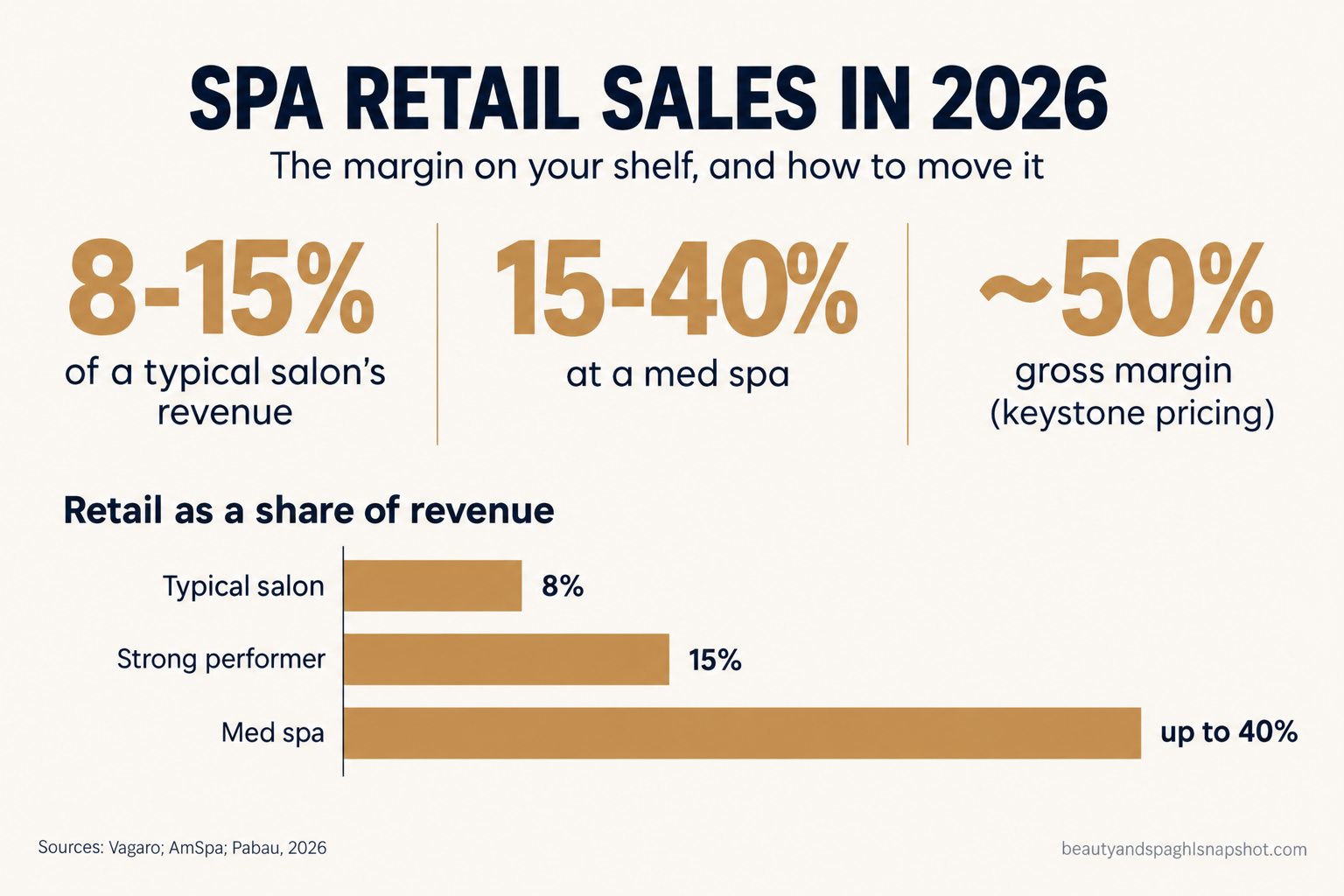
Retail accounts for more of a spa’s revenue than most owners think. Vagaro puts it at about 8% on average, and up to 15% at successful salons. Med spas run much higher: published benchmarks put retail at roughly 15% to 40% of med spa revenue, with consultant Dr. Lisa Jenks, quoted by the American Med Spa Association, citing 20% to 40%.
Sources: salon retail share, Vagaro; med-spa retail share, Pabau (citing AmSpa and Skytale Group); repeat-client revenue, Zenoti 2025 Benchmark Report.
Now the margin. Retail is traditionally priced at double the wholesale cost, a convention called keystone pricing, which leaves roughly half the retail price as gross margin. The facial cost you a room, product, and a provider’s time and commission. The jar of serum cost you half its price and thirty seconds. One of those two lines is your best margin in the building, and it is the one you ignore. At 200 weekly visits, lifting one in five clients to a $45 product is roughly $90,000 a year in mostly-margin revenue, no new clients, rooms, or ad dollars required.
Why clients walk past your retail
It is almost never price. Clients spend $110 on a facial without blinking, so a $45 serum is not the problem. The problem is that nobody made it easy, specific, and trusted. Three things go wrong, and the system below fixes each one:
- Nobody told them what to buy. A shelf of forty products is a decision, and a relaxed client does not want a decision. She wants a prescription: this one, for you, because of what we just saw.
- The recommendation came at the wrong moment. A front-desk “do you want to add anything?” after she has closed her wallet lands as an upsell. The same words from her esthetician mid-treatment land as expert advice.
- There is no follow-up. Clients who mean to buy it next time never do, because you never reminded them.
Fix those three and attach rate climbs on its own. A typical shop without a system hovers near 20% to 25% of visits; strong performers reach 30% to 40%. The gap is pure found money.
Part 1: Know your attach rate before you change anything
You cannot improve “we should sell more product.” You can improve “23% of facial clients buy a product, almost all of it one cleanser, and nobody who gets a massage buys anything.”
Pull the last 90 days and calculate attach rate, the share of service visits that included a retail purchase. Break it down three ways: by service (facials probably convert, massage probably does not), by provider (one esthetician likely carries your whole number), and by product (you are probably selling three heroes and sitting on slow movers).
How it breaks: owners skip this and “add retail” by ordering more inventory, so they end up with more dead stock and the same attach rate. The number tells you where the leak is: maybe one provider is at 45% and the rest at 8%, which is a training problem, not a product problem.
Part 2: Build a tight shelf, not a warehouse
More products sell less. A wall of options paralyzes a client, buries your best sellers, and ties up cash in aging inventory. The spas with the best retail numbers carry a short, curated line, not a pharmacy.
Cut to a tight core. For most shops that is eight to twelve heroes: a cleanser, a treatment serum, a moisturizer, an SPF, and a couple of add-ons tied to your signature treatments. Every product should answer “who is this for and after which service,” or it does not earn its shelf space.
How it breaks: you let reps talk you into the full catalog, each line adds SKUs nobody champions, and six months later a third of your shelf is expired. Review it quarterly: anything that has not sold in 90 days gets discounted out and not reordered.
Part 3: The recommendation happens in the room, not at the register
This is the whole game. The sale is made during the treatment, in the window where the client is relaxed, sees the result, and trusts the person who created it. By the time she reaches the desk, the decision is already made or lost.
Train providers to do three small things during the service:
- Name what they see. “Your skin is really dehydrated along the cheeks, that is why it feels tight.”
- Tie it to a result. “The serum I used today plumped that out. Using it at home three nights a week keeps this between visits.”
- Make it a prescription. “I’ll set one aside for you up front so you do not have to think about it.”
That is it. No closing, no pressure, just the expert explaining how to protect the result. The script for your training doc, said mid-treatment:
“What I’m using right now is [product]. It’s the one doing the heavy lifting on [the concern we talked about]. I’d keep using it at home [frequency], and I’ll leave one at the desk for you so it’s ready when you check out, no pressure if you’d rather wait.”
How it breaks: providers feel like salespeople and skip it, or recommend at the register where it reads as an upsell. Reframe it in training: home care is part of the treatment, so skipping the recommendation is the unprofessional option, not the polite one. If the team still resists, a small retail commission usually closes the gap.
Part 4: Make the checkout a handoff, not a hard sell
If Part 3 is done right, the register is not where you sell. It is where you complete a sale the provider already made, and the front desk’s only job is the handoff.
The provider flags the recommendation before the client reaches the desk, so the product is at the register with her name on it. Then the front-desk line is not a question that invites a no, it is a confirmation:
“[Provider] set aside the [product] she used on you today, it’s right here. Want me to add it to today’s visit?”
Compare that to “would you like to buy anything?” One assumes the yes the provider already built; the other starts from zero at the worst moment. Keep payment one tap and let the product ride on the service ticket.
How it breaks: the handoff never happens, so the front desk is guessing and the recommendation dies in the hallway. Close the gap with a one-line note on the ticket, or, in a connected system, have the provider tap the recommended product in the client’s record during the service so it is waiting on the checkout screen.
Part 5: The replenishment text that reorders itself
This is the lever almost nobody pulls, and the one with the highest return. A client buys a serum that lasts 60 days. On day 65 she is out. Say nothing and she buys the next one wherever is fastest, usually not you. Text her on day 50 and you get the reorder and look like you care.
The move is simple: tag each product with how long it lasts, and fire a friendly reorder text a few days before it runs out. Text beats email because it gets read. SMS runs around a 98% open rate with most messages read within three minutes; a reorder email dies in a promo folder.
The replenishment text, sent a few days before the product runs out:
Hi [First name], it's [Studio]. You're probably getting
low on the [product] from your last facial, it runs about
[60] days. Want me to set another aside for pickup, or
ship it to you? Just reply here. Reply STOP to opt out.
For a client who bought but never refilled, a gentle one-off a couple of weeks later:
Hi [First name], hope the [product] has been treating your
skin well. If you're running low or want to tweak your
routine, [provider] is happy to help, here's her next
opening: [booking link].
How it breaks: you send the reorder text as a fixed monthly blast instead of timing it to each client’s product. A generic “shop our retail” text converts near zero and trains people to mute you. The whole trick is the timing, which is why you tag products by duration. Done right, this one automation lifts retail more than anything else on this list.
Part 6: Turn repeat buyers into recurring revenue
Once a client has reordered the same product twice, she is no longer a retail buyer. She is a subscriber who has not been asked yet. Offer her a standing order: the product ships or is set aside on a schedule, she saves time and maybe a small perk, and you get predictable revenue that does not depend on her remembering.
This is where retail becomes real money. The repeat clients who buy product are the same 42% of clients who generate around 80% of revenue, per the Zenoti benchmark, so every standing order deepens your most valuable relationships. If you have a membership program, bundle a retail credit into it; if you are still working out your client lifetime value, recurring retail moves that number fast.
How it breaks: you pitch the subscription cold to a client who has bought once, and it feels like a lock-in. Wait for the second reorder, then frame it as convenience: “Want me to just keep this coming so you never run out? Cancel any time.” The ones who say yes were going to keep buying anyway.
Retail attach rate, the share of service visits that include a product purchase, by maturity of the retail routine. Source: Softscotch attach-rate benchmarks.
Run it for your size: solo, team, multi-location
The six parts are the same. How hard you lean on each depends on your shop.
Solo operator or 1 to 2 chairs. You are the provider and the front desk, so the recommendation and the handoff are the same person, which makes it easy. Your highest-return additions are a tight shelf (Part 2) and the replenishment text (Part 5), since you cannot chase reorders by memory between clients.
Mid-size team, 3 to 8 providers. Your problem is consistency: one esthetician is probably at a 40% attach rate and the rest near 10%, so your opportunity is training the room, not the shelf. Standardize the script, make the handoff a tracked step, and watch attach rate by provider.
Multi-location chain. Standardize everything: the same core line, scripts, and follow-up timing across locations, with attach rate and sell-through on one dashboard. Lean on recurring orders and membership-bundled retail, because a subscriber who can pick up from any location is your most durable retail revenue.
The legal fine print on claims and texts
Selling retail means making claims and sending texts, so get the basics right.
Honest claims (FTC). What your team says about a product has to be true. Be careful with “medical grade” and “FDA approved,” which many state boards restrict, and never imply a cosmetic treats a medical condition. Before-and-after results must be typical or clearly disclosed as not typical. The FTC’s 2024 rule also bans fake reviews and review-gating, so never trade a perk for a five-star review. The FTC’s endorsement guidance is the starting point.
Texting rules (TCPA). Replenishment texts are still marketing, so you need clear consent, a real opt-out on every message, and you honor STOP immediately and text within reasonable hours. The FCC’s guidance on unwanted texts covers it, and our spa SMS marketing guide has the consent language.
A note for med spas. A pure day spa doing facials, waxing, massage and nails is generally not a HIPAA-covered entity: no protected health information, no insurance billing. Once licensed medical providers perform medical procedures, the posture changes. Keep intake forms, photos and consult notes out of unsecured SMS and email, and keep reorder texts to the product and the client’s name, never a diagnosis. Our spa marketing compliance guide covers that line.
Objections I hear every week
“My clients just buy it cheaper on Amazon.” Some will, but most buy wherever is easiest and most trusted, and that can be you. They drift to Amazon because nobody told them which product and nobody reminded them to reorder. Fix the recommendation and the replenishment text and you win on convenience. Price is rarely why a happy client walks past your shelf.
“My staff won’t sell, they hate it.” They hate feeling like salespeople, which is fair. They do not hate giving a client the right home-care advice, which is their job. Reframe it in training, give them a simple script, and most resistance disappears. A small commission handles the rest; if one provider is already at 40%, have her show the others how she does it.
“Doesn’t my booking software already do this?” It holds inventory and rings up a sale, yes. What most of it does not do is prompt the provider with the right recommendation, carry it to the checkout screen, and fire a replenishment text timed to each client’s product. Those get bolted on, and the base bill climbs anyway: Mangomint moved every customer to one plan on August 1, 2026 at $120 a month per location plus $10 per user, with texting as a paid add-on. Paying more for the point of sale does not sell the serum.
Frequently asked questions
What is a good retail attach rate for a spa?
Attach rate is the share of service visits that include a retail purchase. A new effort often sits around 10% to 15%, a typical shop without a system runs near 20% to 25%, and strong performers reach 30% to 40%. Measure your own first, broken down by service, provider and product.
What percentage of a spa's revenue should come from retail?
For a typical salon, retail runs about 8% of revenue, with strong performers reaching 15%. Med spas run higher, roughly 15% to 40%, because professional skincare carries well. If you are well below those ranges, the gap is almost always a missing recommendation-and-follow-up system, not a pricing problem.
How do I get my staff to sell retail without being pushy?
Stop framing it as selling. Train providers to recommend home care during the treatment as part of protecting the result, using a simple script. The recommendation comes from the expert in the room, not the register, which reads as advice rather than a pitch. A small commission helps the habit stick, but the reframe does most of the work.
Are reorder and replenishment texts legal?
Yes, if you follow the rules. They count as marketing under the TCPA, so you need clear consent before sending, every message needs a working opt-out, you honor STOP immediately, and you text within reasonable hours. For med spas, never include any medical detail or diagnosis in a text.
How much extra revenue can better retail actually add?
It compounds fast because product carries a higher margin than the service and costs almost nothing to sell. At 200 weekly visits and a $45 product, lifting attach rate from one in five visits to two in five adds roughly $90,000 a year in mostly-margin revenue, with no new clients, rooms or ad spend.
The takeaway
Your retail shelf is the highest-margin line you already own, sitting idle because no one built the routine that moves it. You do not need a bigger shelf or a pushy register, just six quiet steps: know your attach rate, carry a tight core, let the provider prescribe in the room, hand off at checkout, text the reorder before she runs out, and turn repeat buyers into standing orders.
Back to that client walking past the serum. In a spa running this system she never makes that walk. Her esthetician set it aside mid-facial, it was waiting at the desk with her name on it, and in eight weeks a text asked if she wanted another before she ran low. Same facial, same shelf, same team. One version lost the sale to Amazon; the other kept the client, the margin, and the result she paid for.