
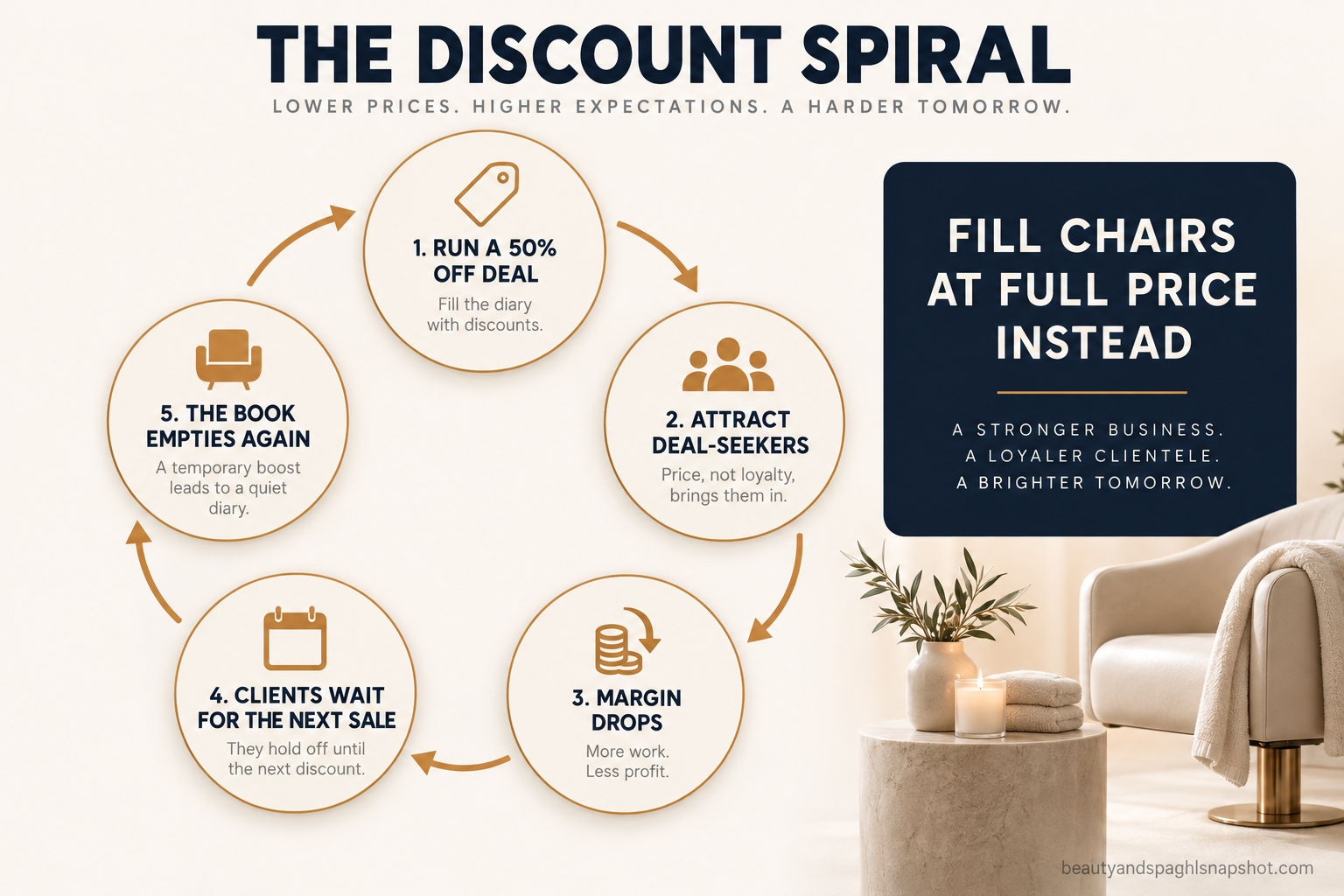
It is a slow Tuesday and the book has three gaps staring back at you. So you do what you always do. You post a flash deal, “40% off facials this week only,” and the slots fill. It feels like a win. It is not. You just taught clients who were already thinking about you to wait for your next sale, and booked a chair with someone who may never pay full price again.
Here is the short version. Discounting works once and costs you forever. A habit of deals lowers the price your clients believe your work is worth, attracts people who shop on price instead of loyalty, and hands a chunk of your margin to Groupon or to your own markdown. The fix is not “never run an offer.” The fix is a system that fills the chair with full-price regulars, so the slow Tuesday stops happening. This is that system, in six parts, with the scripts and the math.
On this page
- What the discount actually costs you
- The six-part full-price system
- Run the whole thing for your size shop
- The objections you are already thinking
- One legal note before you run an offer
- FAQ
What the discount actually costs you
Start with the one everybody misreads: Groupon. The model is simple and brutal. You list a deal, usually at 50% off or deeper, and Groupon keeps about half of what is left. Industry breakdowns put the standard split near 50/50, per this Search Engine Journal teardown written by a former Groupon employee. Run the math on a facial you normally sell for $100. Half off makes it $50 to the client. Groupon keeps about half of that. You see roughly $25, minus product and an hour of a licensed esthetician’s time.
What a $100 facial becomes on a typical Groupon deal, using the ~50% off plus ~50% platform split described by Search Engine Journal. Your product cost and staff time still come out of that $25.
Your own “20% off” is gentler on the surface and more dangerous underneath, because it never stops. When a client sees your price drop on a slow week, their brain quietly rewrites what your service is worth. Economists call that a reference price, and a 2016 review in the Journal of Business Research found that price promotions lower a brand’s reference price and are less profitable for brands with loyal customers. Every discount teaches your regulars that your real price is the sale price, and the number on your menu starts to feel like a suggestion.
Then there is the client you actually attract. A landmark set of field experiments by Anderson and Simester, published in Marketing Science, found that deep discounts raised future purchases from brand-new customers but reduced them from established ones, and increased deal sensitivity overall. A deal can win a first-timer. It also makes your loyal base shop harder on price. That is the trap in one sentence.
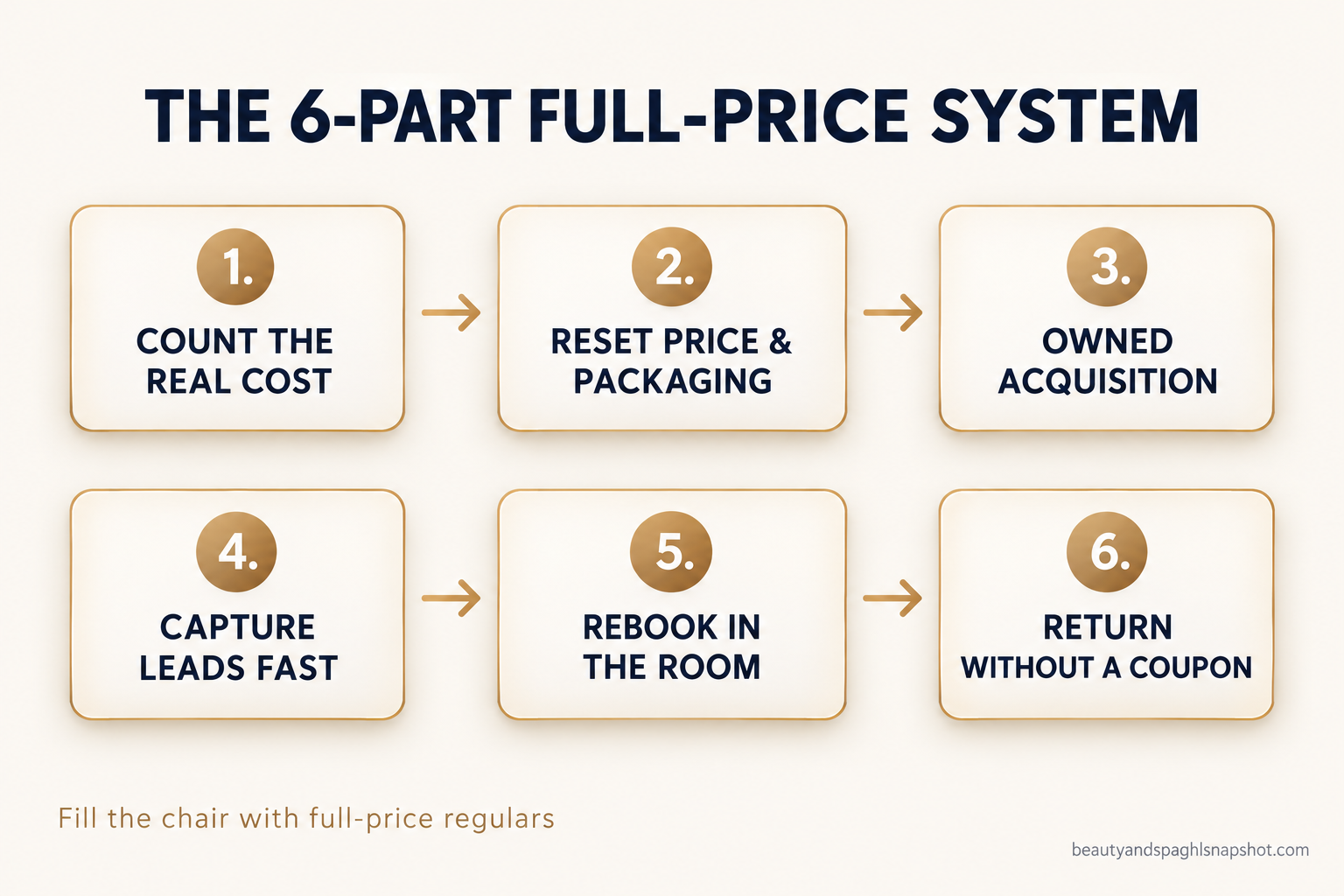
The six-part system to fill chairs at full price
The goal is not to swear off offers forever. It is to build enough of a client machine that you are not reaching for a markdown every slow week. Here are the six parts, in the order they matter. Each one includes how it breaks, because that is where most owners lose the thread.
Part 1: Count the real cost before you run anything
Before you fix discounting, you have to see it. Pull the last three months and tag every discounted booking: Groupon, flash sale, “first visit 30% off,” friends-and-family, the lot. For each one write down the price you banked after fees and product, and whether that client came back at full price. Most owners have never run this, which is exactly why the habit survives.
The number that stops people cold is the rebook rate on deal clients versus full-price clients. If your Groupon crowd rebooks at full price far less than your referral clients, you are not running a promotion, you are buying one-time visits at a loss and calling it marketing.
How it breaks: you count the revenue and skip the rebook column. A deal that “brought in 40 new clients” is only a win if those clients come back and pay. Track the second visit, not the first.
Part 2: Reset your price and your packaging
If you discount constantly, your menu price is probably a fiction nobody pays, and that is the first thing to fix. Set a real price you can defend, then give clients a way to spend more that is not a discount. The cleanest tool is good-better-best. Offer a standard facial, a premium version with an add-on, and a membership or package that locks in the best per-visit rate. Most people pick the middle. You raised the average ticket without marking anything down.
Packaging also kills the “can I get a deal” conversation, because the answer becomes “the best value is the package or the membership,” not “sure, 15% off.” Our breakdown of how a spa membership program crosses $20k a month walks through the pricing.
How it breaks: the gaps are wrong. If premium is only $10 more than standard, nobody trades up. If the package saves 40%, you just rebuilt a discount with extra steps. Price the middle tier so it is the obvious choice and the package so it rewards commitment, not bargain hunting.
Part 3: Trade discount acquisition for owned acquisition
The reason the slow Tuesday keeps coming back is that your new-client pipeline depends on deals. Replace it with channels you own. Reviews, referrals, and local search bring in people who chose you on merit, and they rebook far better than a coupon crowd. A steady stream of fresh Google reviews each month does more for a slow week than any flash sale, because it feeds the local search results where buyers with real intent are looking. Ask every client honestly, within Google’s review policies, not only the ones you expect to rave.
Referrals are the highest-trust clients you will ever get, and they arrive expecting to pay. A “bring a friend, you both get a complimentary add-on” rewards loyalty with value instead of price, and costs you a $12 product, not 50% of the ticket.
How it breaks: you ask for reviews and referrals by hand, remember for a week, then stop. Owned acquisition only works when the ask is automatic, fired after every visit, every time, without you thinking about it.
Part 4: Capture and answer every lead fast
Here is a discount you are running without knowing it. Every lead who calls while you are mid-treatment and gets voicemail, every Instagram DM that sits for six hours, every form nobody answers, that is lost full-price revenue you then try to win back with a markdown. Speed is the cheapest fix in this whole list.
The move is a missed-call text-back and an instant reply to every form and DM, so a lead who reaches out at 7:40pm gets a warm, human text in seconds instead of silence. We covered the mechanics in speed-to-lead for spas and the missed-call text-back setup. When you catch leads at full intent, you book them at full price, and you stop discounting to resurrect the ones who went cold.
How it breaks: the auto-reply sounds like a robot and the lead feels processed, not welcomed. Write it the way you would text a friend who asked about a facial. One warm line, one question, one easy next step.
Part 5: Rebook before she leaves the room
The single biggest reason spas feel forced to discount is that clients do not come back on their own, so the book empties and panic sets in. Fix the rebook and the slow week shrinks. The best moment to book the next visit is before the current one ends, while the client is relaxed and happy and still in the chair. A provider who says “let’s get you back in four weeks” out loud rebooks far more often than a reminder text sent later.
Back that up with an automated nudge for anyone who left without rebooking, and a reactivation sequence for lapsed clients. We went deep on the second-visit drop-off and why the first-to-second visit is where most spas leak money. A full-price regular who comes six times a year is worth more than a dozen Groupon one-timers, which is the whole point of understanding your client lifetime value.
How it breaks: rebooking depends on one person remembering to ask. Make it a step the provider cannot skip at checkout, and let the automation catch everyone who still slips through.
Illustrative first-year value of three clients for a $100 facial: a deal one-timer who never returns, a full-price first visit, and a full-price regular who rebooks every eight weeks. The gap, not the exact dollar, is the point.
Part 6: Give a reason to return without a coupon
When you do want to drive a slow week, reach for value, not price. A complimentary upgrade, a free add-on, a members-only early booking window, a small gift with a package, all of these move behavior without rewriting your reference price. The client feels like they got something extra, your menu price stays intact, and you spent product cost instead of margin.
If you still run a real discount, keep it fenced: new clients only, time-boxed to a genuinely dead window, or tied to a prepaid package. The difference between a smart offer and the discount spiral is whether it brings in people who then pay full price, or trains the people you already have to wait for the next markdown.
How it breaks: the “new clients only” offer leaks to regulars, who now expect it too. Pin every offer to a rule your system enforces, not a promise you police by hand.
Run the whole thing for your size shop
The system is the same, but the first move is different depending on how big you are. Here is where to start.
The solo operator, one or two chairs. You feel every slow day personally, so you are the most tempted to discount, and the most hurt by it, because you have no volume to absorb a 50% cut. Start with Part 4 and Part 5: catch every lead fast and rebook in the room. You do not need a marketing budget, you need to stop leaking the clients you already touch. Kill Groupon first, because at $25 banked on a $100 facial, one no-show wipes out the next three deals.
The mid-size shop, three to four providers. Your problem is consistency. One provider rebooks beautifully, two forget, and the front desk discounts to fill the gaps. Start with Part 2 and Part 6: reset packaging so there is a clear best-value path, and standardize offers so nobody hands out a random 20% to hit a daily number. Then automate the rebook so it does not depend on which provider is working.
The multi-location or chain owner. Your risk is that discounting becomes policy, baked into every location’s slow-week playbook, with nobody seeing what it costs across the group. Start with Part 1 at the portfolio level: tag discounted bookings by location and compare rebook rates. You will almost certainly find one location propping up its numbers with deals that look fine locally and bleed margin group-wide. Then roll the full-price system out as the standard.
The objections you are already thinking
“But discounts fill my slow Tuesdays.” They do, and that is the problem, because they fill them with people who only come when it is cheap, so next Tuesday is slow again. A value-add offer, a members-only early slot, or simply rebooking last week’s happy clients fills the same gap with people who pay full price and come back.
“My clients only come for deals.” Some of them, because that is what you trained them to expect. The way out is not a cliff. Hold your price, add value instead of cutting it, and let the deal-only crowd churn while your referral and review pipeline brings in people who chose you on merit.
“Groupon brings me people I’d never reach.” Sometimes true. The test is simple, and you already have the data from Part 1: what share of your Groupon clients rebook at full price? If it is low, Groupon is not acquisition, it is a paid sample you give away at a loss. If a real slice rebooks, cap it, treat it as a one-time trial, and get those clients onto your own booking link immediately so you never pay the cut twice.
“If I stop discounting, I’ll lose clients.” You will lose some, and they will be the least profitable ones you have, the people who were only ever going to come at a markdown. Meanwhile the regulars who pay full price stop watching for your next sale, which actually raises what the average client spends. Losing deal-chasers is not a cost. It is cleanup.
“I have to discount to compete with the chains.” You do not beat Massage Envy or a franchise on price, you beat them on the experience and the relationship they cannot personalize. We laid this out in competing with the chains as an independent. Racing a franchise to the bottom on price is a race you are built to lose.
One legal note before you run an offer
Two rules keep a smart offer from becoming a problem. First, if you advertise a “was $X, now $Y” price, the former price has to be one you actually sold at, not a number you inflated so the discount looks bigger. That is the core of the FTC’s Guides Against Deceptive Pricing, which treat a fictitious former price as deceptive. Second, never tie a discount or a gift to getting a positive review. The FTC’s rule on fake and suppressed reviews, in effect since October 2024, prohibits buying reviews and conditioning incentives on them being positive. Ask every client for an honest review. Do not pay for a good one.
These are general notes, not legal advice. The FTC’s advertising guide for small business is a plain-English starting point, and if you run aggressive promotions, have a local attorney check your language.
FAQ
Discounting and full-price pricing: common questions
Is discounting ever okay for a spa?
Yes, when it is fenced and intentional. A new-client-only offer, a genuinely dead-window promo, or a gift tied to a prepaid package can all bring in people who go on to pay full price. The damage comes from the habit: standing discounts and constant flash sales that train your regulars to wait for the next markdown.
What's better than a discount for filling a slow day?
Rebook last week's happy clients before the gap appears, offer a complimentary add-on or upgrade instead of a price cut, open an early or members-only booking window, or text a short waitlist. All of these fill the chair without lowering the price clients believe your work is worth.
Is Groupon worth it for a day spa or med spa?
Rarely as a long-term channel. On a typical deal you net roughly 25% of your normal price after the discount and Groupon's cut. It can work as a one-time trial if you move those clients onto your own booking link immediately and a real share rebook at full price. Track that rebook rate before you run a second deal.
How do I stop clients waiting for a sale?
Stop giving them a reason to. Hold a steady, defensible price, add value instead of cutting it, and run offers only behind rules (new clients, packages, dead windows). When the discount stops being predictable, the waiting fades.
Can I legally advertise a 'was $100, now $60' price?
Only if $100 is a real former price you actually sold at. The FTC's Guides Against Deceptive Pricing treat an inflated former price, set just to make the discount look bigger, as deceptive. When in doubt, check with a local attorney.
How big should a new-client offer be?
Big enough to lower the trial barrier, small enough that it does not reset your price. A free add-on or a package that rewards commitment beats a deep percentage off. Avoid 50%-plus cuts, which attract deal-seekers and anchor your value far below your menu.
Discounting is not a marketing strategy. It is what you reach for when the marketing system is missing. Build the six parts above, catch and rebook the clients you already have, and the slow Tuesday that sent you running for a markdown mostly stops happening. Fill the chair with people who are glad to pay full price, because the experience was worth it and coming back was easy.