
You booked a Friday off months ago. Your sister’s wedding, four hours away. By 9:15 you have texted the front desk twice, approved a reschedule from the car, and told a lash client over DM that yes, you can still fit her in Tuesday. By noon you have answered a stranger’s pricing question on Instagram and sorted out a double-booking. You are at a wedding. You are also, somehow, still at work.
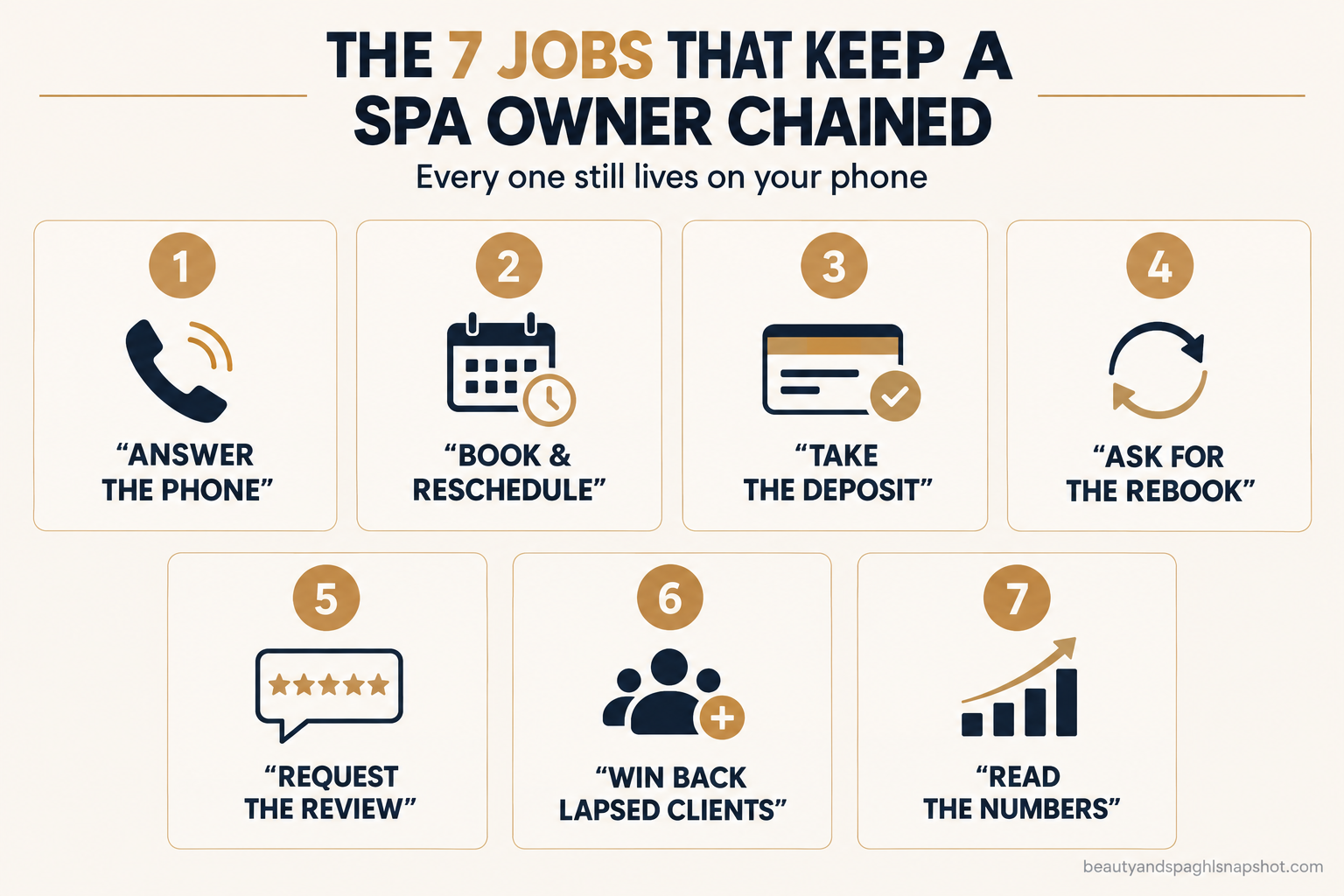
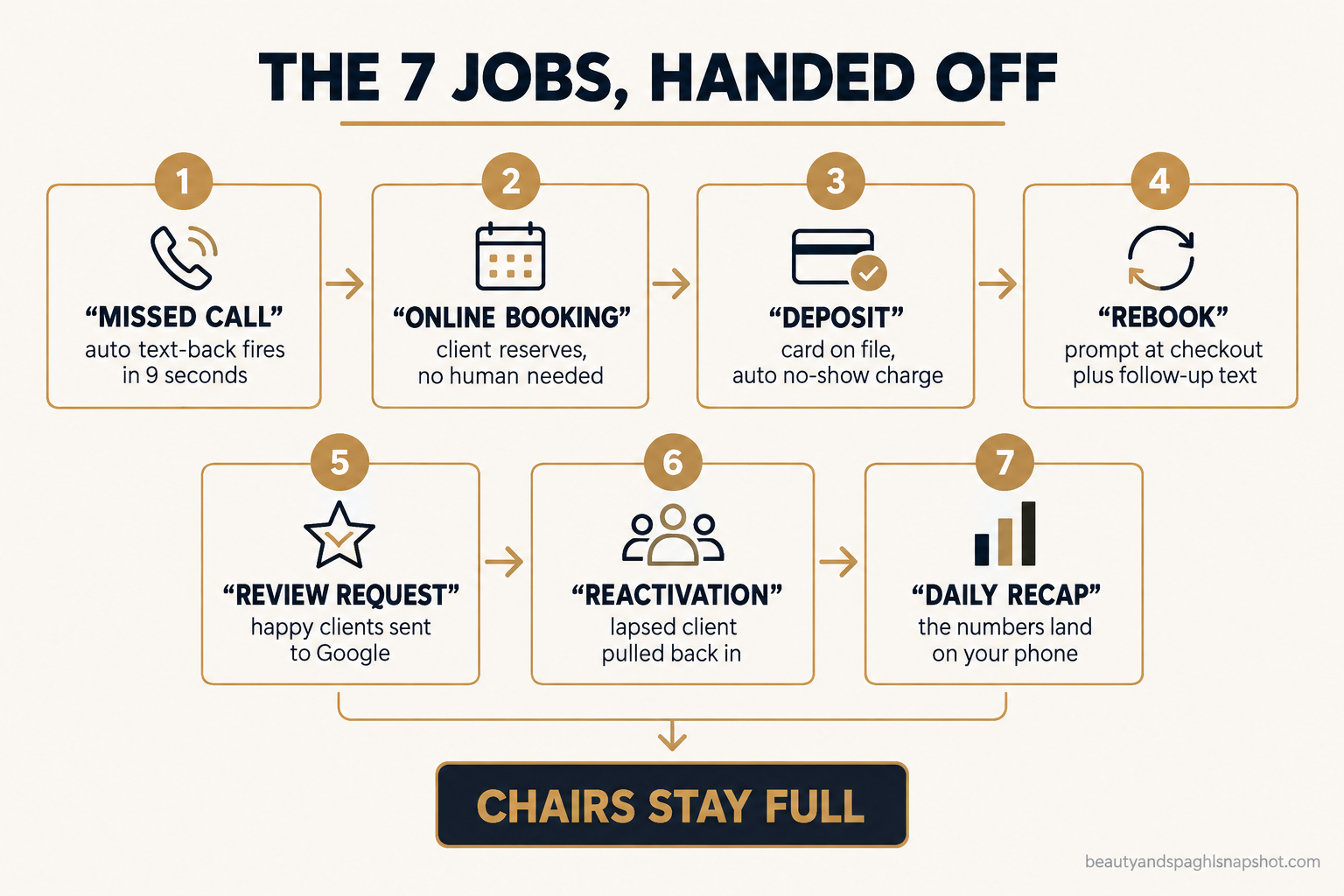
Here is the short version. Your spa can’t run without you because seven specific jobs still live on your phone, and every one can be handed to a system instead. Not fired-the-front-desk automation, and not a robot that talks to clients like a robot. Workflows that answer the phone, hold the slot, take the deposit, ask for the rebook, request the review, win back the client who drifted, and show you the numbers. Below is each job, how it breaks when it depends on a person, and the copy to hand it off.
Table of contents
- What it costs to be the system
- The seven jobs that keep you chained
- Job 1: The phone only you answer
- Job 2: The booking that lives in your DMs
- Job 3: The deposit you enforce by hand
- Job 4: The rebook you forget to ask for
- Job 5: The review you keep meaning to request
- Job 6: The regular who quietly stopped coming
- Job 7: Knowing your numbers
- Solo, mid-size, multi-location
- The compliance line
- Objections
- FAQ
What it costs to be the system
The money you lose being the human glue is invisible, so it never gets fixed. Nobody invoices you for the missed call or the client who did not rebook. The chair sits empty and you blame a slow week.
Start with the phone, the biggest single leak. Moneypenny’s small business call report found 69% of callers who reached voicemail hung up without leaving a message, and the firm’s co-founder put it plainly: buyers simply ring the next supplier on the list (Moneypenny). For a spa, the next supplier is the place two blocks over. That caller was ready to book, but you were mid-facial, so she booked elsewhere and you never knew she called.
Now the quieter leaks. Across the industry, roughly half of all bookings happen after hours, and new-client retention sits near 35%, so two of three first-timers never return (our med spa industry statistics). The U.S. medical spa market has crossed $17 billion and grows more than a billion dollars a year (AmSpa), so demand is not your problem. Catching it is. Every miss traces to one cause: a job that only happened when you had a free hand, and you rarely did.
The point is not that you work too hard. It is that the business has one point of failure, and it is you. The fix is to stop being the backup.
The seven jobs that keep you chained
Walk through a normal day and note every moment a client needs something and you are the only one who can give it. The list is always the same seven: answer the phone, book and reschedule, take the deposit, ask for the rebook, request the review, win back the client who drifted, and read the numbers. Each feels small, but together they are a full-time job in disguise. The goal is to automate the predictable part, not the human touch.
Job 1: The phone only you answer
This one bleeds most, and it is the easiest to fix. The hand-off is a missed-call text-back: the second a call goes unanswered, an automatic text fires from your business number with a greeting, an apology, and a booking link. The caller who would have hung up now has your link instead.
Here is the copy to steal:
Hi! This is [Studio Name], sorry we missed your call, we’re with a client. Did you want to book or ask about a treatment? Reply here or grab a time: [link].
How it breaks when it depends on you: you mean to call everyone back after close, and by then half have booked elsewhere. The 69% who leave no voicemail never register as a lost client at all, so there is nobody to call back.
What callers do when a spa’s phone goes to voicemail. Source: Moneypenny Small Business Call Report.
Full build on this one job: missed-call text-back for spas.
Job 2: The booking that lives in your DMs
Clients book on the channel they are already on: a text, an Instagram DM, a Facebook message, a form on your site at 10 at night. When all of those funnel to your phone, you become the calendar, and the calendar closes when you sleep.
The hand-off has two parts: real online booking that shows live availability and lets a client reserve without a human in the loop, and a single inbox that pulls every channel into one place, so a question on Instagram and one by text are the same job.
Speed is the whole game. Harvard Business Review’s study of online sales leads found that contacting a lead within an hour made a meaningful conversation with a decision-maker roughly seven times more likely than waiting one more hour (HBR). A spa inquiry is the same: the client messaging three studios at once books with whoever answers first.
How it breaks when it depends on you: the DM you swear you will answer after lunch gets buried, and the client books with the studio that replied in two minutes. More in speed to lead for spas.
Job 3: The deposit you enforce by hand
Every owner says they take deposits. Most take them only when they remember. A policy you enforce by mood is not a policy.
The hand-off is a card saved at booking plus a confirm-and-remind sequence that runs itself. The client reserves, enters a card, and agrees to your terms in one step. The system then sends a confirmation, a reminder two days out, and a morning-of nudge, each with an easy reschedule link. If they no-show or cancel late, the fee charges automatically. You never have the awkward conversation, because they agreed in writing before they sat down.
Reminders alone move the number more than people expect. In a controlled study of outpatient appointments, the no-show rate was 23.1% with no reminder, 17.3% with an automated reminder, and 13.6% with a staff reminder call (Am J Med, PubMed). A spa is not a clinic, but the behavior is identical: a person who gets reminded, and who left a card, shows up.
No-show rate by reminder type, outpatient study. Source: Parikh et al., American Journal of Medicine (PubMed).
How it breaks when it depends on you: you chicken out. The client pushes back once, you waive the fee, and word gets around that the policy is a bluff. A system charges every time, and a waiver rule still lets you forgive the client who deserves it. Full build in our no-show deposit policy guide.
Job 4: The rebook you forget to ask for
This is the quiet killer. A client finishes a great facial, pays, and leaves, and nobody asks when she is coming back. She meant to rebook; six weeks became six months.
The hand-off is a rebooking prompt baked into checkout plus a follow-up for anyone who leaves without one. At the desk, the ask is a script, not a judgment call: “Your next one lands around [date], want me to hold your usual time?” For the ones who slip out, a text goes at the right interval for the service, with a one-tap link.
The numbers reward this. Industry benchmarks put a healthy salon rebooking rate at 50% or higher, the best studios above 65%, while the average shop sits at just 30 to 40% (Strategies). The gap between 35% and 60% is not a marketing budget. It is a question you are not asking and a text you are not sending.
How it breaks when it depends on you: the desk is slammed, the question gets skipped, and the follow-up text never gets written because you are the one who has to write it. Automate the ask and it happens every time. See how first visits leak in our piece on the second-visit drop-off.
Job 5: The review you keep meaning to request
Reviews are the one marketing asset that compounds, and the thing owners most reliably forget, because asking feels awkward when you are standing right there.
The hand-off is an automatic review request that fires a few hours after the appointment, when she is home and still glowing. A short, warm text asks how it went and sends happy clients straight to your Google listing with a one-tap link. If someone signals they were not thrilled, the same flow routes them to you privately first, so you fix the problem instead of collecting a public one-star.
Reviews are now the storefront. BrightLocal’s 2025 consumer survey found only 4% of people say they never read online reviews, and 63% lose trust in a business after seeing mostly negative ones (BrightLocal). A steady drip of fresh five-star reviews is what makes the next stranger choose you, and it builds whether you remember to ask or not.
How it breaks when it depends on you: you ask the clients you happen to be chatting with and forget the rest, so the count crawls. Worse, the unhappy client is the one who reviews unprompted. Our getting 12 Google reviews a month has the full sequence.
Job 6: The regular who quietly stopped coming
Nobody tells you they are leaving. A client who came every month just stops. The calendar still looks busy, so you do not notice for a while, and by the time you do, she has a new place.
The hand-off is a reactivation workflow that watches for lapse and acts without you. The system knows a facial client is overdue at, say, ten weeks, and sends a gentle, specific text that reads like you noticed, not a blast. A small, honest incentive on the second touch is fine. It runs off the booking data you already have, so the win-back happens whether or not you looked at the report.
How it breaks when it depends on you: you would have to run a report, cross-reference last visits, and hand-text each lapsed client, so you never do, and a slow month arrives with no warning. Our reactivation playbook has the exact messages.
Job 7: Knowing your numbers
The last job is the one owners skip entirely, then regret. You cannot fix a leak you cannot see, and right now the only way you see anything is to log into three tools and do math at 11 p.m.
The hand-off is a single dashboard plus a short recap that lands on your phone each morning: bookings, no-shows, revenue, rebooking rate, reviews, reactivations. The business tells you how it is doing without you digging, so when a number moves the wrong way you see it on day two, not at the end of a bad quarter.
Solo, mid-size, and multi-location
The seven jobs are the same at every size. What changes is which one is on fire and what you hand off first.
The solo operator or booth renter. You are the owner, provider, and front desk, and you cannot answer the phone during a service. Jobs 1 and 2 are everything: missed-call text-back and online booking buy back the hours you lose to your own hands being busy, so you reclaim your evenings without hiring. Deposits come next, because one no-show is a bigger share of your week.
The mid-size team, two to six providers. Now the problem is consistency: one provider rebooks every client, another never asks; one person chases reviews, the other forgets. Automate Jobs 4 and 5 so rebooking and reviews happen the same way no matter who is working, and let the dashboard show whose column is leaking.
The multi-location chain owner. You are not at any single location on a given day, so every job has to run without you in the building. Standardize all seven so a client gets the same confirmation, reminder and rebooking nudge everywhere, and reactivation runs on the whole database. The business you built to scale only scales if the front desk is a system, not a person you clone.
The compliance line you cannot cross
Handing these jobs to automated texts and stored client data means you inherit three rules. Get them right once at setup and you never think about them again.
TCPA, for the texting. Every automated message needs clear opt-in where you collect the number, and must honor STOP immediately. Confirmations and reminders to a client who just booked are expected; marketing blasts need explicit consent. Build opt-in into your forms (FCC on TCPA).
HIPAA, if you are a med spa. A pure day spa doing facials, waxing, massage and nails is generally not a HIPAA covered entity, with no protected health information and no insurance billing. That changes once licensed medical providers perform medical procedures and you run covered transactions. Many med spas are cash-pay and may sit outside covered-entity status, but once medical staff and procedures are involved, keep intake forms, treatment photos and consult notes out of plain SMS and unsecured email (HHS on HIPAA). This is not legal advice, check your setup with counsel.
FTC, for the reviews. Review-gating, only asking happy clients to post while steering unhappy ones away, is an explicit violation under the FTC’s 2024 rule on reviews and testimonials. Routing a dissatisfied client to you privately while still letting everyone post is fine; blocking the unhappy ones is not. Before-and-after results must be typical or clearly disclosed (FTC). Our full HIPAA, FTC and TCPA guide covers all three.
Objections
“Won’t automated texts feel cold and annoying?” They feel cold when they are written like a bank and sent at the wrong time. Written in your voice, a missed-call text and a rebooking nudge read like a thoughtful front desk. Clients do not resent being answered fast and remembered, they resent being ignored. The test: read it out loud, and if it does not sound like your best receptionist, rewrite it.
“I already pay for Mindbody or Vagaro, isn’t this what I’m paying for?” Your booking tool books appointments, a different job than filling them. Most platforms do some of the seven, often with the texting and follow-up behind paid add-ons. The real question is whether it is actually set up and running, in your voice, right now, without you. Usually it is not.
“What if I lose the personal touch that makes my spa special?” You keep the touch that matters and shed the parts that were never personal. A client does not feel loved because you personally typed the reminder. She feels loved because the facial was incredible and she got remembered. Automation handles the remembering so your hands are free for the facial. That is more personal, not less.
Finish the day off
Back to the wedding. Picture the same Friday with the seven jobs handed off. The missed call texts the client back and she books herself. The DM gets an instant reply and a link. The two no-shows get charged the deposits they agreed to. Three clients rebook at checkout, and a lapsed regular gets a note that pulls her back in. That evening a recap hits your phone; you read it in six seconds and put it away.
That is the difference between a spa that needs you and one that works for you. The chairs do not care whether you are in the building, only whether the system is. Build it once, and the day off stops being a fantasy you schedule and then work through anyway.
FAQ
How do I make my spa run without me being there?
Move the seven front-desk jobs off your phone and into workflows: missed-call text-back, online booking, deposits with reminders, rebooking prompts, review requests, reactivation, and a daily numbers recap. Each is a predictable task a system can do the same way every time, so the chairs keep filling whether or not you are in the building.
What is the fastest way to stop losing clients when I can't answer the phone?
A missed-call text-back that fires from your number the moment a call goes unanswered, with a greeting and a booking link. About 69% of callers who reach voicemail hang up without a message and ring the next business, so the text catches a client who would otherwise be gone.
Isn't this what Mindbody or Vagaro already do?
Those tools book appointments, a different job from filling them. Most do only part of the seven jobs, and the texting and follow-up are often paid add-ons. The real question is whether the workflows are set up and running in your voice right now, without you.
Do I need to be HIPAA compliant to automate spa texts?
A pure day spa doing facials, waxing, massage and nails is generally not a HIPAA covered entity. A med spa with medical providers and covered transactions can be, and even cash-pay med spas should keep intake forms, treatment photos and consult notes out of plain SMS and email. Confirm your own setup with counsel.
How much does automated rebooking really help?
A lot. Industry benchmarks put a healthy salon rebooking rate at 50% or higher and the best studios above 65%, while the average shop sits at 30 to 40%. Closing that gap is mostly a checkout question you are not asking and a follow-up text you are not sending.