
It is the last Friday of the month and you are looking at a number you already know: how much came in. Then the quieter question. How much of that is coming in again next month, before a single new client books? For most spas the honest answer is “almost none,” because everything resets to zero on the first. A membership changes that answer. Not a punch card, not a loyalty app nobody opens. A real monthly agreement where the client pays in advance, visits more often, and stays longer, so your Tuesday is booked before you wake up.
Here is the short version, because you have a front desk to run. A membership works when the offer is simple enough to explain in a sentence, the agreement is something clients actually consent to, the billing keeps running when a card expires, and you have a script for the day someone tries to cancel. Get those four right and you build a floor under your revenue. Get one wrong and you build a refund queue and a pile of chargebacks. Below is the whole build, with the copy to steal.
Table of contents
- Why a membership beats a better month
- The six-stage build, start to finish
- Stage 1: Design an offer you can explain in one sentence
- Stage 2: Write the agreement and capture real consent
- Stage 3: Set up billing that survives a declined card
- Stage 4: Enroll clients at the moment they already love you
- Stage 5: Drive usage in the first 60 days
- Stage 6: Save the cancel and win back the lapsed
- Solo, mid-size team, and multi-location
- The legal line: auto-renewal rules you cannot ignore
- Steal these: agreement clauses, scripts and messages
- Objections
- FAQ
Why a membership beats a better month
A single good month is a lucky month. A membership base is a decision you made last quarter still paying you today, and the data backs the feeling. Zenoti reports that spas selling memberships earn about 22% more revenue than those that don’t, and that membership-focused spas run a median average ticket of $144 against $103 at non-membership spas (Zenoti). Members spend more per visit and come in more often, because they have already paid and do not want to waste it.
The timing matters too. In a year when new-guest visits across beauty and wellness fell by roughly 8 to 11%, membership sales still grew about 10% (Zenoti 2026 Benchmark). When fewer new faces walk in, the spas that keep the ones they have keep growing.
With the med-spa and aesthetics market now past $17 billion and growing by more than a billion dollars a year (AmSpa), more spas than ever are chasing the same regulars with the same discounts. A membership is how you stop renting clients by the visit. For which tier to set and the break-even math, pair this build with our piece on the math behind a $99 membership.
The six-stage build, start to finish
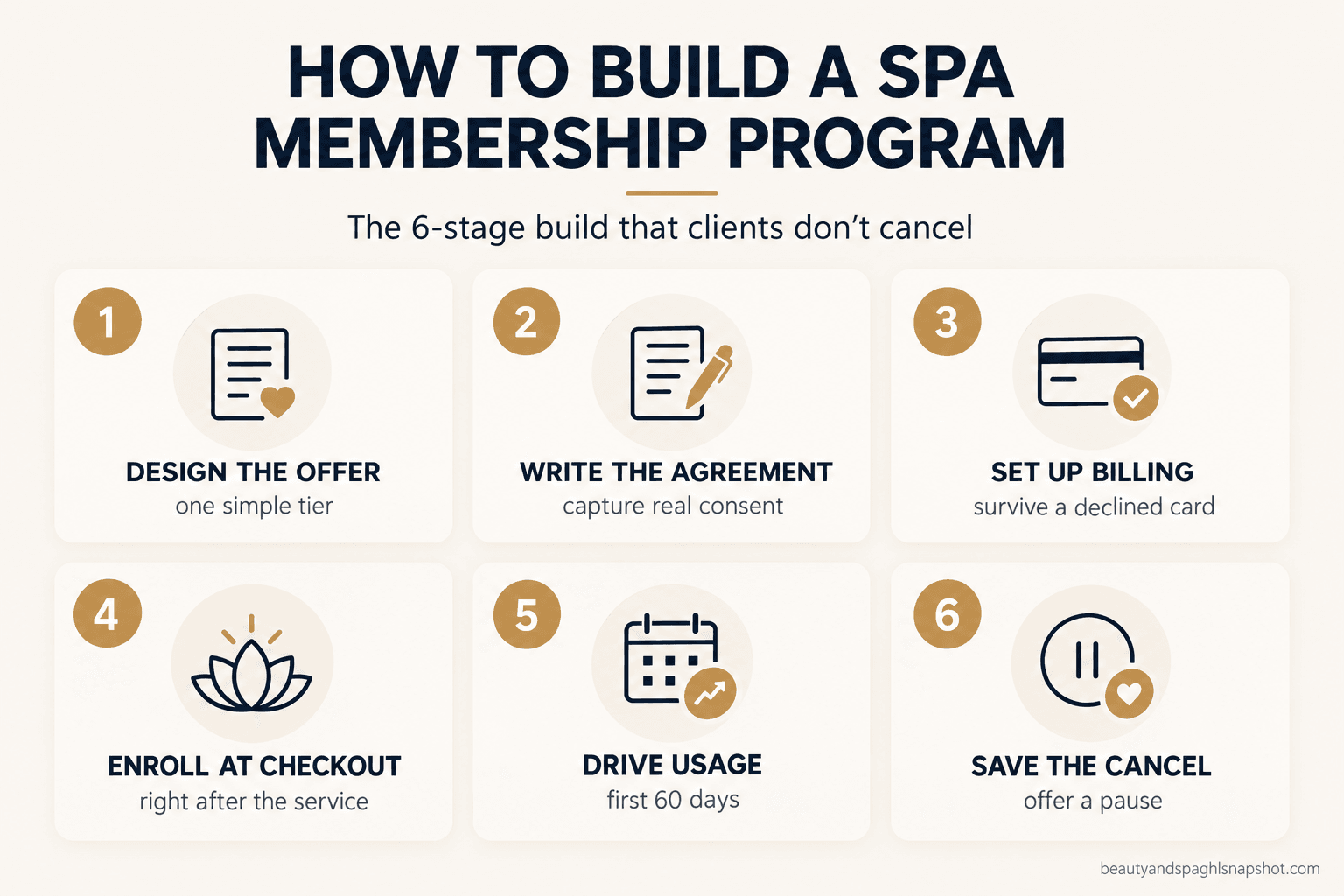
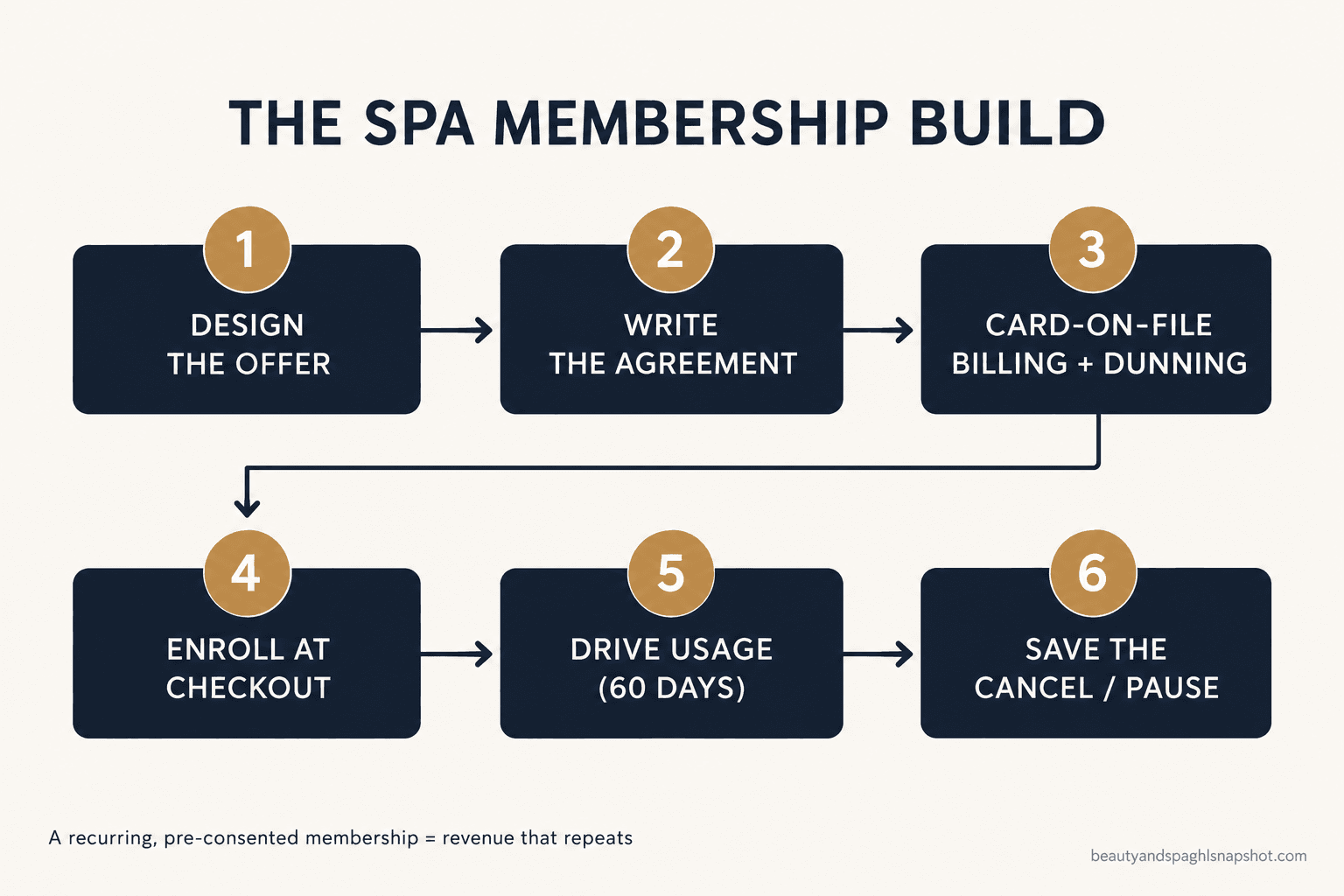
Here is the whole thing in order: design the offer, write the agreement and capture consent, set up billing that survives a declined card, enroll at the right moment, drive usage in the first 60 days, and save the cancel before it happens. Each stage has a way it quietly breaks, so I have flagged how under every one.
Stage 1: Design an offer you can explain in one sentence
If your front desk cannot pitch the membership in one breath, nobody will join, so the first rule is simplicity. Pick one anchor benefit, usually a monthly service the client already buys (a facial, a massage, a hydrafacial), and build the price around it. The member pays a set monthly fee, gets that service, and gets a standing perk on everything else: say 15% to 20% off retail and add-ons, plus member-only booking windows.
Keep tiers to two or three, no more. A single tier is the easiest to sell and run. If you add a second, make it an obvious step up (two services a month, or a premium treatment), not a confusing grid. Then settle the unused-visit question: let a skipped month roll over once, then expire. Rollover feels generous and reduces cancel pressure, but let it stack forever and you owe a growing pile of visits. State the rule plainly up front.
How it breaks: you design a program for yourself, not the client. A five-tier menu with blackout dates and a points system is a program only a spreadsheet could love. If the pitch takes more than two sentences, cut until it does.
Stage 2: Write the agreement and capture real consent
This stage decides whether your billing holds up or falls apart, and it is the one most spas skip. A monthly charge that recurs forever is, legally, an automatic renewal, so the client has to clearly agree to the recurring terms, in writing, before the first charge, and you have to be able to prove it later.
So the agreement is written in plain English, presented at signup, and accepted with a real action: a checkbox they tick themselves, a signature, or a texted “I AGREE” you can timestamp. It names the monthly fee, the billing date, what is included, the rollover rule, how to pause, and how to cancel, with the renewal terms getting their own line and their own consent, not a sentence buried in a PDF nobody reads. The exact clauses are in the steal-this section below.
The reason for this much care over a $99 charge: the moment a client disputes a renewal she says she never agreed to, your paperwork is the only thing between you and a reversed charge plus a dispute fee. A pre-agreed, clearly disclosed recurring charge is one of the most defensible a small business can make. One she “didn’t know about” is a chargeback you lose by default.
How it breaks: the renewal terms live only in a general terms-of-service link, with no separate consent, so when the client disputes, you cannot show she agreed to the recurring part specifically. Capture the consent to the renewal as its own step, and keep the timestamped record.
Stage 3: Set up billing that survives a declined card
Here is the leak nobody warns you about. You sign up fifty members, and six months later you are quietly down a handful of them, not because they quit, but because their cards expired or got declined and the charge silently failed. In the subscription world this is called involuntary churn, and it accounts for roughly 20% to 40% of all cancellations (Recurly). Recurly projected that failed payments would cost subscription companies more than $129 billion in 2025 (Recurly). These are people who wanted to keep paying you and whose money never arrived.
Card-on-file is the start, not the finish. The finish is a dunning step: when a charge fails, the system retries it on a smart schedule and texts the member a one-tap link to update the card, warmly, before her membership lapses. That single automated message recovers members you would otherwise lose without ever knowing they were gone. Set the billing date to the same day each month, send a receipt every time, and make updating a card the easiest thing she can do from her phone.
How it breaks: the charge fails, nothing happens, and the member finds out three months later when she goes to book and her account is dead. Now it feels like your fault, and you have lost a regular over an expired card. A retry-and-remind step turns that silent loss into a two-tap fix.
Stage 4: Enroll clients at the moment they already love you
The best time to sell a membership is not an email blast. It is at the front desk, in the thirty seconds right after a treatment, when the client is relaxed, glowing, and already reaching for her card. That is where enrollment lives.
The pitch is not a pitch, it is a helpful observation framed as math. “You come in about once a month for the facial anyway, right? The membership is basically the same price, you get 20% off your products, and it saves you about $X a year. Want me to set it up while you’re here?” You are not selling, you are pointing out that she is already a member in everything but name. Train every provider to run that line after the service, and reinforce it with a short follow-up two days later for the “let me think about it” clients. The front-desk mechanics live in our post-service rebooking scripts.
How it breaks: enrollment depends on one person remembering to mention it. The owner sells it beautifully, the part-time Saturday staffer never brings it up, and growth stalls on the days you are not there. Make the ask a standard step at checkout, not a personality trait.
Stage 5: Drive usage in the first 60 days
A member who does not use the membership cancels it. Zenoti puts healthy member utilization, the share of members actually using their monthly benefit, at 60% to 75%, and warns that below 60% signals high cancellation risk (Zenoti). The first sixty days set the pattern: if a new member books her first two monthly visits she keeps the habit, and if month one slips by unused she starts to feel like she is paying for nothing.
So treat the first two months as onboarding, not autopilot. The day she joins, book her first member appointment before she leaves. A week before each monthly benefit, send a friendly nudge: “Your November facial is included and ready whenever you are, want me to grab you a Tuesday?” If a month is about to expire unused, say so, because a member who got reminded feels looked-after, not nagged. Make the monthly charge always land next to a visit she loved, never next to nothing.
How it breaks: you enroll the member and then go quiet until the next charge. She forgets to book, the month lapses, the charge hits anyway, and now the membership feels like a gym she never goes to. Book the next visit before she leaves, every time.
Stage 6: Save the cancel and win back the lapsed
Cancellations are a conversation you get to have before you lose someone, and the trick is to make the save easier than the quit. Zenoti reports that offering a pause option converts 30% to 40% of cancellation requests into temporary holds instead of losses, and that a structured win-back sequence recaptures 15% to 25% of lapsed members (Zenoti). Those are members you keep for the price of one good message.
So when someone asks to cancel, the system offers a graceful off-ramp first: pause for one, two, or three months with the rate locked, no pressure. People cancel for seasons, not forever, and a pause honors that while keeping the relationship alive. If she still wants out, let her, cleanly, because a messy cancel is a one-star review. Then the win-back runs on its own timeline: a check-in a few weeks later, a specific offer to come back at her old rate after that. We go deeper in our win-back playbook for lapsed clients.
How it breaks: cancellation becomes a hostage negotiation. You hide the cancel button, make her call during business hours, and guilt her on the phone. She wins anyway, tells her friends you are hard to quit, and you trade one membership for your reputation. Make leaving easy, make staying easier.
Solo, mid-size team, and multi-location
The same six stages run differently depending on your size.
Solo operator or booth renter. A membership is your best defense against a slow month, because it pre-books your calendar and smooths cash flow. Start with one simple tier built on the service you do most, set the billing and dunning to run automatically so you never personally chase a declined card, and book the next visit at the end of every appointment. Keep the agreement airtight from day one, because when you are the whole business, one lost dispute is real money.
Mid-size team (3 to 8 providers). Now consistency is the problem. One provider sells memberships at every checkout, another never mentions them, and growth tracks whoever is working. Make enrollment a standard checkout step on every calendar, with the same one-line pitch. Watch utilization per provider too, because a provider whose members rarely rebook is a cancellation wave you can see coming.
Multi-location. Decide early whether a membership is usable at every location or tied to one, because “it depends which manager you ask” is how you lose a traveling regular. You want one agreement, one billing structure, one pause-and-cancel policy, and one dashboard showing member count, utilization, and recovered failed payments per site. The save and win-back scripts have to be shared, or every location runs a different program.
The legal line: auto-renewal rules you cannot ignore
A recurring membership charge is an automatic renewal, and automatic renewals are regulated. The headline is confusing right now, so here is the plain version. The FTC’s federal “click-to-cancel” rule, the one that would have forced simple online cancellation nationwide, was vacated by the Eighth Circuit on July 8, 2025, on procedural grounds (Benesch). It is not in effect. That is not a green light to get sloppy. The FTC can still act against deceptive recurring charges under its existing authority, and state auto-renewal laws never went anywhere, many of them stricter than the federal rule would have been.
California’s Automatic Renewal Law, expanded by AB 2863 and in effect since July 1, 2025, is the one to design around, because it is the toughest and many states echo it (Cooley). It requires express affirmative consent to the renewal terms, separate from the rest of the agreement, with no pre-checked boxes; a cancellation at least as easy as signup, without forcing the client to call a live person; and proof of that consent kept on file. Build Stage 2 and Stage 6 the way this guide describes and you are already most of the way there. For what you can legally text, charge, and advertise, see our spa marketing compliance guide.
Steal these: agreement clauses, scripts and messages
Copy these, swap in your numbers, keep the voice warm, and you have a working program today. These are templates to adapt with your attorney, not finished legal documents.
1. The membership agreement core (shown at signup, accepted with a ticked box or signature):
I’m joining the [Spa] Glow Membership for $99/month, billed on the [1st] of each month to the card on file. My membership includes one [signature facial] per month plus 20% off retail and add-ons. Unused monthly visits roll over for one month, then expire. I can pause my membership for up to 3 months or cancel anytime with [7] days’ notice before my next billing date, online or by replying to any membership message. I understand my membership renews automatically each month until I pause or cancel.
2. The separate renewal consent (its own checkbox, not pre-checked):
☐ I agree that my membership will automatically renew and bill $99 each month until I cancel, and I know how to cancel.
3. The front-desk enrollment line (right after the service):
You come in about once a month for the facial anyway, right? The membership is basically the same monthly price, you get 20% off your products, and member-only booking times. It saves you around $[X] a year. Want me to set it up while you’re relaxed and here?
4. The failed-card recovery text (sent automatically when a charge declines):
Hi [Name], the card on your [Spa] membership didn’t go through this month, usually just an expired card. Tap here to update it in a few seconds so your membership and your [service] stay active: [link]. Thanks!
5. The cancellation-save offer (sent the moment someone asks to cancel):
Totally understand, life gets busy. Before I cancel, would a pause help instead? I can freeze your membership for 1, 2, or 3 months at your current rate, no charge while it’s paused, and pick right back up when you’re ready. Want me to pause it, or cancel it fully?
6. The win-back (sent 4 to 8 weeks after a cancel):
Hi [Name], we’ve missed you at [Spa]. If you’d like to come back, I can reopen your membership at your old $99 rate, no sign-up fuss. I’ve got a [Tuesday] open this week with your name on it, want it?
Objections
“Won’t a membership just discount the clients who already pay full price?” Only if you build it as a discount instead of a commitment. A good membership trades a small per-visit saving for a monthly commitment and more frequent visits, and the Zenoti numbers show members spend more overall, not less, because of add-ons and retail. You are not cutting the price of a facial, you are buying a year of visits up front. For the full case against training clients to wait for a deal, see why discounting is killing your spa.
“What if I already use Mindbody or Vagaro for booking?” Then you already have card-on-file and recurring billing, so you can start. The gap is almost never the booking tool, it is the pieces around it: the separate renewal consent, the automatic failed-card recovery, the usage nudges, and the pause-and-save sequence, which most tools bury or sell as add-ons with a per-message fee. Getting all of that running on one system is where a setup done for you earns its keep.
“I’m not technical. Isn’t recurring billing complicated to run?” The setup is a one-time job: build the agreement, wire the billing and dunning, write the scripts. After that it runs on its own, and you spend your time doing treatments, not managing software. If wiring it up is the blocker, that is exactly what a done-for-you install removes. To see what a membership does to a client’s lifetime value, read our breakdown of spa client lifetime value.
The bottom line
A membership program is not a loyalty gimmick. It is the difference between a business that resets to zero on the first of the month and one that already knows most of next month is handled. It works when the offer is simple, the agreement is something your client genuinely consented to, the billing keeps running when her card expires, and you have a kind, practiced answer for the day she thinks about leaving. Build those four and you build a floor under everything else.
So back to that last Friday and the quiet question. The answer changes the day you stop selling single visits and start enrolling members. When you want the agreement, the billing, the dunning, the follow-ups, and the save-and-win-back sequence running off one system that installs in a day, the done-for-you spa setup already has every piece wired in.
How much should a spa membership cost?
Price it around one monthly service the client already buys, so the monthly fee is close to what she spends anyway. Many spas land in the $75 to $150 range for a single-service tier, with the member making it back through a monthly treatment plus 15 to 20 percent off retail and add-ons. The exact number depends on your service costs and margins, which is covered in our membership pricing math guide.
Do I need a signed contract for a spa membership?
You need clear, documented consent to the recurring charge, which can be a ticked checkbox, an e-signature, or a texted agreement you can timestamp. A recurring charge is legally an automatic renewal, so the renewal terms need their own affirmative consent, separate from the rest of the agreement, and you should keep that record. Many state auto-renewal laws, led by California's, require exactly this, so have a local attorney review your wording.
Why do spa members cancel, and how do I stop it?
The two biggest causes are low usage and life changes. A member who does not use her monthly benefit starts to feel like she is paying for nothing, so driving usage in the first 60 days is the best prevention. For the ones who still want out, offering a pause instead of a cancel keeps a large share of them, because most people cancel for a season, not forever.
What happens when a member's card is declined?
Across subscription businesses, failed and expired cards cause roughly 20 to 40 percent of all cancellations, and most of those members never meant to leave. The fix is a dunning step: the system retries the charge on a smart schedule and texts the member a one-tap link to update her card before her membership lapses. Without it, you silently lose paying regulars to expired cards.
Should unused membership visits roll over?
A clean approach is to let an unused monthly visit roll over for one month, then expire. Rollover feels generous and reduces the pressure to cancel, but unlimited rollover creates a growing liability of visits you still owe. Whatever you choose, state it plainly in the agreement up front so there are no surprises. The same securely stored card that backs your [no-show deposit policy](/blog/spa-no-show-deposit-policy-2026) can run the monthly charge, so booking, deposits, and membership billing all live on one system.