
It is 6:52 on a Friday and your last client of the week is at the front desk, card out, coat half on, saying “I’ll just call to book my next one.” You smile, say “sounds good,” and she walks out. You both know she will not call, and three weeks from now she is a gap in your Tuesday.
That one exchange, repeated across a week, is where most of your empty chairs come from. Not marketing. Not your prices. The words you use, or do not use, at seven specific moments. The shop that keeps its chairs full is the one that says the right sentence at the right moment, the same way, every time. Below are the exact scripts, the timing, and how each one quietly breaks when you leave it to “whenever someone remembers.”
Table of contents
- Why the words matter more than the marketing
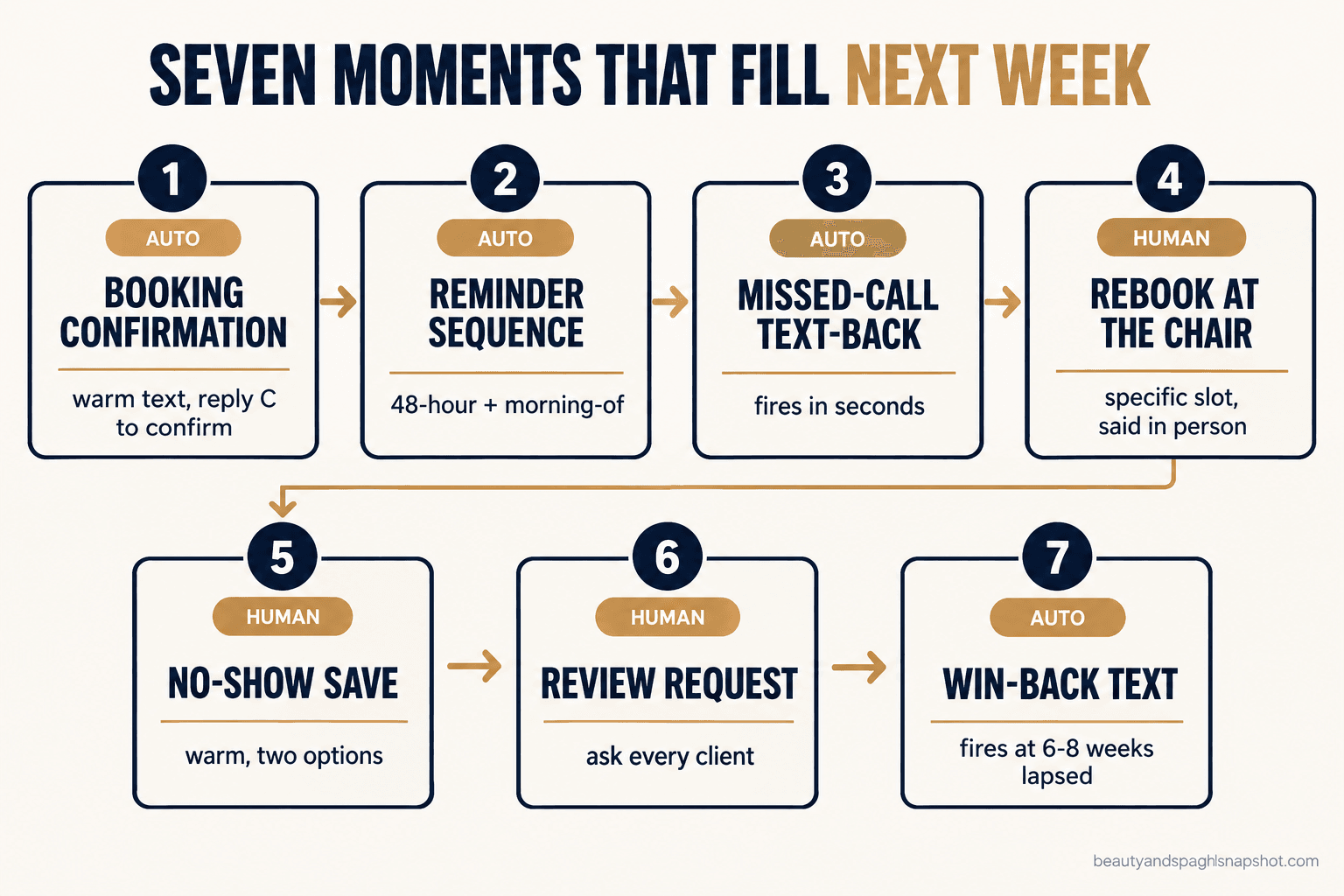
- The seven moments, mapped
- Moment 1: The booking confirmation
- Moment 2: The reminder sequence
- Moment 3: The missed-call text-back
- Moment 4: Rebooking at the chair
- Moment 5: The no-show and late-cancel save
- Moment 6: The review request
- Moment 7: The win-back text
- Solo, mid-size team, and multi-location
- The two scripts that touch the law
- Objections
- FAQ
Why the words matter more than the marketing
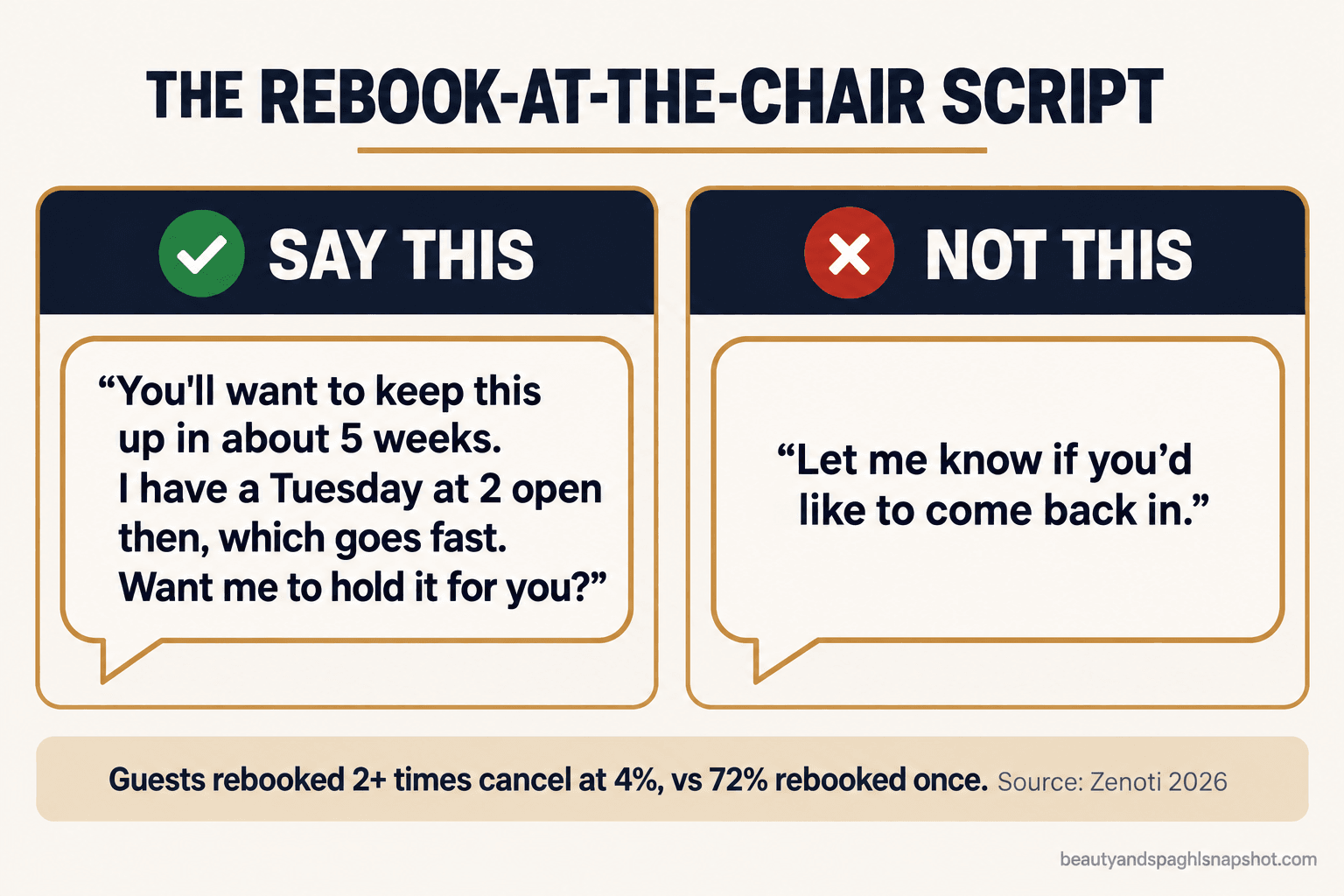
Here is the stat that should change how you run your front desk. In Zenoti’s 2026 salon benchmark, among businesses where a guest was rebooked only once, 72% of those next appointments were cancelled. But guests rebooked two or more times cancelled at just 4% (Zenoti). The gap between a client who returns once and one who returns for good is decided in the small window when you ask her to book the next one.
So the job is not “get more leads.” You already meet dozens of perfect clients a week: they are in your chair, paying you, right now. The job is the sentence that turns this visit into the next one, and most shops fumble it. The fix is free.
At the one moment you could have anchored her to a date, you said “call us anytime.” Fix these seven moments and your calendar stops relying on luck. For why second visits vanish, see the second-visit drop-off.
The seven moments, mapped
Four of the seven should run themselves. The confirmation, the reminders, the missed-call reply and the win-back are texts a system sends on a timer, so they happen whether or not Friday was chaos. Three need a human: the rebook at the chair, the no-show save and the review ask all land better from a real person who was in the room.
Moment 1: The booking confirmation
The second a client books, online or by phone, one text should go out. Not a receipt. A warm, human confirmation that sets the tone and quietly plants the cancellation policy so nothing is a surprise later.
Ask for a one-tap confirm (“reply C”), because a client who actively confirms is less likely to ghost. Name the service, so there is no “was that the facial or the peel” the morning of. Mention the window once, gently, so it reads as housekeeping, not a threat.
How it breaks: a cold automated receipt with no personality, or nothing at all, so the client wonders if the booking even stuck. A stern policy paragraph here reads as “we expect you to flake,” the opposite of the tone you want in moment one.
Moment 2: The reminder sequence
Two reminders, not one. Healthcare evidence is consistent that a text reminder lifts attendance, and a well-worded second nudge adds more on top (NCBI). The phrasing matters too: a large A/B test of appointment messages found wording changed no-show rates measurably (NCBI). So send two, worded like a person.
The 48-hour text catches a conflict while you can still refill the slot. The morning-of text is reassurance plus a friction-remover like parking. For the full anti-no-show system, see our guide to reducing spa no-shows.
How it breaks: one reminder instead of two, or a reminder that only talks at the client with no reply option. If she cannot easily answer “actually, can we move it?”, she just does not show.
Moment 3: The missed-call text-back
You are mid-treatment, hands full, and the phone rings. In most shops that caller dials the spa down the street. The fix is a text that fires automatically the instant a call goes unanswered.
The magic is speed: it turns a call you cannot take into a text thread you can answer between clients. A caller who gets a warm reply in thirty seconds feels looked after; one who gets voicemail feels ignored. We walk through the setup in missed-call text-back for spas.
How it breaks: the auto-reply fires but nobody watches the inbox, so a client who texts back gets silence for three hours. A dead thread is a worse impression than voicemail, because you promised a fast answer and did not deliver.
Moment 4: Rebooking at the chair
This is the one. If you fix a single moment on this page, fix this. The highest-converting rebooking happens while the client is still in the chair, relaxed and happy, not three weeks later when she is busy. The 72% cancellation stat from the top is really about this moment: book the next visit before she stands up, do it again next time, and the drift stops. The trick is to make the next appointment feel like part of this one, with a specific date.
It gives a reason tied to her result, names a specific slot instead of asking “when works,” and frames booking now as the convenience, not the pressure. If she hesitates, fall back to “no problem, I’ll pencil it and text you to confirm tomorrow,” which keeps a date alive instead of “I’ll call.”
How it breaks: “let me know if you’d like to come back in.” That sentence feels polite and costs you the client, because it hands her a decision for later that never comes. The second failure is asking “when would you like to come back?” with no date in hand, turning a ten-second yes into a calendar negotiation she would rather skip.
Moment 5: The no-show and late-cancel save
Someone did not show, or cancelled an hour out. The next message decides whether this was a one-time slip or the last time you see them: warm, zero guilt, rebooking in the same breath.
No “you missed your appointment and per our policy.” This message exists only to rebook, so it leads with care and two concrete options, because a choice between two is easier to answer than an open “want to reschedule?” Deposits help here too, lifting kept appointments about 32% (GlossGenius); our deposit policy guide covers that side.
How it breaks: leading with policy, or leading with guilt. Shame a client for a no-show and you have taught her to avoid you, not to show up. The other break is no follow-up at all, where a no-show becomes a permanent loss instead of a rescheduled Tuesday.
Moment 6: The review request
A happy client will leave you a review if you ask at the right time, a few hours after a great visit while the glow is still there, in the right words. Those words, in 2026, follow one rule below: ask every client, not only the ones you think will rave.
Send it as a text, with a direct link straight to the review form, since every extra tap loses people. What you cannot do is route unhappy clients away from the public review while funneling happy ones toward it, and the compliance section explains why. For a steady rhythm, see how one studio gets twelve Google reviews a month.
How it breaks: asking at the front desk while she is rushing out, or sending a link that dumps her on your Google Business page to hunt for the review button. Friction kills review rates. So does asking days later, when the visit is a blur.
Moment 7: The win-back text
A client you have not seen in six or eight weeks past her usual rhythm is not gone, she is distracted, and one good text brings a surprising number back. Fire it automatically when she crosses her normal visit interval, and make it feel personal, not like a blast.
The voice is a specific person, not “the team,” because a text from Priya reads like a human and a text from a brand reads like spam. It offers to do the work (“want me to send a couple?”) so she just says yes. Our full reactivation playbook has the longer sequences.
How it breaks: a discount-led blast (“WE MISS YOU, 20% OFF”) sent to everyone, which trains clients to wait for the coupon and pulls back the bargain-hunters you least want while leaving your best clients cold. Lead with the person and the service.
Solo, mid-size team, and multi-location
The seven scripts are the same. Who says them, and how you keep them consistent, changes with your size.
Solo operator or booth renter. You are the front desk, the provider, and the one who forgets to text back between clients. Automate the four system messages first, because you cannot send them by hand while working. The chair-rebook is your biggest lever: you are already standing at checkout, so make the specific-slot sentence a habit on every client.
Mid-size team (3 to 8 providers). Now the enemy is drift between people. One provider rebooks with a specific slot, another mumbles “see you next time,” and retention becomes a lottery based on who is working. Make the chair-rebook a trained standard, not a personality trait: put the sentence on a card at every station, role-play it, and track rebook rate per provider so you can coach the ones who skip it.
Multi-location. Consistency is now an operations problem across sites. You want one script library, one message system, and one dashboard showing rebook rate and review volume per location, so a weak front desk shows up as a number instead of a mystery. The failure is letting each manager “do their own thing,” which produces five different client experiences under one brand name.
The two scripts that touch the law
Most of these scripts are just good manners. Two of them, the review request and any marketing text, have hard rules in 2026, and getting them wrong is expensive. The good news: the compliant versions convert just as well.
Review requests: ask everyone, or do not ask. The FTC’s rule on consumer reviews and testimonials took effect in October 2024. It bars a business from misrepresenting that its displayed reviews represent all or most of what people submitted when it has been suppressing reviews based on rating or sentiment (FTC). In plain terms, the old “review gating” trick, texting happy clients a review link and routing unhappy ones to a private form so only five-star reviews go public, is what this rule targets. Send the moment-6 script to every client. If someone is unhappy, let them post and then fix it in public, which builds more trust than a wall of suspiciously perfect fives. This is not legal advice; at scale, have a professional check your setup.
Marketing texts: consent in, STOP honored, fast. Confirmations and reminders are transactional and generally fine. Win-backs and promos are marketing, and those need the client’s prior express consent, captured at booking or intake, not a bought list. Under the FCC’s revocation rule in force since April 2025, a client can opt out in any reasonable way, and words like stop, cancel, end, quit, unsubscribe, opt out or revoke all count (National Law Review). You must honor it quickly, and may send only a single, non-marketing confirmation of the opt-out. Practically: a consent checkbox at booking, a one-tap opt-out on marketing texts, and make sure STOP actually stops the sends. Our SMS marketing guide has the full TCPA-aware setup.
Objections
“Won’t clients find all these texts annoying?” Not if they are useful and spaced right. A confirmation, two reminders and a review ask around a single visit is a service, not spam, roughly what a dentist already sends you. The line you do not cross is marketing with no consent and no easy opt-out.
“I already pay for Mindbody or Vagaro, doesn’t it do this?” Partly. Most platforms send a basic confirmation and one reminder. Where they fall down is the multi-step and human-triggered pieces: the missed-call text-back, the two-step reminder with easy reschedule, the timed win-back, and the rebook script your team says out loud. The question is whether yours fires all seven moments automatically or leaves half to memory. If you are weighing a switch, read how to move off Mindbody or Vagaro without losing history.
“My team won’t stick to a script, they like to be natural.” Let them be natural, after they have the anchor. The script is a floor, not a cage. The real failure is a front desk improvising a weaker ask every time, half of which amount to “see you whenever.” Give them the specific-slot sentence as the default; let the warmth be theirs.
Seven moments, one rule: automate the four that should never depend on a busy Friday, and drill the three that need a human. Do that, and the client at your front desk on Friday evening does not say “I’ll call.” She says “yes, Tuesday at two works,” and your next week fills itself.
What is the single most important rebooking script?
The rebook at the chair, said while the client is still in the room. Offer a specific open slot tied to her result ('I have a Tuesday at 2 open in five weeks, want me to hold it?') instead of asking 'when would you like to come back?' Zenoti's 2026 data shows guests rebooked two or more times cancel at just 4%, versus 72% for those rebooked once.
How many appointment reminders should a spa send?
Two. A 48-hour reminder that catches conflicts while you can still refill the slot, and a morning-of reminder that reassures and removes friction like parking. Both should offer a one-tap reschedule, because a reminder with no easy way to move the appointment just turns conflicts into no-shows.
Is it legal to text clients reminders and promotions?
Transactional texts like confirmations and reminders are generally fine. Marketing texts such as win-backs and promos need prior express consent, captured at booking. Under the FCC's revocation rule in force since April 2025, clients can opt out in any reasonable way (stop, cancel, unsubscribe and similar all count) and you must honor it quickly. This is general information, not legal advice.
Can I send review requests only to clients I know are happy?
No. Routing only happy clients to public reviews while steering unhappy ones to a private form, known as review gating, is the kind of practice the FTC's 2024 consumer reviews rule targets, since it misrepresents your displayed reviews as representative. Ask every client after a visit and handle complaints in public.
Should I automate these scripts or send them by hand?
Automate the four that should never depend on someone remembering: the confirmation, the two-step reminders, the missed-call text-back, and the win-back. Keep three human: the rebook at the chair, the no-show save, and the review request land better from a real person who was in the room.