
Your lease renewed and the rent went up. Your product distributor quietly raised prices twice this year. The esthetician you cannot afford to lose asked for a raise, and she deserves it. Everything it costs to run your room has climbed, and the number on your menu has not moved in two years. You know you need to raise prices. You also lie awake worried the regular who comes every four weeks will walk the second she sees it.
Here is the short version. You can raise your prices, most clients will stay, and the ones who leave were the least profitable people on your book. The nerves are real but the math is on your side: a small increase drops almost entirely into profit, while a flat menu quietly bleeds you as costs rise. What matters is how you do it, the size of the move, the timing, who you protect, and how you tell people. This is that system, in seven steps, with the scripts to copy and the numbers to steady your hand.
On this page
- What a flat menu actually costs you
- The seven-step system
- Run it for your size shop
- Compliance and messaging rules
- The objections you are thinking
- FAQ
What keeping your prices flat actually costs you
Start with the fact that your costs did not ask your permission. The Bureau of Labor Statistics tracks a personal care services price index, and the BLS series on FRED shows it climbing year after year, a polite way of saying the whole industry is already charging more. Even your software is doing it: Mangomint moved every customer onto a single plan in 2026, $120 per month per location plus $10 per staff member, with phone at $70 a line on top. The companies that sell to you raise prices without a second thought. You are the only one holding still.
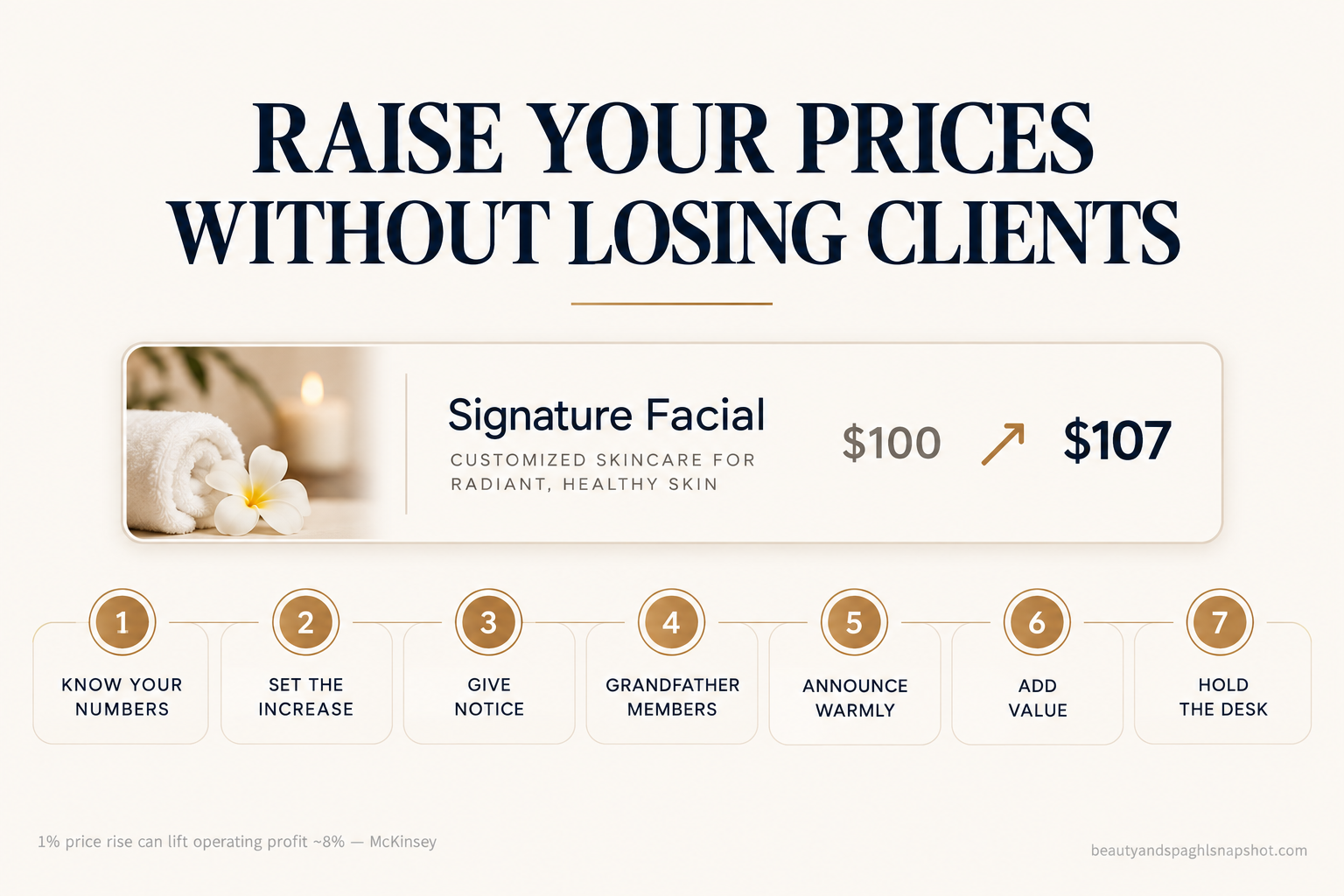
Now the part that should change how you feel. A price increase is the most powerful lever you have, because almost all of it falls straight to profit. McKinsey ran the frequently quoted analysis, reported by Quirk’s Media: for a typical company “a 1 percent price rise, if volumes remained stable, would generate an 8 percent increase in operating profit.” The mechanics are identical in a treatment room: raise a facial from $100 to $107 and the client still books, and that $7 does not pay for more product or time. It is profit you did not have yesterday.
Illustrative. A shop doing $40,000/mo and keeping $6,000 raises prices 7% and holds volume: the extra $2,800 carries almost no new cost, so take-home jumps about 47%. The exact dollars depend on your numbers; the size of the gap is the point, and it is the same principle behind McKinsey’s finding above.
The seven-step system to raise prices without losing clients
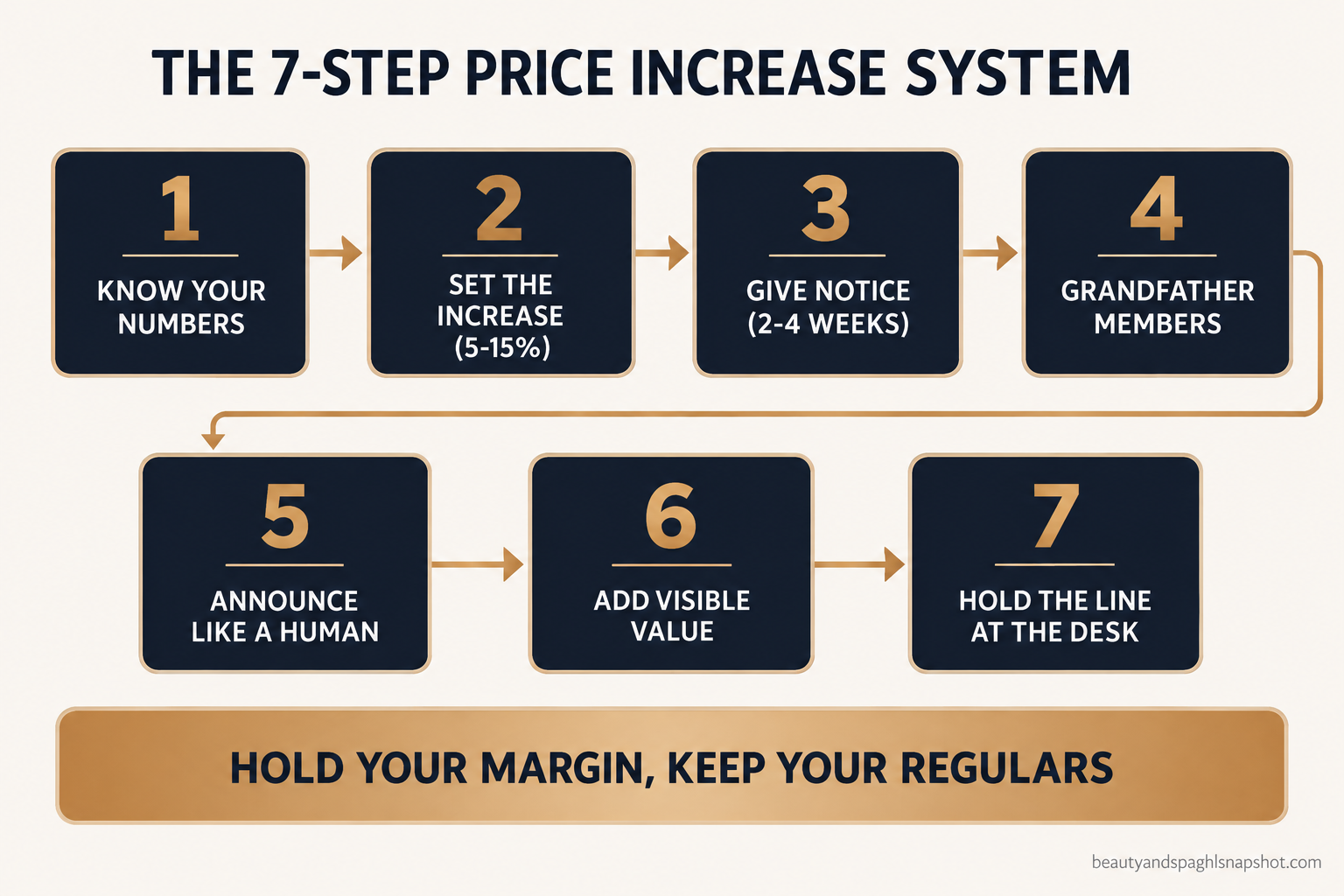
The goal is not a nervous 3 percent bump you apologize for. It is a confident, planned increase that holds your margin and keeps the clients worth keeping. Here are the seven steps in order, each with how it breaks, because that is where most owners lose their nerve.
Step 1: Know your real numbers before you touch a price
You cannot set a price well if you do not know what a service costs you. For your three or four busiest services, add up product used per treatment, the provider’s pay or booth-rent share of that hour, and a slice of fixed overhead. Most owners find at least one “signature” service at a margin so thin it barely clears product and labor. That is the first thing a price increase should fix.
While you are in the numbers, pull your rebook rate and average ticket, because they tell you how much room you have. A shop where clients rebook well can raise prices with far more confidence than one leaking clients after the first visit. If that first-to-second visit is where you lose people, fix it alongside the increase; we went deep on the second-visit drop-off.
How it breaks: you raise every service by the same flat percentage without knowing which were underwater. Raise the thin-margin services more and the healthy ones less. A price increase is your chance to fix the worst-priced service.
Step 2: Set the increase, and anchor it to cost
Most increases should land between 5 and 15 percent, depending on how far behind you are. Below 5 percent and inflation eats the change by spring; above 15 percent in one jump and you invite sticker shock. If you are badly behind, raise now and again in nine months rather than double a price overnight.
The size matters less than the reason you attach to it. The classic study by Kahneman, Knetsch and Thaler, Fairness as a Constraint on Profit Seeking, found people judge a price increase as fair when it passes through a real rise in costs, and unfair when the business simply exploits higher demand. That is your entire messaging strategy. “Our costs went up, so prices are adjusting” reads as fair and almost everyone accepts it. “We are popular now, so we are charging more” reads as a grab that punishes a loyal client for her loyalty.
How it breaks: you pick a number you are comfortable with instead of one your costs justify, then undersell it with a sheepish tone. If your rent, product, and wages genuinely rose, you earned the increase. Say so plainly.
Step 3: Pick the timing and give notice
Do not raise prices silently and let a regular discover it at checkout. That is the fastest way to turn a routine increase into a betrayal. Give notice, two to four weeks is plenty, pick a clean start date (a first of the month reads as deliberate), and tell people before it lands.
A notice window also gives your best clients a reason to prebook or buy a package at the current price, which fills your calendar now and locks them in. You are using the old price’s final days to pull future bookings forward. Treatment packages are the natural vehicle, and we broke that down in the treatment-package playbook.
How it breaks: you give so much notice, two or three months, that it becomes background noise, or you give none and blindside people. A short, firm window with a real date drives action; a vague “prices going up soon” drives nothing.
Step 4: Decide who you protect, and who you do not
Grandfathering means letting a group keep the old price, usually your members or longtime regulars, for a set period. It is a powerful loyalty signal, but only when it is deliberate rather than a leak.
The cleanest approach for most shops: new clients pay the new price on the date, one-off clients move with notice, and paying members hold their rate for a set window like six months. That rewards the people who committed to you without freezing your whole book at a price you can no longer afford. A member is recurring revenue, not a single visit, so it is the asset worth protecting. If you have not built that layer, our guide to a spa membership program that crosses $20k a month shows why a recurring base makes a price increase feel safe.
How it breaks: you grandfather everyone forever “to be nice,” and a year later half your book still pays 2024 prices. Grandfather on purpose, for a named group, with an end date. Generosity without a boundary is just an increase you never actually made.
Step 5: Announce it like a human, not a legal memo
This is where increases live or die. The message should be short, warm, confident, and anchored to cost, never apologetic. Lead with gratitude, state the change and date plainly, give one honest reason, then stop. Over-explaining reads as guilt.
How it breaks: the announcement sounds like a law firm wrote it, or it apologizes three times, or it is a sign on the register nobody reads. Send it directly, from a real person. Say it once, say it warmly, and mean it.
Step 6: Add visible value so the new price feels earned
A price increase lands softer when something visibly got better at the same time, and you do not need to spend much. A warm neck pillow, a better post-treatment beverage, a short scalp massage added to the facial. None of these cost what they signal, and they turn “it costs more now” into “it got nicer and it costs a little more now.”
It is also the moment to make sure the experience around the appointment is not leaking goodwill. If a client has to call three times to book, or never hears back from a DM, the new price feels unearned. Fast, warm follow-up is the cheapest value you can add, and it is exactly what our front-desk and rebooking scripts automate so nothing slips.
How it breaks: you raise the price and change nothing the client can feel, so the increase sits there naked. Pair the number with one real upgrade she notices next visit.
Step 7: Arm the front desk, because that is where it is tested
The increase is not tested in the email. It is tested at the desk, when a client with the new total in front of her raises an eyebrow. If your front desk flinches, apologizes, or quietly offers a discount, you just undid the whole thing and taught that client to push. Brief whoever checks people out before the change lands: give them the one-liner from Step 5, permission to hold the price, and a clear rule that nobody hands out an off-script discount.
The deeper fix is a system that holds the line so a person does not have to. When the price, the deposit, and the policy are enforced by your booking software instead of a nervous human at the counter, the increase simply is the price, not a negotiation. It is the same discipline that stops you patching slow weeks with markdowns in why discounting is killing your spa.
How it breaks: one team member, trying to be kind, starts waving the increase for anyone who hesitates, and within a month the new price is optional. The policy has to hold for everyone, or it is not a price, it is an opening bid.
Run the whole thing for your size shop
The seven steps are the same at every size, but where you start is different.
The solo operator, one or two chairs. You send the awkward text yourself, so the fear is personal. Your advantage is the same relationship: a warm, personal note lands far better than a corporate memo, and you can grandfather your handful of true regulars by name cheaply. Start with Step 1 and Step 5. You do not have a volume problem, you have a nerve problem, and the math above is the cure.
The mid-size shop, three to four providers. Your risk is inconsistency. One provider defends the new price, another apologizes for it, and the front desk discounts to keep the peace. Start with Step 2 and Step 7: set the increase by service, then brief and script everyone who touches a checkout. This size fails at the desk, not in the inbox.
The multi-location or chain owner. Your danger is that the increase rolls out unevenly and one manager decides to “wait a quarter.” Start with Step 1 at the portfolio level and Step 4 as policy: one cost-based increase, one member grandfathering rule across all locations, one start date. Here is roughly what a single clean increase adds in monthly profit at three sizes.
Illustrative added monthly profit from a 7% price increase that holds volume, at three revenue levels. Because the increase carries almost no new cost, nearly the full amount falls to profit.
The compliance and messaging rules to get right
Three rules keep a clean increase from turning into a complaint. First, if you frame the old price as a limited-time saving, “book before [date] at the current rate,” the current price has to be one you actually charge, not an inflated number invented to make the deadline feel urgent. That is the core of the FTC’s Guides Against Deceptive Pricing, which treat a fictitious former price as deceptive. Just do not dress a routine increase as a fake “sale ending.”
Second, your announcement text has to respect the rules for business texting. Send it only to clients who opted in, and always honor a STOP. Consent and opt-out are the backbone of the TCPA, and the FCC’s guidance on unwanted texts is the plain-English starting point.
Third, a note for med spas. If part of your menu is medical, Botox, fillers, protocol lasers, keep price conversations tied to treatment records out of unsecured channels, and let a provider, not a marketing text, handle anything touching a medical recommendation. These are general notes, not legal advice; the FTC’s advertising guide for small business is a good plain-English reference, and a local attorney can check your language.
The objections you are already thinking
“My clients will leave the second I raise prices.” A few will, and here is the part nobody says out loud: the ones who leave over a 7 percent increase are almost always your least profitable, most price-sensitive clients, already one deal away from the shop down the street. Your regulars barely blink. You are not losing your base, you are trimming the edge that was never loyal.
“I feel guilty charging more for the same service.” It is not the same service. Your product, rent, and staff all cost more, so holding the price means delivering the same experience at a steadily worse margin until you cannot afford it. Raising the price is how you keep the service that good.
“A competitor down the street is cheaper.” There is always someone cheaper, and racing them to the bottom is a race you are built to lose, especially against a chain. You win on the experience and relationship they cannot personalize, which we laid out in competing with the chains as an independent.
“What if I raise prices and the book goes quiet?” That fear is usually about retention, not price. If clients rebook, a modest increase will not empty your calendar. If they do not come back, a low price was never holding them anyway. Your client lifetime value tells you how much room you really have, and it is almost always more than your nerves suggest.
FAQ
Raising spa prices: common questions
How much should I raise my spa prices?
For most shops, between 5% and 15%, depending on how long it has been and how far behind your costs you are. Below 5% barely keeps up with inflation; above 15% in one jump invites sticker shock. If you are badly behind, a moderate increase now plus another in six to nine months is easier to absorb than one large jump.
How do I tell clients about a price increase without losing them?
Give two to four weeks' notice, anchor the reason to your real rising costs, lead with gratitude, and state the change and date plainly. Research on price fairness shows people accept a cost-driven increase far more readily than one that looks like cashing in on demand. Send it from a real person and do not over-explain.
Should I grandfather my existing clients at the old price?
Grandfather deliberately, not by default. A clean approach: new clients pay the new price immediately, one-off clients move with notice, and paying members hold their rate for a set window like six months. Grandfathering everyone forever just means you never actually raised prices.
Will raising prices really increase my profit if some clients leave?
Usually yes, and by more than you expect. A price increase carries almost no new cost, so most of it falls to profit; McKinsey's widely cited analysis found a 1% price rise can lift operating profit around 8% when volume holds. The margin from everyone who stays typically more than covers the few price-sensitive clients who leave.
How often should a spa raise prices?
A small, planned increase every 12 to 18 months is far easier on clients than a big jump every few years. Modest adjustments tracked to your costs feel routine; a long freeze followed by a sudden large increase feels like a shock.
What if a client pushes back at the desk?
Brief your front desk with a confident line: 'Our costs went up this year, so we adjusted prices to keep the quality the same.' Give them permission to hold the price and make clear nobody hands out an off-script discount. If one person starts waving the increase, it stops being a price and becomes a negotiation.
Your costs already moved. The only question is whether your prices move with them, or you keep giving yourself a quiet pay cut to avoid one uncomfortable conversation. Know your numbers, set an increase your costs justify, give notice, protect your members on purpose, announce it like a human, and hold the line at the desk. Do that and the regular you were lying awake worrying about books her next appointment at the new price without a second thought, because the experience was worth it and you told the truth.