
It is 9:12 on a Saturday, your busiest day, and the 10:00 just texted to cancel. Something came up. No hard feelings. But now you have a prepped room, a provider who showed up for a full book, and a $216 hole in the day that was full ten minutes ago. You know three people would take that slot in a heartbeat. You just have no fast way to reach them before the hour is gone.
Here is the short version, because you have a floor to run. A last-minute cancellation only costs you money if the chair stays empty. The fix is a waitlist system that captures the people who already wanted that time, spots the opening the second it happens, texts the right few, and lets the first one lock it in with a card. Build those steps once and most cancellations quietly refill themselves. Below is the whole system, the exact texts to copy, and the three ways it breaks.
Table of contents
- What an empty last-minute slot actually costs
- Why most spa waitlists never fill anything
- The six-part waitlist system, start to finish
- Part 1: Capture the waitlist at two moments
- Part 2: Detect the opening the second it happens
- Part 3: Match and text the right clients
- Part 4: First to claim it wins
- Part 5: Secure the refill with a card
- Part 6: Close the loop and track your recovery rate
- Steal these waitlist messages
- Solo, mid-size team, and multi-location
- What the big booking tools actually do
- The consent line you cannot cross
- Objections you are about to raise
- FAQ
What an empty last-minute slot actually costs
Start with the number, because it is bigger than it feels in the moment. Zenoti’s 2026 Beauty and Wellness Benchmark Report puts the median medical-spa ticket at $216 and the med-spa no-show rate at 4%, with non-membership day spas around a $103 median ticket (Zenoti). One flaked room on a Saturday is a day’s lunch for the whole team. A room that flakes most Saturdays is a part-time salary you are paying your calendar to throw away.
And that is only the no-shows. Late cancels are a separate, bigger leak. Fresha’s 2025 study of beauty and wellness businesses found they lose almost 7% of monthly revenue to cancellations and no-shows combined, with most of the pain coming from people who cancel too late to refill the room the old way (Fresha).
Here is the part owners miss. Deposits and reminders are about stopping the cancellation; a waitlist is about what you do after one happens anyway, because some always will. Deposits and reminders shrink the hole, the waitlist fills whatever is left, and with only the first half every cancel that slips through is a dead room. For the prevention side, start with our guide to reducing spa no-shows and the no-show deposit policy that actually gets paid. This post is the other half.
Why most spa waitlists never fill anything
Almost every spa has a “waitlist” already. It refills almost nothing. Three reasons, and they are the reasons, so name yours before you build.
The first is the dead paper list. A client asks to be told if something opens up, your front desk writes a name on a pad, and that pad never gets looked at again, because at the exact moment a slot opens the desk is checking someone out and the phone is ringing. A waitlist that depends on a human remembering to work it, mid-rush, is not a system. It is a good intention.
The second is the blast-everyone panic. The slot opens, someone finally notices, and in a hurry they text the whole client list “we have a 10:00 facial open today.” Now 40 people get a message for one slot, 39 cannot use it, a few get annoyed, and two reply at once so you have to tell one of them it is already gone. Do that twice and your clients learn your texts are noise.
The third is the vendor toggle nobody set up. Your booking software may technically have a waitlist, but it is buried three menus deep, it was never configured, and it only covers group classes anyway. The feature existing and the feature running are very different things, and we will get specific about which tools do what further down.
A system that works does the opposite of all three: automatic, so no human has to remember; targeted, so only people who can use the slot hear about it; and set up once, on purpose, so it runs on your busiest day without you.
The six-part waitlist system, start to finish
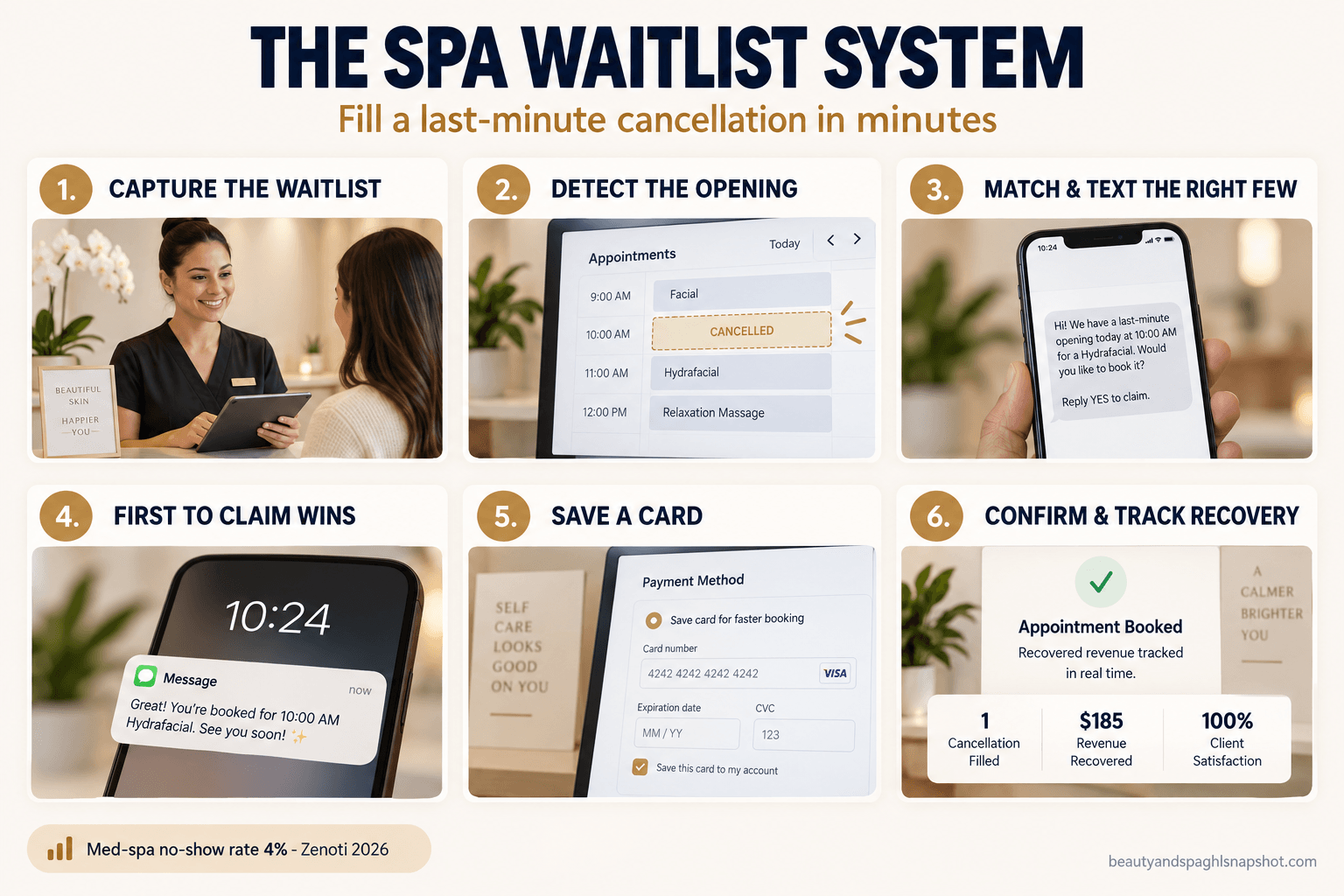
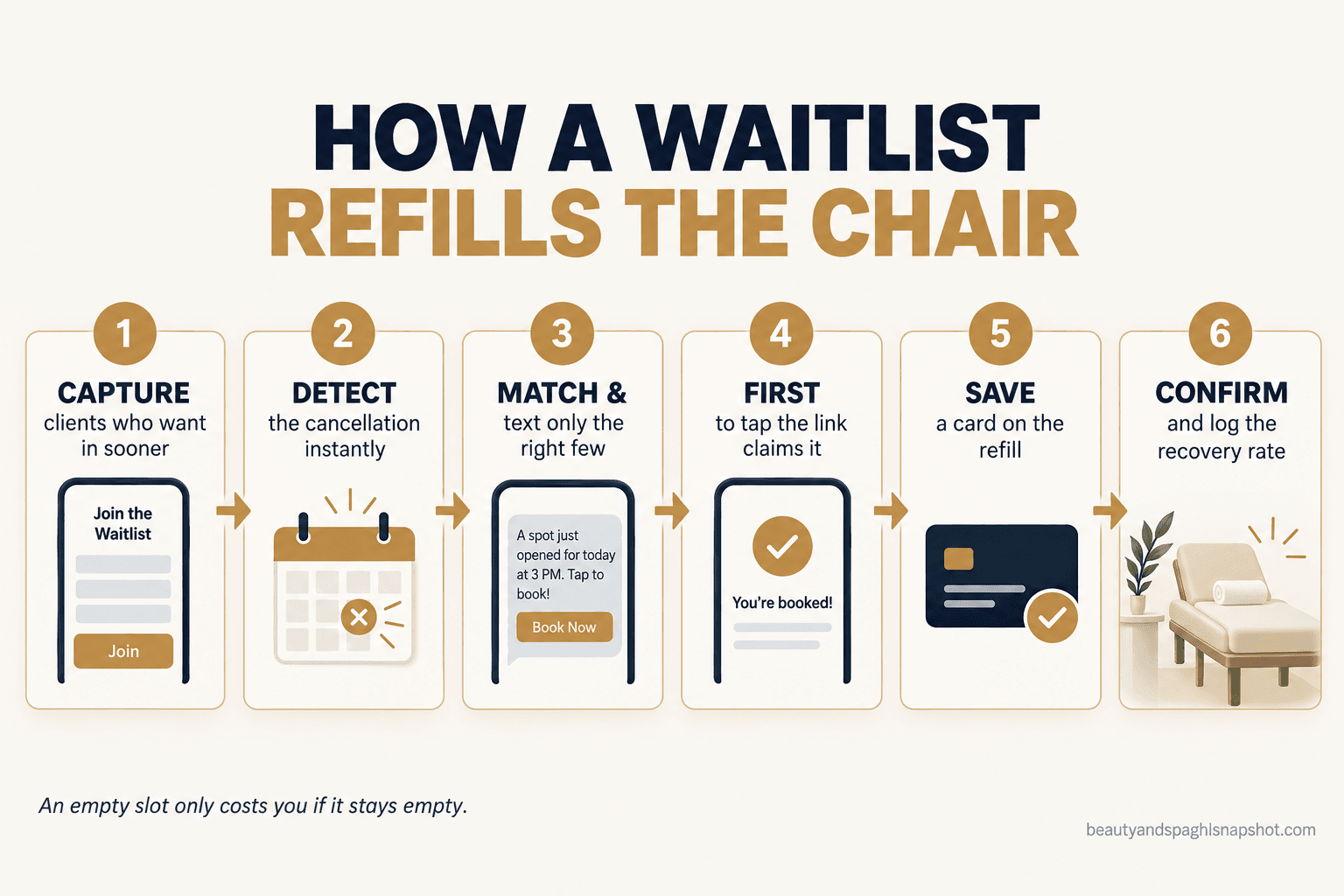
Here is the whole thing in order: capture the waitlist, detect the opening, match and text the right clients, let the first one claim it, secure the refill with a card, and close the loop and track recovery. Each part has a way it quietly breaks, so I have flagged how.
Part 1: Capture the waitlist at two moments
You cannot fill a slot from a waitlist with nobody on it. So the first job is collecting the right people, and there are exactly two moments that matter.
The first is when a client tries to book and their time is taken. Your booking page should not just say “sold out.” It should offer: “want us to text you if this time opens up?” One tap, they are on the list for that service and that window. The second is at checkout, when a happy client is rebooking. If the slot they want is weeks out, offer to text them if something sooner frees up. These are your best waitlist entries, because they are already paying, already here, and already want in.
What you capture matters as much as who. For each person you want the service, the provider if they have a favorite, and the days and times that actually work. A waitlist that just says “Dana wants in sooner” is useless at 9:12 on Saturday, because you do not know if Dana can take 10:00 today or only evenings. The more precise the capture, the cleaner the match later.
How it breaks: you collect names but not time windows, so when a slot opens you are guessing who can use it and you are back to blasting everyone. Capture the window with the name, every time, or the list cannot be matched.
Part 2: Detect the opening the second it happens
Speed is the whole game. A same-day slot is perishable, and the value drops by the hour. The system has to know a room came free the instant it happens, not whenever someone glances at the calendar.
So the trigger is the cancellation itself. The moment a client cancels online, or your front desk marks the appointment cancelled, that should fire the refill automatically, within seconds, with no human step in between. This is the single piece that separates a working waitlist from a paper one: the opening detects itself and starts the fill before anyone has to notice. On a busy floor, that is the only speed that counts, because noticing is exactly what does not happen when you are slammed.
The same logic covers the gap you can see coming. A Friday afternoon that is still half empty on Wednesday is a slower-motion version of the same problem, and the same waitlist can work it. For filling chronically quiet times, see why your spa is empty midweek.
How it breaks: the cancellation and the waitlist live in two different tools that do not talk, so the slot opens in your calendar and your waitlist has no idea. If the trigger is not wired to the cancellation, nothing downstream fires, and you are back to remembering. One system, one trigger.
Part 3: Match and text the right clients
Now the slot is open and the clock is running. Do not text everyone. Text the handful who fit.
Matching means filtering the waitlist to people whose service, provider, and time window line up with the slot that just opened. A 10:00 facial with Mara today goes to the few people who wanted a facial, were open to Mara or had no preference, and said mornings work. That might be three people. Good. Three people who can actually use the slot beat forty who cannot. Then the system texts those few at once, with the opening and a way to grab it.
The tone is a favor, not a fire sale. You are not begging to fill a room, you are telling a client who asked to be told that the thing they wanted just opened up. That is why targeting matters so much: when only the right people hear, every message is useful, and your texts stay something clients open instead of mute.
How it breaks: the match is too loose, so a client who wanted an evening deep-tissue gets pinged about a morning facial, decides your texts are spam, and opts out. Tight matching protects the asset that makes the whole thing work, which is clients who still read your messages.
Part 4: First to claim it wins
When several people get the same opening, you need a rule that is fast and fair and does not create a mess. The rule is simple: first to claim it gets it, and the moment it is claimed, it is closed to everyone else.
In practice the text carries a booking link. The first person to tap it and confirm takes the slot, the appointment books, and the link goes dead for the others automatically, so no one has to referee. The people who missed out get a quick “it is taken, you are still on the list” so they are not left hanging or, worse, showing up. This is how the better tools handle it: Mindbody’s class waitlist has a “First to Claim” option that texts waitlisted clients and gives the slot to the first to respond (Mindbody).
Give the claim a short fuse. A same-day slot held open indefinitely is just a different empty room. Fifteen to thirty minutes is plenty, and if nobody takes it, the system moves to the next few on the list.
How it breaks: two people confirm before the slot closes, you double-book, and now you are apologizing to a paying client. The close has to be instant and automatic. If claiming depends on someone at the desk marking it taken, you will double-book on the exact day you are too busy to catch it.
Part 5: Secure the refill with a card
Here is the counterintuitive part. The person who grabs a same-day cancellation slot is, on average, your highest flake risk. They booked in a hurry, on impulse, with no mental run-up to the appointment. If you refill a no-show with another no-show, you did a lot of work to end up back where you started.
So treat the refill like any other booking: save a card as part of claiming the slot, under the same cancellation policy you use everywhere else, collected before the claim confirms. This is not about punishing anyone, it is about making the refilled slot as real as the one it replaced. The full version, including amounts and policy language, is in the no-show deposit policy playbook.
How it breaks: you are so relieved to refill the room that you skip the card “just this once,” the impulse booker flakes too, and the same hour no-shows twice in one day. Same policy on the refill as on the original. No exceptions for urgency.
Part 6: Close the loop and track your recovery rate
A slot that refills still needs a clean finish, and the whole system needs one number you watch.
The clean finish is three quick, automatic messages: the new client gets a confirmation and the normal reminders, the provider sees the updated calendar, and the people who missed out get the “it is taken” note so nobody shows up for a slot they did not get. Skip that last one and you will eventually have two clients arrive for the same hour, which is worse than the empty room you started with.
The number to watch is your recovery rate: of the slots that open up last minute, what share get refilled before the appointment time. Track it for a month. Near zero means your capture is too thin or your trigger is not firing. Climbing into the half-and-better range means the system is paying for itself in rooms you used to lose.
How it breaks: you fill slots but never close the loop with the clients who missed out, so a second person shows up for the same appointment. Or you never track recovery, so you have no idea the trigger quietly broke three weeks ago. Measure it, and watch for the week it drops to zero.
Steal these waitlist messages
Here is the actual copy. Keep it short, make it sound like a person, and make the action obvious. Swap in your spa’s name and voice.
That is the whole message set. Notice every one of them names the service, the provider, and the time, and every one gives a single obvious action. That is not decoration. It is what keeps the client from having to call to figure out what you meant, which is where same-day fills die.
Solo, mid-size team, and multi-location
The same six parts run differently depending on your size.
Solo operator or booth renter. You are the provider, the front desk, and the person who eats the empty hour, so automation matters most here. You cannot work a waitlist by hand with your hands in someone’s facial. Set it to capture at booking and checkout, fire on cancellation, text the matched few, and collect the card on claim, all without you. The payoff is direct: every refilled slot is money that would otherwise be gone, straight to you.
Mid-size team (3 to 8 providers). Now matching gets real, because a slot is tied to a specific provider and room. The system has to text the people who wanted that provider or had no preference, not your whole book. This is also where the “close it to everyone else” rule stops being optional, because with more openings per day, the odds of a double-book climb fast if claiming is manual. Make the waitlist a business-wide setting, not something each provider runs their own way.
Multi-location. Location now has to be part of the match: a client waiting on your uptown room does not want a text about a slot across town. You want one system and one recovery-rate report across sites, so you can see which location is leaking last-minute rooms and which has the waitlist dialed in. “Each manager handles it” means five different experiences and no way to compare.
What the big booking tools actually do
Most spa software has something called a waitlist. What it actually does varies a lot, and most of it was built for group fitness classes, not one-on-one appointments. Here is the honest state of it.
| Tool | Waitlist built for | Auto-fills a cancellation? |
|---|---|---|
| Mindbody | Classes, primarily | Yes for classes (Auto-add or First to Claim); appointment coverage is thinner |
| Vagaro | Appointments and classes | Has a waitlist with fill rules you configure; depth varies by setup |
| GlossGenius / Square | Appointments | Waitlist exists; auto-matching to a specific opening is limited |
| GoHighLevel build | Appointments, fully custom | Yes, wired to the cancellation trigger with matched texts and a claim link |
Mindbody’s waitlist automation is genuinely good, but read the fine print: its “Auto-add” and “First to Claim” features are documented for classes, filling spots that open in the late-cancellation window, and First to Claim needs two-way SMS turned on (Mindbody). For a med-spa running one-on-one appointments, that is not the same thing. Vagaro lets you “choose how your waitlist is filled” and set cancellation rules, so the setting exists, though how deeply it matches a specific opening to a specific client depends on your configuration (Vagaro). The pattern across the category is that the waitlist is real for classes and shallow for appointments, which is exactly backward for most spas.
That gap is why a lot of spas build the appointment waitlist as a workflow instead of relying on a toggle. The logic is the same six parts above, wired directly to the cancellation event, with the matching and claim link under your control. If you are weighing platforms on more than this one feature, our breakdown of what spa software really costs and the best spa booking software guide go deeper on the trade-offs.
The consent line you cannot cross
A waitlist runs on text messages, so it lives under the same consent rules as any other business texting. The good news is that a waitlist is about as clean as it gets, because the client literally asked to be contacted. Keep it that way.
Two rules. First, get consent at opt-in, which you already do when they reply YES or tap the box to join the list, and keep the record of it. Second, honor STOP instantly, every time, no exceptions. Keep waitlist texts tied to the thing they signed up for, a real opening in their window, and do not quietly turn the list into a promo channel, which is a different consent and a fast way to get muted or reported. The FCC’s rules on consumer texting and the right to opt out are the backdrop here (FCC). For the wider picture on compliant spa messaging, see our spa SMS marketing playbook. None of this is legal advice; when in doubt, ask a lawyer who knows your state.
Objections you are about to raise
“Won’t clients find the texts annoying?” Only if you blast the wrong people. A waitlist text goes to someone who asked to be told about an opening they wanted, which is the opposite of spam. The annoyance comes from texting 40 people for one slot, which tight matching is designed to prevent. Done right, clients thank you for the heads-up.
“I’m a one-chair studio, isn’t this overkill?” It is the opposite. The smaller you are, the more one empty Saturday hour hurts, and the less time you have to work a waitlist by hand. A solo operator with no front desk benefits most from the slot refilling itself while they work.
“My current software can’t really do this.” Many can do a version, usually for classes, often buried. Most appointment waitlists are shallow, which is why spas build the real one as a workflow wired to the cancellation. You do not have to switch everything to get a waitlist that actually fires.
“What if two people claim the same slot?” That is the one real failure mode, and it is solved by closing the slot the instant it is claimed, automatically. If claiming depends on a human marking it taken, you will eventually double-book. If the system closes the link on first claim, you will not.
From empty room to refilled chair
Back to 9:12 on Saturday. In the old version, that 10:00 sits empty, your provider has an unpaid hour, and you find out Monday that three regulars would have killed for it. In the version above, the cancellation fires the refill the second it lands, the three people who wanted a morning facial get a text, the first taps the link and locks it in with a card, the slot closes to the others, and by 9:20 the room is full again. Same cancellation, completely different day.
That is the whole point. You will never stop every cancellation, so stop trying. What you can do is make sure the chair does not stay empty when one happens. Build the six parts once, wire them to fire on their own, and watch your recovery rate instead of your empty rooms.
FAQ
How do I fill a last-minute spa cancellation fast?
Have a waitlist that fires automatically. The moment an appointment cancels, the system should match the opening to clients who wanted that service, provider and time window, text just those few, and let the first one claim it with a booking link. The key is speed and targeting: minutes, not hours, and the right handful, not your whole list.
What is a spa waitlist and how does it work?
It is a list of clients who asked to be told if a sooner slot opens, captured with the service, provider and times that work for them. When a cancellation creates an opening, the system texts the matched clients, the first to tap the link books it, and the slot closes to everyone else. Built right, it runs without anyone working it by hand.
Should I charge a deposit on a slot filled from the waitlist?
Yes. A client who grabs a same-day cancellation booked on impulse and is statistically the most likely to flake, so save a card on file under your normal cancellation policy as part of claiming the slot. Refilling a no-show with another no-show just repeats the problem. Same policy on the refill as on the original booking.
Is it against the rules to text waitlist clients?
Not when they opted in, which they do by joining the waitlist. Keep the record of consent, honor STOP instantly and every time, and keep the texts tied to real openings in their window rather than turning the list into a promo channel. The client asked to be contacted about openings, which is the cleanest consent you can have. This is not legal advice.
Does Mindbody or Vagaro fill cancellations automatically?
Partly. Mindbody's Auto-add and First to Claim waitlist tools are documented for classes and fill spots in the late-cancellation window, with First to Claim needing two-way SMS. Vagaro lets you configure how the waitlist fills. For one-on-one appointments, most tools are shallower than they look, which is why many spas build the appointment waitlist as a workflow wired to the cancellation.
How do I know if my waitlist is actually working?
Track your recovery rate: of the slots that open up last minute, what share get refilled before the appointment time. Watch it for a month. Near zero means your capture is too thin or the trigger is not firing. Climbing into the half-and-better range means the system is paying for itself in rooms you used to lose.