
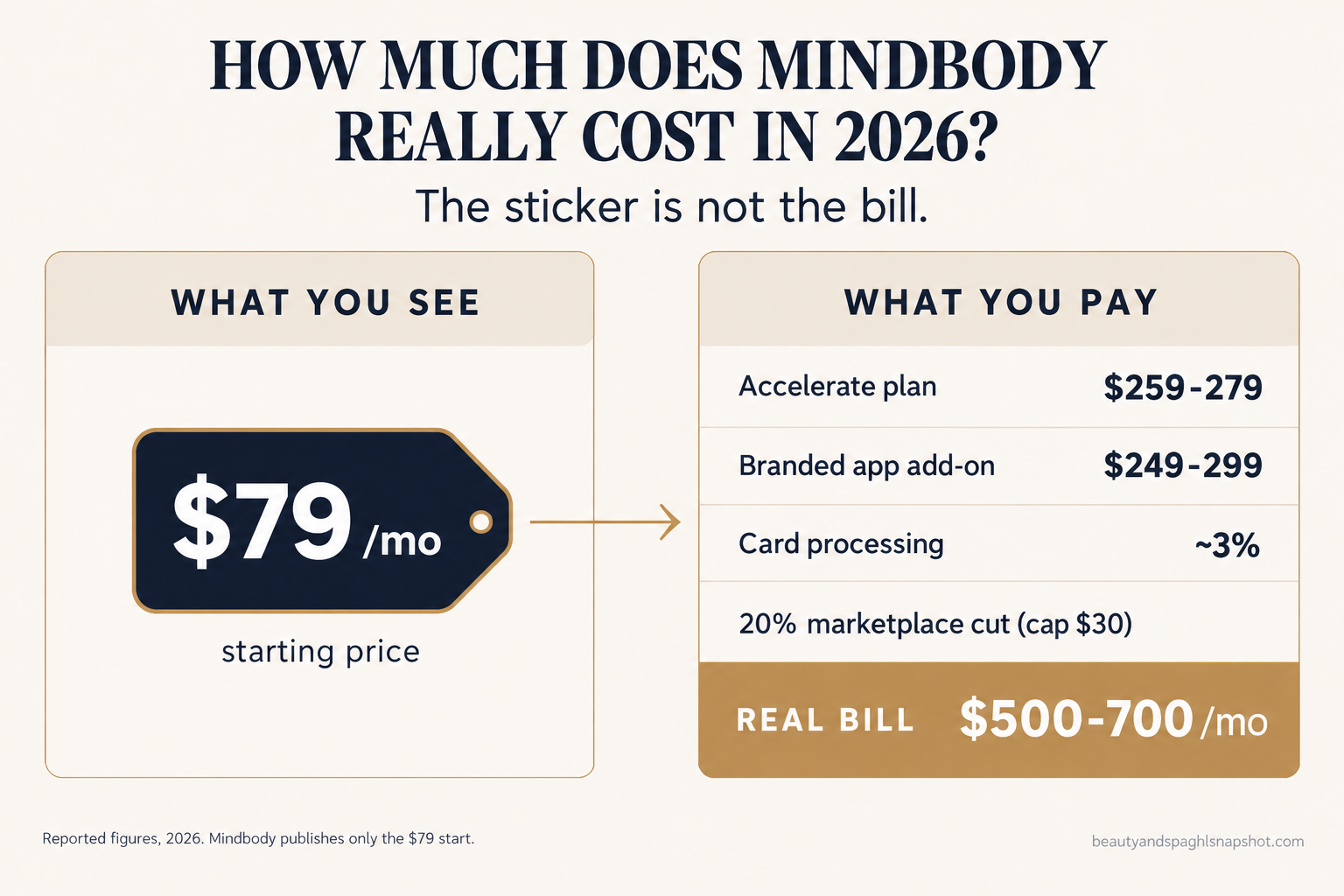
You open the Mindbody pricing page ready to budget, and it gives you one number: “Starting at $79/month.” Then you click the plan that actually has the features you need, and the price vanishes behind a button that says Let’s talk. That is the whole story of Mindbody’s 2026 pricing in one click. The sticker is real. It is also nowhere near the bill.
Here is the short answer. A one-chair studio that right-sizes its plan might pay $99 to $159 a month. A working two-to-four-provider spa that needs the mid tier, a branded booking app, and card processing lands closer to $500 to $700 a month, before the 20% marketplace cut and a contract that commonly runs 24 months. The “$79” buys the headline. Below is the real bill, line by line, and what it costs for a solo operator, a mid-size team, and a chain.
On this page
- What the price page hides
- The three tiers, decoded
- The add-ons that are not optional
- The 20% marketplace cut, explained straight
- The contract and the cost of leaving
- What it costs: solo, mid-size, chain
- Is Mindbody worth it in 2026?
- Cheaper, and often better, by size
- Steal this: decode a Mindbody quote
- Objections, answered straight
- Frequently asked questions
What the price page hides
Start with what Mindbody publishes, because it is a careful piece of writing. The page shows “Starting at $79 USD/month per location” and names three plans, Starter, Accelerate, and Ultimate, plus a custom Enterprise tier (Mindbody). It does not show a price for any of the three; each has a “Let’s talk” button. So the only figure you can put in a spreadsheet is the $79 start, and it attaches to the plan most spas outgrow in a month.
This is not an accident. A published starting price gets Mindbody onto every “best spa software” list with a friendly number, then anchors you low before a rep reframes the cost against the bookings the platform claims it will unlock. That cannot happen if the price is printed, so it is not. AmSpa reports the medical aesthetics industry has passed $17 billion and is adding more than $1 billion a year (AmSpa), which is a lot of busy owners shopping fast, exactly the buyer a demo-gated price is built for.
The three tiers, decoded
Starter is the $79-to-$159 plan tied to the advertised price: online booking, payments, a booking widget, a listing in the Mindbody consumer app, and basic reporting. You do not get the branded app or the AI tools, which Mindbody’s own page confirms are unavailable on Starter (Mindbody). Fine for a true solo; for anyone running a front desk, it is the plan you call to upgrade out of.
Accelerate is the mid tier, where most working spas land, reported near $259 to $279 a month per location (FitBudd). It adds analytics, room and resource management, “pick a spot” booking, and promo codes, and it is the lowest plan where the branded app and AI Concierge become available as paid add-ons, the features most owners think they are buying.
Ultimate and Ultimate Plus sit at the top, reported near $499 and $699 and up per location (FitBudd); other trackers list a different split near $399 and $599, which shows how much the market is guessing (G2). Ultimate targets multi-location businesses, with AI Concierge included.
Reported Mindbody monthly price per location, 2026. Mindbody publishes only the $79 start; Accelerate, Ultimate and Ultimate Plus are from third-party teardowns (FitBudd, G2) and are estimates, not a rate card. Add-ons and processing are separate.
The add-ons that are not optional
Here is where a Mindbody quote quietly doubles: the features that make the platform worth having are mostly add-ons.
The branded member app is the version in the app stores under your studio’s name, so a client rebooks from your icon instead of the shared marketplace. It is the single feature most owners assume they are paying for, and it is a separate line item at a reported $249 to $299 a month (FitBudd). Mindbody confirms it is an add-on on Accelerate and Ultimate and unavailable on Starter (Mindbody). So the rebooking engine you wanted is gated behind the mid tier, then billed again.
AI Concierge handles front-desk-style conversations and booking. It is an add-on on Accelerate and included on Ultimate, with quote-based pricing you will not see until a rep tells you.
Processing is its own cost. Third-party figures put card-present near 2.99% plus $0.30 and card-not-present near 3.60% plus $0.30 (FitBudd). On $25,000 a month of card volume, a half-point difference is roughly $1,500 a year.
The 20% marketplace cut, explained straight
This line gets exaggerated online, so here is the accurate version, which is still a real cost you should plan for.
Mindbody runs a consumer marketplace, the Mindbody app and its ClassPass network, where people who do not know your studio can discover you. When it brings you a brand-new client, Mindbody takes a commission: 20% of that client’s first purchase, capped at $30, applied once, only to clients the marketplace actually sent you (Mindbody). Later bookings by that client are free, and clients who found you through your own Instagram, website, or a tracked referral link carry no fee.
So the viral “Mindbody takes 20% of every booking” claim is not what Mindbody states. Some reviews read it broadly and estimate an effective 23.5% once processing stacks on top (Koalendar), but there is no primary source for the “every booking” version, so use the first-purchase-capped-at-$30 number. Do not wave it away, though: 30 new clients a month who hit the $30 cap is about $900, another plan’s worth of cost. The marketplace is paid acquisition, worth it only if those clients rebook and stick, which is why owning your own booking funnel matters.
The contract and the cost of leaving
Two questions decide whether Mindbody is a one-year regret or a five-year fixture, and neither is on the pricing page.
How long is the contract? Mindbody’s page says only that terms depend on the plan (Mindbody). Third-party teardowns are blunter, reporting a 24-month standard contract as common (FitBudd). A 24-month commitment on a $500-a-month real bill is a $12,000 decision, so treat it as a headline number, not fine print.
What does it cost to leave with your data? Owners report a data-export charge, sometimes cited near $500, to get their own client list and visit history out at cancellation (Koalendar). That is reported rather than published, which is why you ask for it in writing before you sign. Your client history is the most valuable asset the software holds, and paying to retrieve it keeps people on a platform they have outgrown.
What it costs: solo, mid-size, chain
Averages lie here, because the right plan for a one-chair studio is the wrong plan for a ten-location group. Run the question through three shapes of business.
The solo operator, one chair. You do 60 to 120 appointments a month from your phone. The honest fit is Starter at $99 to $159, and even that is more than you need, since Starter lacks the branded app. The catch: GlossGenius at $24 or Square on its free tier do the same booking job for a fraction of that, so Starter only makes sense if you want the marketplace sending you new clients.
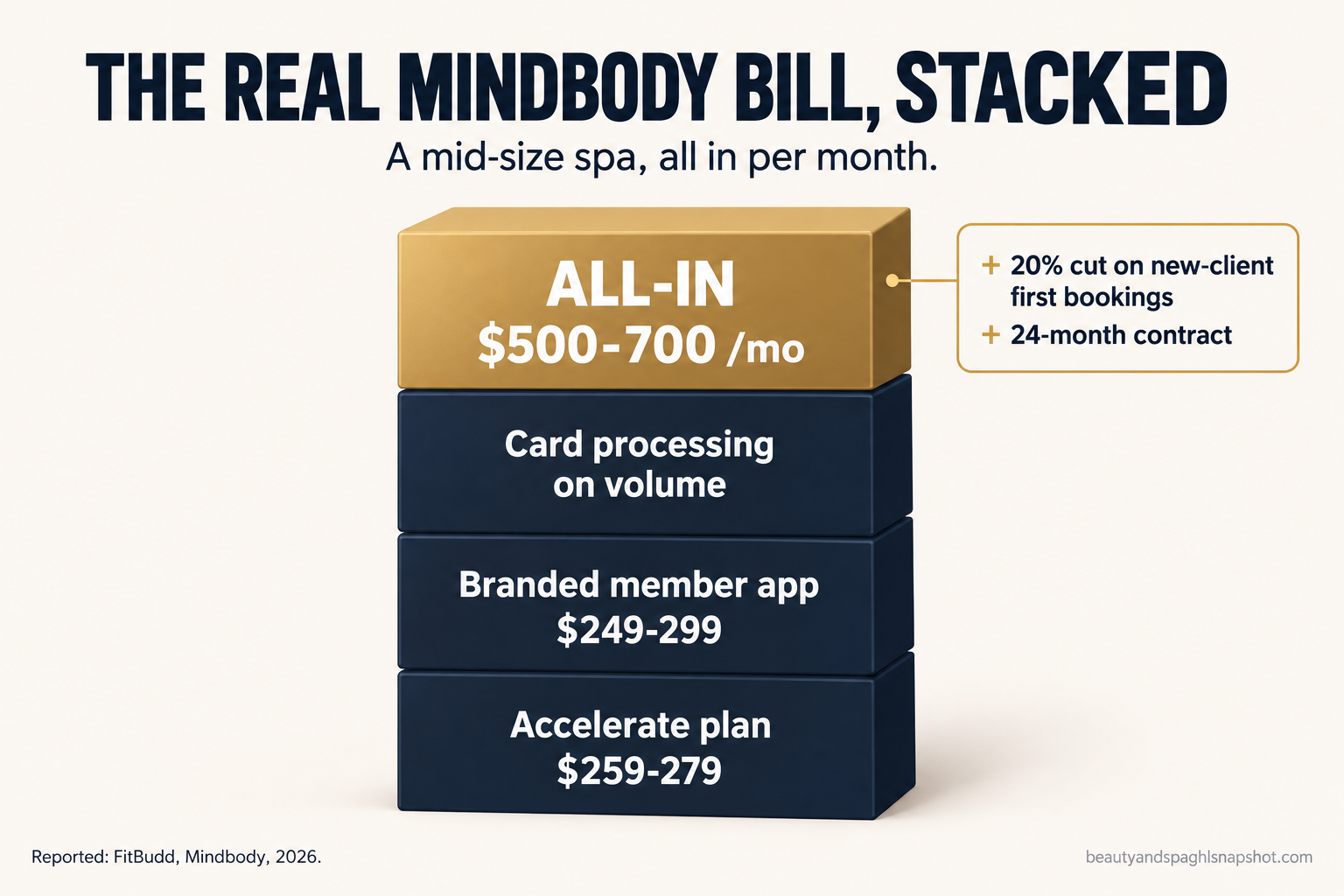
The mid-size shop, three to four providers. Mindbody’s core customer, and where the real bill shows up. You need Accelerate at $259 to $279, the branded app at $249 to $299 so clients rebook from your icon, and processing on real volume. That is roughly $500 to $700 a month all in, plus the 20% cut on new-client first bookings, inside a two-year contract. Compare that number against everything else, not the $79.
The multi-location chain. Six to ten locations, mixed booth-rent and commission staff, a central ops person, real payroll. Here the per-location model and Ultimate’s reporting earn their keep, because cost is spread across real volume and the analytics drive decisions. This is the one case where Mindbody’s structure pencils out. The trap is not the monthly fee, it is the 24-month lock-in across every location and the setup overrun if a rollout stalls.
Illustrative monthly Mindbody cost, 2026: the advertised “$79 starting” figure versus a realistic all-in bill for the same business. The mid-size real bill is Accelerate (reported $259-279) plus a branded app ($249-299) plus processing, before the 20% marketplace commission. The point is the gap, not the exact dollar.
Is Mindbody worth it in 2026?
It depends on whether you use the marketplace and how many locations you run. Its real advantage is the consumer app and the discovery it drives, so if the marketplace reliably sends new clients who rebook, the platform can pay for itself. It stops being worth it in the common case: a one-to-four chair studio that bought booking and the branded app, never used the marketplace, and now pays a mid-tier price plus an add-on inside a two-year contract for a job a $150 stack could do. That is enterprise pricing for a feature you are not using.
Cheaper, and often better, by size
You have more real options in 2026 than Mindbody’s sales page suggests. Here is where the main ones land, with the honest “who it is for.”
| Tool | Reported 2026 price | Best for |
|---|---|---|
| GlossGenius | $24 / $48 / $148 annual, flat 2.6% processing | Solo and 1-2 chair studios |
| Square Appointments | Free to low monthly, pay-as-you-go processing | True solos, no commitment |
| Vagaro | ~$24-84/mo + 2.2-3.5% processing | Small teams; texting and site are add-ons |
| Mangomint | $120/location + $10/user/mo (new Aug 2026) | Growing, staffed spas |
| Boulevard | ~$176-410/location/mo, ~$495 onboarding | Mid-to-large salons and med spas |
| Fresha | ~2.19-3.30% + $0.20, 20% new-client fee (not free in 2026) | Marketplace discovery |
Two reset expectations. Mangomint rewrote its pricing on August 1, 2026, dropping three tiers for a flat $120 per location plus $10 per user per month (Mangomint), and Fresha, long the free option, stopped being free in 2026. The move most owners skip is leaving the per-seat model entirely, for a platform priced flat that does not multiply your bill every time you hire. Our full spa software cost teardown runs every major vendor side by side, and our comparison of nine booking tools ranks them by shop size.
Steal this: decode a Mindbody quote
A Mindbody sales call is built to keep you from asking the hard questions in order, so bring them. Read these out in the first five minutes, and do not end the call until the answers are in an email.
The six questions that get you the real number:
- What is the total monthly cost for my [X] locations and [Y] users, including the branded app and every add-on I would actually use? One number, not a plan name.
- Is there a setup, onboarding, or data-migration fee? How much, and is it refundable if we do not go live?
- How long is the contract, is it auto-renewing, and what is the early-termination penalty?
- What does it cost to export my full client list and visit history if I leave?
- What is my exact card processing rate, and what is the marketplace commission, on which bookings, and with what cap?
- What was the actual all-in bill for a spa my size last year, not the list price?
The follow-up email to send the same day, so the number is in writing:
Hi [Rep name], thanks for the walkthrough. To compare fairly, can you put the all-in number for my business ([X] locations, [Y] users) in writing: total monthly cost with the branded app and the add-ons we discussed, any setup fee, contract length and early-exit cost, data-export fee, and my processing and marketplace rates. Once I have that in an email I can decide. Thanks, [Your name].
If the number comes back fair, you buy with your eyes open. If the rep dodges, pads the quote, or will not put it in email, you learned the most important thing about that vendor before paying a cent. Before you switch anything, export your client list and visit history as a CSV first; our guide on leaving Mindbody or Vagaro without losing your history covers the safe order.
Objections, answered straight
“Isn’t Mindbody the industry standard?” It is the best-known name, which is not the best fit. “Everyone uses it” includes a lot of owners paying mid-tier prices for a tool they have outgrown. Standard is not the same as right-sized for a one-to-three chair studio.
“I’m already locked into a contract. Is this relevant?” Yes. You want your real renewal number before it auto-renews. If you pay for the marketplace and branded app but book from your own channels, you can often drop add-ons or a tier at renewal even if you stay. Mark your end date and start comparing 90 days out.
“Won’t a cheaper tool cost me bookings?” Only if it cannot hold a deposit, chase a no-show, or rebook a client, which is the real question. A $24 tool that books but never recovers a no-show can cost you more in empty chairs than a pricier one that does. Count what the tool helps you earn, not just what it costs.
“Do I even need the marketplace?” The most useful question here. If new clients genuinely discover you through the app, the commission can be worth it. If your growth comes from Instagram, referrals, and your own site, you are paying for a channel you do not use.
Frequently asked questions
How much does Mindbody cost per month in 2026?
Mindbody advertises $79 per month per location but only publishes that figure. The real tiers are quote-only: operator reports put Accelerate near $259 to $279 and Ultimate near $499 and up. A working spa that adds the branded app and processing typically pays $500 to $700 a month all in.
Why won't Mindbody show its plan prices online?
It publishes a low $79 start to win the click, then hides the real tiers behind 'Let's talk' so a rep can frame the cost against projected bookings before you see the number. It is deliberate anchoring, not a technical limitation.
Does Mindbody really take 20% of every booking?
No. Per Mindbody's own pricing page, the 20% commission applies only to a new client's first purchase, is capped at $30, and only when the marketplace brought you that client. Later bookings and clients who found you through your own channels carry no fee. The '20% of everything' claim comes from third-party reviews, not Mindbody.
Is the Mindbody branded app included in the plan?
No. The branded member app, the version in the app stores under your studio's name, is a paid add-on on Accelerate and Ultimate and is not available on Starter. Third-party teardowns report it at roughly $249 to $299 a month on top of your plan.
How long is a Mindbody contract and can I get my data out?
Mindbody's public page only says terms depend on the plan, but third-party teardowns commonly report a 24-month standard contract. Owners also report a data-export charge, sometimes near $500, to retrieve their client list at cancellation. Ask for the contract length and exit cost in writing before you sign.
Related reading
- What salon and spa software really costs in 2026
- Zenoti pricing: why they won’t show you a price
- How to switch from Mindbody or Vagaro without losing your history
- The no-show deposit policy that actually gets paid
The bottom line
Go back to that first click, where “$79” turns into “Let’s talk.” That is the whole story: a real starting number attached to a plan most spas outgrow, with the plan you will actually use, the rebooking app, the processing, the marketplace cut, and the contract all on the other side of a sales call. None of it makes Mindbody a bad product. For a chain that uses the marketplace and the reporting, it earns its price. For the one-to-three chair studio that bought booking and an app, it is usually more money than the job requires.
So do the thing the sticker is designed to prevent. Price the tool with every add-on you will use, get the all-in number and the contract terms in an email, and compare that total against two or three right-sized options before your renewal date. For most studios the honest answer is a flat-priced tool plus a real system for deposits, no-show recovery, and rebooking, because the calendar is only half the job. The appointment automation and SMS automation inside our system are where the chairs get filled, for a one-time $997.