
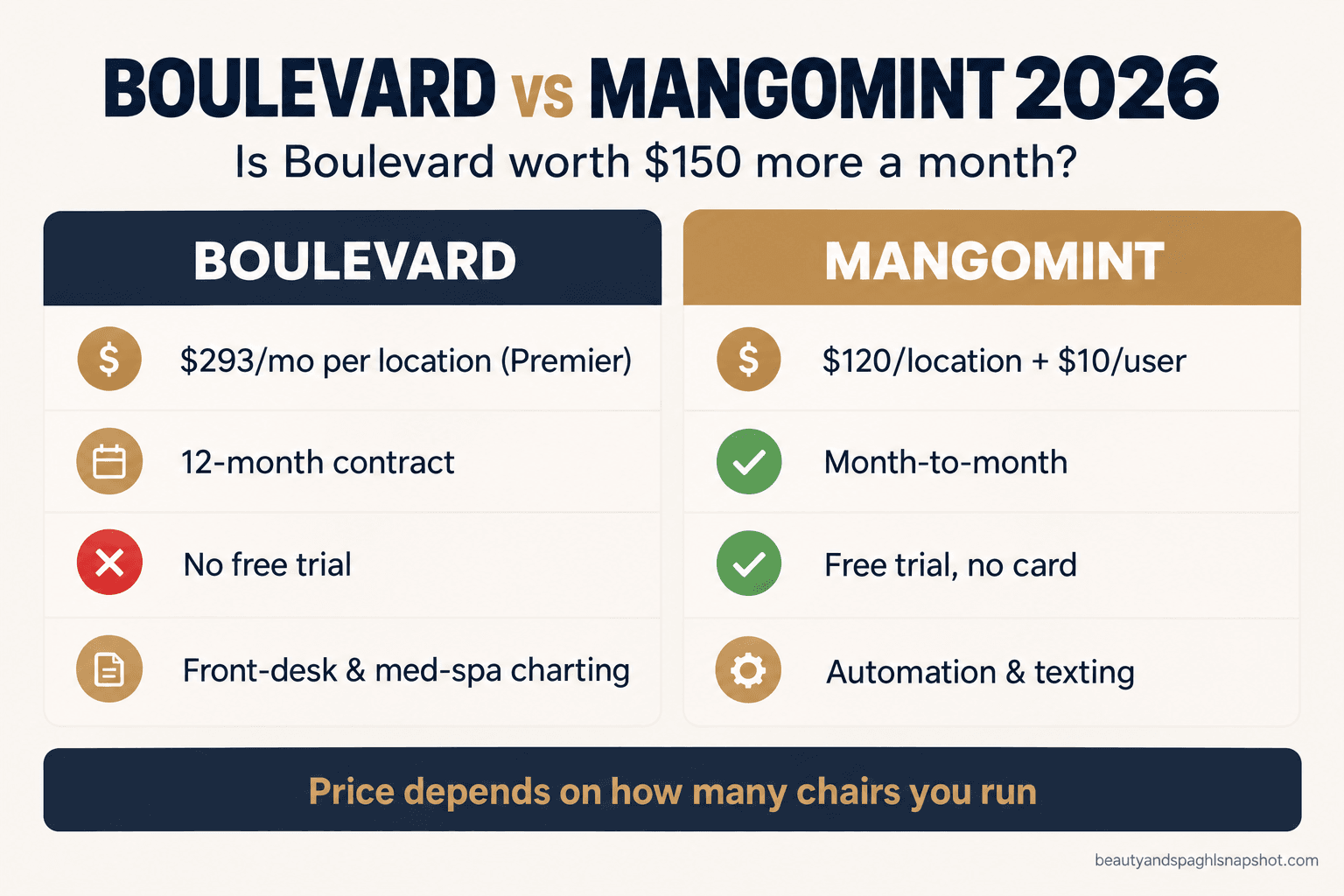
It is a slow Tuesday, you finally have ten minutes, and you open two booking-software tabs side by side. Boulevard looks like the grown-up option every busy salon seems to use. Mangomint just emailed you about a new, simpler price. Both want a demo call before they will talk straight about money. You close the laptop with the same question you started with: is the pricier one worth it, or am I about to pay $150 a month extra for a nicer login screen?
Here is the short answer. For a one-chair or two-chair studio, neither is the smart buy, and I will show you what is. For a working spa with three to six providers at one location, Mangomint usually comes in $100 to $230 a month cheaper than Boulevard’s middle plan. Boulevard earns its higher price in two situations: a high-volume front desk that lives in the calendar all day, and a med spa that needs clinical charting, photo markup, and supervisor sign-off built in. Everywhere else, the cheaper tool wins. Below is the full math, with the real 2026 numbers.
On this page
- What each one actually costs in 2026
- Contracts and free trials
- Payment processing
- Booking and front desk
- Automation and client texting
- Med spa charting and compliance
- What it costs by shop size
- Where each tool breaks
- Objections, answered straight
- Frequently asked questions
The one-line version of each tool
Boulevard is premium, front-desk-first software for busy salons, spas, and med spas with a real reception team. It markets “precision scheduling,” self-booking, memberships, and a med-spa line with charting. Polished, powerful, and priced like it. Mangomint is clean, fast, modern software for shops that want strong automation without an enterprise feel: two-way texting, automated Flows, and a built-in business phone line. In 2026 it threw out its old tiers for one simple rate.
Both are good products. This is not a “one is junk” piece, it is a “which fits your shop and your P&L” piece, and that answer is mostly about staff count and whether you can stomach a contract.
What each one actually costs in 2026
Start with the number, where most owners guess wrong.
Mangomint is now dead simple. On August 1, 2026, every customer moved to one rate: $120 a month per location plus $10 a month per user, with the old Essentials, Standard, and Unlimited tiers retired (Mangomint). Deactivated and archived staff are not billed. Add-ons sit on top: Phone is $70 a month, marketing credits start near $30, and payroll about $50 per account.
Boulevard keeps the traditional tier ladder, priced per location:
| Boulevard plan | Monthly | Annual (about 10% off) |
|---|---|---|
| Essentials | $176/mo | $159/mo |
| Premier | $293/mo | $263/mo |
| Prestige | $410/mo | $369/mo |
Those figures come from third-party trackers, since Boulevard does not publish a clean rate card (The Digital Merchant, Capterra). Its med-spa line runs higher: the Aesthetics Starter Bundle is listed near $410 a month and the full Aesthetics Bundle near $468 per location. Forms and some integrations are paid add-ons, and automated marketing is billed at about $2 per completed appointment.
The headline difference is the model, not the sticker. Boulevard charges the same whether a location has three staff or thirteen; Mangomint charges a base plus a fee per user. So the comparison flips with your team size.
Monthly platform fee, one location, 2026. Mangomint is $120 per location plus $10 per user; Boulevard Premier is a flat list price per location. Even a 12-person location on Mangomint sits below Boulevard’s middle tier. Add-ons and processing are separate. Sources: Mangomint, The Digital Merchant.
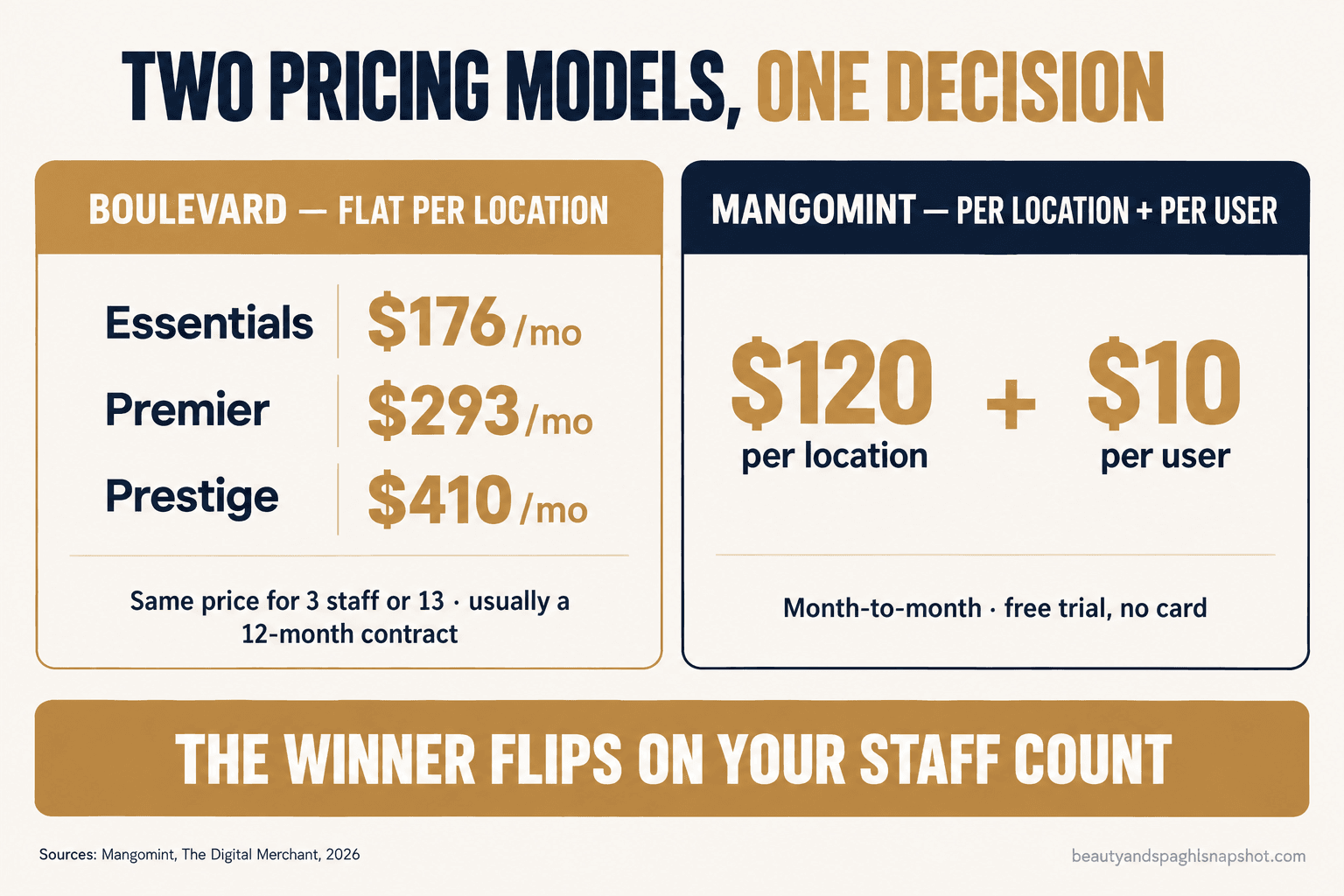
That chart is the whole argument. At one location, Mangomint stays cheaper than Boulevard Premier until you cross roughly 17 users, which most single-location spas never do, so Boulevard has to justify the gap on features, not price.
Contracts and free trials: the quiet dealbreaker
This is the comparison nobody runs, and it is the one that burns people.
Mangomint is month-to-month with no contract, and the free trial needs no credit card and never expires. Its FAQ says it plainly: “Mangomint runs month-to-month for every customer. There are no long-term contracts at any point,” and you build your whole account before you are ever charged (Mangomint). You can test it with real services and staff and walk away having paid nothing.
Boulevard typically wants a 12-month commitment and has no self-serve trial. Multiple pricing guides report a one-year minimum term (The Digital Merchant). You see it through a guided demo.
Price the risk, not just the monthly. A 12-month Boulevard Premier commitment is a $3,500-a-year decision made off a sales demo; Mangomint lets you pay for one month, hate it, and leave. The real cost of booking software is not the monthly fee, it is the six months you lose when you pick wrong and feel stuck.
Payment processing: the fee you forget
Software is the small number. Card processing is usually the bigger one, and owners skip past it.
Mangomint publishes its rates: 2.45% plus 15 cents in person and 2.90% plus 30 cents for keyed or online payments (Mangomint). Boulevard does not publish an official rate; third-party guides report a starting rate near 2.65% plus 15 cents in person and higher for card-not-present (The Digital Merchant).
Run it on your own volume. On $30,000 a month of card sales, a 0.2-point difference is about $720 a year, roughly a whole extra month of software. When two platforms look close on the monthly fee, processing is the real tiebreaker, so ask both to quote your blended rate in writing.
Booking and front desk
This is where Boulevard earns its price.
Boulevard is built front-desk-first. Its scheduling is designed for a receptionist managing a packed multi-provider calendar: dragging appointments, protecting gaps, handling walk-ins, routing the right service to the right room. Self-booking is clean, waitlists are solid, and it keeps a high-volume desk moving. If the calendar is the center of your day, Boulevard feels like it was made for you, because it was.
Mangomint’s calendar is genuinely good and far more modern than the old guard, but its center of gravity is automation, not the reception desk. For a single provider or small team where the owner is also the receptionist, it is more than enough. For a chaotic ten-chair Saturday, Boulevard’s scheduling pulls ahead.
The honest split: the more your day depends on a human front desk juggling a dense calendar, the more Boulevard’s premium makes sense; the more you want the software itself to handle front-desk work, the more Mangomint is the answer. Both beat the legacy tools most spas are escaping, like Mindbody, whose real bill is a different story.
Automation and client texting
Flip the board. This is where Mangomint earns its keep.
Mangomint’s automation engine, Flows, and its two-way texting are the reason people switch to it. You can build sequences that confirm appointments, chase no-shows, request a rebook, and ask for a review, and the texting feels like a real conversation, not a robot. Its built-in Phone add-on gives the business a dedicated line for calls and texts at $70 a month (Mangomint).
Boulevard does messaging and automated marketing too, but its campaigns are billed about $2 per completed appointment, a cost that scales with volume, and automation is not its headline the way it is for Mangomint.
If your weekly pain is an empty midweek and clients who book once and vanish, a strong automation engine beats a prettier calendar. And workflows only pay off once built, which is why filling last-minute cancellations with an automated waitlist is a setup task, not a toggle.
Memberships, packages and retail
Both handle recurring memberships, prepaid packages, and gift cards, which is table stakes now. Boulevard’s membership tools are more mature, built for shops where memberships are a core revenue line, with tighter control over how benefits apply and how staff sell them at checkout. Mangomint’s are clean and genuinely usable, and for most spas cover everything. If recurring revenue is your main play, the membership math is worth running on its own before the software choice decides it.
Med spa charting and compliance
If you run a med spa with injectables, lasers, or medical-protocol treatments, this section may decide the whole thing.
Boulevard has a dedicated Aesthetics line with clinical charting, photo markup, and supervisor sign-off built in, priced higher than the salon tiers at roughly $410 to $468 a month per location (The Digital Merchant). For a med spa that needs treatment notes, before-and-after photos, and a medical director approving charts in one system, that is a feature set you would otherwise bolt on separately. Mangomint serves med spas too and handles booking, payments, and automation well, but for deep charting Boulevard’s tooling is more complete.
Now the part most comparisons skip: your platform choice carries compliance weight, and it is not the same for every shop.
A pure beauty or day spa, doing facials, waxing, massage, and nails with cosmetologists and estheticians, is generally not a HIPAA covered entity, because there is no protected health information and no insurance billing. A med spa changes that once licensed medical providers perform medical procedures and the business runs covered transactions like electronic insurance billing. Many med spas are cash-pay and may technically sit outside covered-entity status, but once medical staff and procedures are involved, the safe posture is to treat intake forms, treatment photos, and consult notes as sensitive and keep them out of unsecured SMS and email (HHS), which favors a system with real charting over texting photos around.
Two rules bind your marketing on either platform. Before-and-after results must be typical or clearly disclosed, and review-gating, the practice of only inviting happy clients to review, is an explicit violation under the FTC’s 2024 fake-reviews rule, effective October 21, 2024, with civil penalties per violation (FTC). So set either tool’s review automation to invite everyone, not just the five-star crowd. State boards also restrict “medical grade” and “FDA-approved” phrasing; this is not legal advice, so confirm your own state’s rules.
Ease of use and support
Both are far easier than the legacy platforms, and both get good support reviews (G2). Mangomint’s reputation is speed and simplicity, and non-technical owners get comfortable fast, which matters for a shop run from a phone between clients. Boulevard is also well-designed but has more surface area to learn, which is fine when you have a front-desk team. If you are the owner, operator, and receptionist all at once, lean toward the tool you can set up yourself in an afternoon.
What it costs: solo, mid-size, multi-location
Averages lie. Run it through three shapes of business; the winner changes each time.
Solo operator, 1 to 2 chairs. Neither is the right first buy. Boulevard Essentials at $176 on a 12-month contract is a lot for one chair; Mangomint at $140 is more reasonable but still rich for a true solo. A flat-rate tool like GlossGenius runs $24 to $148 a month by tier (Koalendar), and for one or two people that is the smarter spend until a front desk and no-show problem actually appear.
Mid-size spa, 3 to 6 providers, one location. The heart of the fight. Mangomint lands near $150 to $180 a month plus add-ons; Boulevard Premier lists near $293. That is roughly $110 to $230 a month, or $1,300 to $2,800 a year, that Boulevard has to earn on features. If your pain is no-shows and rebooking, Mangomint wins and keeps the cash; if you run a busy front desk and sell a lot of memberships, Boulevard can be worth it. Most shops this size are better served by Mangomint.
Multi-location group. Here the models really diverge. At three locations with modest staff, Mangomint is three base fees plus per-user, roughly $540 a month for eighteen users. Boulevard Premier across three locations is about $879, and Prestige higher. Boulevard’s enterprise reporting can justify that, but the gap is wide, so make the vendor prove the spend against features you will actually use.
Estimated monthly platform fee, three-location group, 2026, before add-ons and processing. Mangomint: three location fees plus eighteen users. Boulevard: three locations at the listed tier. Sources: Mangomint, The Digital Merchant.
The pattern across all three: the fewer staff per location, the more Mangomint’s model saves, and the more locations, the wider that saving gets. Boulevard wins on the front desk and clinical charting, not on price. If you are weighing these two against the rest of the market, the full teardown of what spa software really costs puts both in context.
Where each tool breaks
Nobody writes this part.
Boulevard breaks when the shop is too small for it. A solo operator on a 12-month contract paying $176 a month for ten-chair software is overpaying for capacity they will never use, and the contract means they cannot quickly fix the mistake. It also breaks as a budget line when add-ons stack: forms, integrations, and per-appointment marketing turn a $293 plan into a $400-plus bill, so price it with the add-ons you will actually turn on.
Mangomint breaks when your user count quietly climbs. The per-user fee is cheap at ten dollars, but a fast-growing location adding assistants and part-timers can watch the bill creep. The fix is discipline: deactivate users who have left, since archived users are not billed (Mangomint). It can also feel light if you need deep clinical charting.
Both break the same way on migration. Moving your client list, appointment history, and gift-card balances off an old system is the risky part, not the software choice. Underestimating the data migration is the top reason a switch goes badly. If you are coming off a legacy platform, here is how to leave without losing your client history.
Objections, answered straight
“Everyone in my area uses Boulevard, so it must be right.” Popularity in a feed is not a fit for your P&L. The shops you see on Boulevard are often bigger, with front-desk teams and heavy membership revenue. If that is not you, price it against your own staff count and pain.
“Mangomint changed its pricing. Will it change again?” Possibly, like any vendor, Boulevard included. The 2026 change simplified things and made the trial permanent and card-free (Mangomint). And because Mangomint is month-to-month, a future price you dislike means you leave. Boulevard’s 12-month term is the real lock-in.
“I already pay for one. Is switching worth it?” Only if the saving clears your switching cost in a few months. Mangomint at $180 instead of Boulevard Premier at $293 saves about $1,350 a year, enough to pay for a careful migration. But if your current tool works and your team knows it, “a bit cheaper” rarely beats the disruption.
“Do I need to be technical?” No. Both are built for owners, not IT departments, and Mangomint is the easier to set up solo. The hard part is not the software, it is designing the no-show, deposit, and rebooking workflows so they run, and that work is the same no matter which calendar you pick.
The honest verdict
So, back to that slow Tuesday. Boulevard is worth the extra $150-plus a month in two cases: a high-volume shop that lives in the front-desk calendar, or a med spa that needs clinical charting, photo markup, and supervisor sign-off in one place. For most single-location spas with three to six providers whose real problem is no-shows and rebooking, Mangomint does the job for meaningfully less, with no contract and a free trial you can actually drive. If you run one or two chairs, buy neither yet.
And whichever you choose, the software is the plumbing, not the water. Booking, texting, and rebooking flows only make money once they are built and switched on. Get the workflows right first, then pick the calendar that carries them.
Is Boulevard or Mangomint cheaper in 2026?
For most single-location spas, Mangomint. It is $120 per location plus $10 per user, so a six-provider shop pays around $180 a month, against about $293 for Boulevard's Premier plan. Mangomint stays cheaper at one location until you pass roughly 17 users.
How much does Mangomint cost after the 2026 pricing change?
Since August 1, 2026, Mangomint is a flat $120 per location plus $10 per user, and the old Essentials, Standard and Unlimited tiers are gone. Deactivated users are not billed. The Phone add-on is $70 a month, marketing credits start near $30, payroll about $50.
How much does Boulevard cost per month?
Third-party trackers put Boulevard near $176 for Essentials, $293 for Premier and $410 for Prestige, per location, with about 10% off annually. Med-spa Aesthetics bundles run near $410 to $468. Boulevard does not publish a public rate card, so confirm your quote in writing.
Does Boulevard or Mangomint require a contract?
Mangomint is month-to-month with no contract, and its free trial needs no credit card and never expires. Boulevard typically requires a 12-month minimum term and has no self-serve trial. For an unsure owner, that difference often matters more than any feature.
Which is better for a med spa?
For clinical charting, before-and-after photo markup and medical-director sign-off in one system, Boulevard's Aesthetics line is more complete out of the box, though priced higher. Mangomint handles med-spa booking, payments and automation well but is lighter on deep charting. Either way, keep intake forms and treatment photos out of unsecured text and email.